Introduction
Singapore's construction industry is intensely competitive. The BCA Contractors Registration System lists approximately 24,000 registrations across all workheads, with hundreds of firms carrying equivalent technical qualifications. When procurement officers review shortlists, most capability statements read identically: "quality workmanship, on-time delivery, strong safety record."
In this environment, branding separates firms winning premium contracts from those competing on price alone. Since November 2024, BCA's Price Quality Method framework assigns 40-60% of tender evaluation weight to quality attributes for projects above S$3 million.
Those quality signals—corporate identity, past performance narratives, stakeholder perception—are exactly what a strong brand communicates.
This article examines concrete patterns from construction branding case studies in Singapore and beyond, clarifies what effective construction branding actually involves, and provides an actionable framework for firms ready to build brand equity that converts to contract wins.
TLDR
- Construction branding wins trust from developers and government agencies before tender evaluation begins
- Branding signals capability — shaping how clients judge a firm before any conversation starts
- Core elements include positioning, identity system, employer brand, and digital presence
- Firms that invest in branding consistently report stronger tender shortlisting, better hires, and higher perceived value
Why Construction Companies in Singapore Need Strong Branding Now
Technical Parity Creates Brand-Based Competition
BCA licensing creates a paradox: it ensures quality standards but also produces hundreds of technically equivalent competitors. Grade A1 contractors can all legally tender for unlimited-value projects, meaning technical qualification becomes table stakes rather than a differentiator.
When procurement officers evaluate five shortlisted firms with identical BCA grades, similar safety records, and comparable track records, brand perception influences approximately 20% of the purchasing decision—often the margin between winning and losing.
Industry Transformation Demands Capability Signalling
Singapore's Built Environment Industry Transformation Map sets aggressive targets:
- 70% adoption of Integrated Digital Delivery (IDD) by 2025
- 70% adoption of Design for Manufacturing and Assembly (DfMA) by 2025
- 80-80-80 Green Mark targets by 2030 (80% green buildings, 80% super low energy new builds, 80% energy efficiency improvement)
These targets shift procurement toward value-based evaluation. Firms that brand around IDD capability, DfMA expertise, or Green Mark credentials position themselves for the contracts government agencies and developers prioritize.
The Manpower Crisis Makes Employer Branding Strategic
Winning contracts is only half the challenge—delivering them requires people. BCA projected construction demand of S$32–38 billion for 2026, yet the sector faces:
- An estimated 15% manpower shortfall sector-wide
- Rising PMET and engineering vacancy rates year-on-year
- Increasing competition for younger professionals with digital and sustainability skills
Skilled candidates evaluate employers on brand perception—corporate identity, career narrative, and culture. Firms with a clear employer brand don't just attract talent; they reduce hiring costs and retain the people competitors are still searching for.
What Does Branding Actually Mean for a Construction Company?
Branding is not a logo refresh. For construction firms, branding encompasses three interconnected systems:
Brand Positioning answers the question developers actually ask: "Why should we choose you over a technically equivalent competitor?" Strong positioning is specific — "We build complex healthcare facilities that remain operational during construction" — not generic claims that every competitor repeats.
Brand Identity is the visual and verbal language that expresses positioning across every touchpoint: tender documents, site hoardings, safety vests, vehicle livery, and corporate presentations. Consistent brand presentation delivers a 10-20% average revenue increase — yet only 30% of organisations consistently enforce their guidelines.
Brand Experience is how clients, subcontractors, and recruits encounter the firm at every interaction — from the first website visit through to project delivery. In B2B construction, that accumulated experience builds the trust that reduces perceived procurement risk.
Who the Customer Really Is
Construction branding must speak simultaneously to multiple audiences:
- Developers and government agencies evaluating tender submissions
- Joint-venture partners assessing financial stability and delivery capability
- Institutional clients requiring proof of specialised expertise
- Top-tier talent evaluating career opportunities
- Subcontractors and suppliers choosing preferred partners
Each audience evaluates different signals — and a brand that tries to say everything to everyone ends up convincing no one.
Construction Branding Case Study Examples: Key Patterns from Singapore
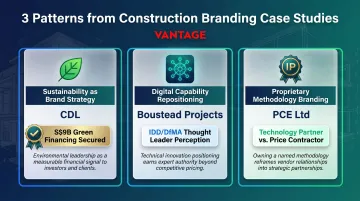
Pattern 1: The Developer Brand Commanding Premium Positioning
City Developments Limited (CDL) provides Singapore's strongest documented case of sustainability-as-brand strategy delivering measurable business outcomes.
Brand positioning: "Conserving as We Construct" (adopted 1995). CDL positions sustainability not as operational practice but as strategic business lens and competitive advantage.
Measurable outcomes directly linked to brand:
- Secured over S$9 billion in green and sustainability-linked financing since 2017, where brand reputation directly enables favorable financing terms
- S$44 million in energy cost savings from 2012–2024
- 129 BCA Green Mark-certified projects since 2005
- Ranked world's most sustainable real estate company on Corporate Knights Global 100
Brand-building assets beyond property marketing: CDL Green Gallery, CDL MicroForest, Singapore Sustainability Academy (1,200+ programmes reaching 43,100+ attendees). These are thought leadership platforms building corporate brand, not sales tools for individual projects.
Key lesson: CDL didn't just implement sustainability — it branded the commitment, creating public-facing proof points that institutional investors, government agencies, and partners recognise as differentiation.
Pattern 2: The Main Contractor Repositioning Toward Digital Capability
Boustead Projects demonstrates technology-led repositioning. Featured in CNA's "Building Change: Rethinking Construction" documentary, Boustead publicly positions itself through BIM and Common Data Environment (CDE) capability, signalling "digitally integrated design-build firm" rather than traditional general contractor.
This repositioning aligns with ITM's IDD and DfMA targets, creating brand-adjacent competitive advantage: firms researching digital construction partners encounter Boustead's name associated with innovation, not just execution.
What this shows: Brand repositioning happens through consistent capability signalling — no published case study required. Media features, thought leadership, and project narratives shift perception over time.
Pattern 3: The Specialist Differentiating Upward Through Proprietary Systems
PCE Ltd (UK benchmark) illustrates how specialist subcontractors use branded intellectual property to differentiate. PCE developed "hyTower", a proprietary HybriDfMA structural solution marketed for safe, fast, efficient construction. By naming and branding the methodology, PCE achieves three things a generic subcontractor cannot:
- Positions as a technology partner, not a price-competitive trade contractor
- Gives procurement teams a named solution to research and specify
- Creates preference before tender evaluation begins
The takeaway: Specialist firms that brand their methodology — not just their company — shift the conversation from cost to capability.
Common Thread: Branding Begins With Perception Gap Analysis
In each pattern, branding started with understanding how the firm was currently perceived versus how it needed to be perceived to win at the next level.
- CDL identified sustainability as an undervalued competitive asset and built brand around proof
- Boustead recognised that "general contractor" positioning limited access to digitally sophisticated clients
- PCE understood that undifferentiated subcontractors compete on price; branded solutions command premium
Closing that gap — between how the market sees you and how you need to be seen — is the core work of brand strategy. For Singapore construction firms navigating BCA pre-qualification, institutional procurement, and ESG scrutiny, the gap is often wider than leadership assumes.
The Digital Content Benchmark: Korte Company
Brand positioning sets the foundation — but content is how that positioning reaches decision-makers at scale. The widely cited Korte Company case study documents a 650% increase in monthly website contacts (from 27 to 202) through SEO, content marketing, and conversion optimisation. One content piece — "The Complete Guide to Warehouse Construction" — generated 189 new leads.
Critical distinction: This is digital lead generation layered on existing strong brand, not a branding case study. The intervention was content strategy and UX optimisation, not brand identity or positioning change.
Lesson for Singapore firms: Most construction companies rely solely on referrals and tender pre-qualification. Firms that combine strong brand with sector-specific content — project case studies, technical guides, thought leadership — generate qualified inbound leads that traditional competitors miss.
What Separates Forgettable Construction Brands from Standout Ones
Brand Positioning Clarity
The firms that win work can articulate in one sentence what they do, who they serve best, and why a client should choose them over other shortlisted firms. The firms that lose on shortlist rely on generic claims—"quality workmanship, on time, on budget"—that apply to every competitor on the list.
Strong positioning directly influences tender language. When capability statements reference specific sector expertise ("We build complex healthcare facilities that remain operational during construction") rather than generic competence, evaluators remember and differentiate.
Visual Identity That Signals the Right Things
Procurement officers review dozens of capability statements. Firms with generic clip-art identities blur together. Those with cohesive identity systems—consistent logo treatment, distinctive colour application, professional photography—signal the attention to detail that clients associate with project delivery.
McKinsey research shows the themes B2B buyers value most—specialist market knowledge and effective supply-chain management—are the least communicated. Construction firms that visually brand around specific expertise stand out.
Consistency Across All Touchpoints
Strong construction brands maintain consistency from website and LinkedIn to site hoardings, safety vests, vehicle livery, tender documents, and presentations.
Each touchpoint either reinforces or erodes perceived professionalism. A firm with a premium website but generic tender documents signals inconsistency. One with cohesive identity across all touchpoints—digital, document, physical—signals operational discipline.
Brand Story Rooted in Genuine Expertise
Where visual identity earns attention, brand story earns credibility. Standout firms anchor their narrative in specific capability:
- "We manage construction logistics in occupied buildings with zero operational disruption"
- "We specialise in prefabricated bathroom pods that reduce site installation time by 60%"
- "We deliver data centers with MEP coordination precision that eliminates costly rework"
This specificity builds credibility with technically sophisticated buyers who evaluate claims against evidence.

Employer Brand Alignment
Standout construction brands actively communicate culture, safety standards, training investment, and career pathways. This matters because winning contracts increasingly requires demonstrating you can attract and retain the talent to deliver them.
Clients evaluating major projects scrutinise subcontractor networks and workforce stability. A strong employer brand signals that your delivery capacity is real—not just claimed on a capability statement.
How to Build a Construction Brand That Wins in Singapore's Market
Step 1: Conduct Brand Audit and Perception Gap Analysis
Before any design work begins, understand how your firm is currently perceived by key audiences:
- Developers and government agencies who shortlist tenders
- Joint-venture partners evaluating collaboration
- Top recruits assessing career opportunities
Research methods include:
- Client and stakeholder interviews—ask past clients why they selected you and what almost made them choose a competitor
- Tender debrief analysis—review feedback from lost bids to identify perception gaps
- Competitor benchmarking—audit how competitors position themselves and identify whitespace
That gap between current perception and desired positioning sets the scope for everything that follows.
Step 2: Define Positioning and Brand Story
Choose focused positioning that reflects genuine capability and differentiates from competitors. The goal is to become the obvious choice for a specific client type or project category — not to appeal to everyone.
Strong positioning answers:
- What do we do? (Specific capability, not generic construction)
- Who do we serve best? (Target client type or project category)
- Why choose us? (Differentiated value, not generic quality claims)
Your brand story connects history and expertise to a clear future promise. It should feel authentic to internal teams and credible to external audiences.
Step 3: Build Coherent Identity System
Develop visual and verbal identity expressing your positioning across all touchpoints:
- Digital: Website, LinkedIn, email signatures
- Document: Tender submissions, capability statements, proposals, presentations
- Environmental: Site hoardings, safety vests, vehicle livery, signage
- Print: Business cards, brochures, project case studies
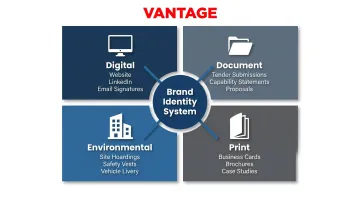
The system must be practical enough for your team to apply correctly without designer supervision for every application. Brand consistency drives 10-20% revenue increase, but only when guidelines are consistently followed.
Step 4: Activate Brand Through Content and Digital Presence
Use your brand to generate trust before you walk into a room. A professional website with documented project case studies, sector-specific content, and clear capability statements means procurement officers researching your firm see a brand that matches your work quality.
Consider:
- Project case studies showcasing sector expertise and delivery outcomes
- Technical guides or insights demonstrating thought leadership
- Clear service descriptions and sector specialisations
- Team profiles and culture content supporting employer brand
Vantage Branding works with construction firms on exactly this process — from brand audit and strategy through to identity development, tender collateral, and digital presence.
Frequently Asked Questions
What is a branding case study?
A branding case study documents how a company identified a brand challenge, undertook strategic and creative brand work, and achieved measurable outcomes—improved client perception, stronger lead generation, or better talent attraction. Case studies serve as proof of a branding agency's methodology and results.
What is branding in construction?
Branding in construction is the strategic and creative process of defining how a construction firm is perceived by clients, partners, and recruits. It encompasses positioning, visual identity, messaging, and brand experience across all touchpoints from tender documents to site presence.
How does branding help construction companies win more contracts in Singapore?
Strong branding ensures a firm is perceived as credible, capable, and differentiated before tender evaluation begins. Under BCA's Price Quality Method, up to 60% of evaluation rests on quality attributes—many communicated through brand-adjacent channels like capability statements and corporate identity.
What elements make up a strong construction brand identity?
Four core components define a strong construction brand:
- Positioning statement — defines your competitive advantage clearly
- Logo and visual identity — applied consistently across all touchpoints
- Messaging and tone of voice — shapes how the firm communicates
- Systematic rollout — across digital, document, and physical environments
How long does it take to rebrand a construction company?
A full rebrand typically takes 3 to 6 months, with brand strategy and positioning requiring 4 to 8 weeks before design work begins. Complex organisations with multiple divisions or legacy systems may extend to 9 to 12 months.