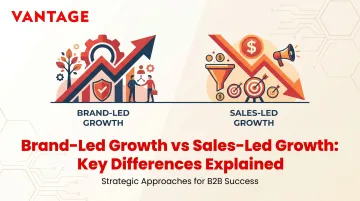
Sales-led growth delivers short-term revenue. Brand-led growth builds long-term pull. Understanding both approaches—and when to deploy each—is one of the most consequential decisions a business leader can make, especially in competitive markets across Singapore and Asia where reputation and relationship-based trust carry significant weight.
TL;DR
- Brand-Led Growth attracts customers organically through brand equity — they come to you because they already trust your name
- Sales-Led Growth relies on an active sales team to identify prospects, run demos, and close deals directly
- BLG compounds over time with lower acquisition costs; SLG delivers faster revenue but scales linearly with headcount
- SLG is better for short-term pipeline; BLG builds long-term defensibility
- The right choice depends on market maturity, product complexity, deal size, and how differentiated your brand already is
- Most mature businesses benefit from a hybrid model where brand builds inbound demand and sales converts it
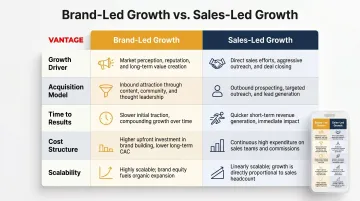
Brand-Led Growth vs. Sales-Led Growth: Quick Comparison
| Dimension | Brand-Led Growth | Sales-Led Growth |
|---|---|---|
| Growth Driver | Brand equity and market reputation attract inbound interest without active outreach | An active sales team drives acquisition through outbound prospecting, demos, and deal-closing |
| Acquisition Model | Pull model — brand awareness draws prospects in organically; content fuels the funnel | Push model — reps identify and pursue leads through outbound outreach and structured sales cycles |
| Time to Results | Longer investment horizon; brand equity builds gradually but compounds over time | Faster, more measurable short-term revenue outcomes tied directly to sales activity |
| Cost Structure | Higher upfront investment in strategy and positioning; lower acquisition cost per customer over time | Ongoing costs tied to headcount, commissions, and tools; revenue scales proportionally with team size |
| Scalability | Grows without adding headcount; a strong brand works across channels and geographies around the clock | Adding revenue means adding reps — and margins compress over time |
What is Brand-Led Growth?
Brand-Led Growth is a strategy where the brand itself—its reputation, positioning, values, and emotional resonance—becomes the primary mechanism for attracting and retaining customers. This is not about visual identity alone. It's about how the market perceives, trusts, and chooses your business over alternatives.
The Business Case for BLG
When a brand is well-defined and consistently communicated, it creates inbound demand, commands premium pricing, and reduces customer acquisition costs over time. Edelman Trust Barometer research shows that 80% of people trust the brands they use—a higher level than trust in business, media, government, or NGOs. Customers who choose a brand proactively tend to have higher loyalty and lifetime value than those closed through a sales pitch.
Research from the LinkedIn B2B Institute indicates that brand strength accounts for approximately 30% of revenue across categories, functioning as a "performance multiplier" that reduces customer acquisition costs and increases the efficiency of all marketing channels.
Core Pillars That Make BLG Work:
- Defines what you stand for and how you differ from competitors
- Delivers a uniform experience across every customer touchpoint
- Builds credibility through educational content and thought leadership
- Reduces buyer risk through community presence, awards, and social proof
This requires a clear brand strategy as its foundation—the kind developed through structured brand discovery and positioning work.
Advantages of Brand-Led Growth
Done well, Brand-Led Growth delivers compounding returns that sales activity alone cannot replicate:
- Reduces dependence on outbound sales through inbound, pull-based demand
- Defends against commoditisation—Bain & Company found brand leaders hold a price premium of 5% or more in roughly two-thirds of categories
- Attracts better talent, partners, and customers over time
- Builds brand equity as an appreciating asset, not a cost that resets each quarter
Where BLG Gets Challenging
Brand-building requires patience—results are not always linear or immediately attributable. It demands organisational alignment across marketing, communications, product, and leadership.
Without a clear brand strategy as the foundation, brand investment can feel scattered or unmeasurable. A structured approach to brand strategy creates the clarity and direction that makes the investment work.
How Brand-Led Growth Works in Practice
In a BLG model, a company invests in brand strategy and identity first, then builds marketing and content around that positioning. Prospects encounter the brand through organic channels—referrals, thought leadership, awards, community reputation—and arrive with a higher level of trust and intent than cold sales leads.
Brand-led companies don't eliminate sales. Instead, brand does the heavy lifting of educating and pre-qualifying the market, making sales conversations shorter, warmer, and more likely to convert.
What is Sales-Led Growth?
Sales-Led Growth is a strategy where a dedicated sales team is the primary engine for acquiring and retaining customers. Sales reps identify prospects, qualify leads, run discovery calls and demos, handle objections, negotiate contracts, and manage relationships throughout the customer lifecycle.
When SLG Is the Right Motion
SLG is well-suited for:
- Complex, high-value solutions where buyers need guidance and education before committing
- Markets where personal relationships matter — particularly relevant in Asian B2B contexts where trust-building through human interaction is essential
- High-ACV enterprise deals that require stakeholder alignment, procurement processes, and contract negotiations
Gartner research shows that B2B buying committees have grown from 5.4 stakeholders in 2015 to 8-13 in 2025—nearly doubling in a single decade. These complex buying environments require skilled salespeople to navigate.
Advantages of SLG
- Faster, more predictable revenue in the short term
- Highly personalised selling that addresses specific buyer pain points
- Effective at navigating complex multi-stakeholder buying decisions
- Generates direct market intelligence that can inform product and brand strategy
Where SLG Gets Hard
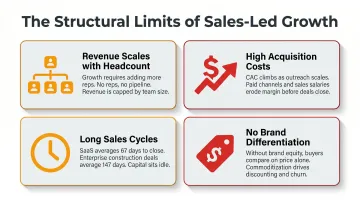
The model carries structural limits that compound as a business grows:
- Revenue scales with headcount — margin expansion requires hiring, not efficiency
- High acquisition costs across salaries, commissions, tools, and management overhead
- Long sales cycles that slow cash flow (SaaS averages 67 days; real estate and construction, 147 days)
- No brand differentiation means every conversation risks becoming a price negotiation
How Sales-Led Growth Works in Practice
SLG growth runs on outbound prospecting, inbound lead handoffs from marketing, pipeline management, and relationship-based selling. Teams measure success through MQLs, SQLs, win rates, deal velocity, and average contract value.
When growth slows, the instinct is to hire more reps. Without brand differentiation, though, additional salespeople face the same resistance in the market. Harvard Business Review research shows that 80% of B2B buyers have a set of vendors in mind before they do any research, and 90% of buyers who complete a purchase choose a vendor from their "day-one" shortlist. Brands discovered after formal research begins have less than a 5% chance of being selected.
Brand-Led Growth vs. Sales-Led Growth: Which One Should You Choose?
Key Factors to Evaluate
- Brand maturity in the market — How well-known and trusted are you?
- Offering complexity and price point — Does your solution require extensive education?
- How your ideal customers research and buy — Do they prefer self-service or consultative relationships?
- Competitive positioning — Are you competing on differentiation or price?
- Time horizon for growth investment — Can you wait 12-24 months for brand equity to compound?
Consider Brand-Led Growth If:
- Your market is crowded and commoditisation is a real risk
- You want to build long-term pricing power and customer loyalty
- Your buyers research extensively before engaging a vendor
- You are targeting markets where reputation and referrals carry significant weight (as is common in Singapore and Asian B2B markets)
- You are aiming to reduce over-reliance on outbound sales activity over time
Consider Sales-Led Growth If:
- You are an early-stage company with little to no brand recognition and need fast revenue
- Your offering is complex and requires significant education or customisation
- Your target buyers are senior decision-makers who expect a consultative sales relationship
- Your average deal value justifies the cost of high-touch selling
The Hybrid Model—Most Businesses Need Both
The most effective growth strategies combine brand-led and sales-led approaches. Brand creates the conditions for sales to succeed: warmer leads, shorter cycles, stronger conversion rates. Sales, in turn, feeds brand insight—what resonates with buyers, what objections recur, what story lands.
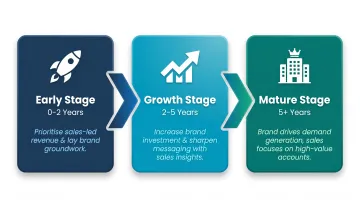
Sequencing Framework:
- Early stage (0-2 years): Prioritise sales-led revenue while laying the groundwork for brand positioning.
- Growth stage (2-5 years): Increase brand investment progressively, letting sales insights sharpen your messaging.
- Mature stage (5+ years): Let brand carry the demand-generation load while sales focuses on high-value accounts.
Research supports this balance. The LinkedIn B2B Institute recommends an optimal B2B budget split of approximately 46% brand building and 54% sales activation. The same research introduces the 95-5 Rule: at any given time, only around 5% of your market is actively ready to buy. That makes long-term brand investment essential for capturing demand when it finally emerges.
Real-World Examples of Brand-Led vs. Sales-Led Growth
Brand-Led Growth: Patagonia
Patagonia's brand drives organic demand without traditional sales teams. In 2011, the company ran a "Don't Buy This Jacket" ad in The New York Times detailing the environmental cost of one R2 jacket: 135 litres of water consumed and 20 pounds of CO2 emitted. Despite the anti-consumerist message, revenue grew by 30% in the year following the campaign.
The company spends less than 1% of sales on marketing and advertising. Instead, it builds brand equity through:
- Pledging 1% of all sales to environmental causes
- Operating "Worn Wear," a resale platform embedding sustainability values into customer experience
- Transferring 100% of company ownership to a trust and non-profit in 2022, directing approximately $100 million in annual profits to combat climate change
Patagonia commands premium pricing and generates customer loyalty primarily through brand strength and values-based positioning—not through active outbound sales.

Sales-Led Growth: Salesforce
Salesforce exemplifies enterprise sales-led growth. The company reported FY26 revenue of $41.5 billion with sales and marketing expense of $14.345 billion—approximately 34.5% of revenue allocated to sales and marketing.
Their sales process is built for multi-stakeholder procurement cycles, long evaluation periods, and large deal values. Their 1-1-1 philanthropic model (devoting 1% of equity, technology, and employee time to social causes) functions as a brand-building layer within an otherwise sales-led organisation.
Interestingly, Salesforce reportedly allocates approximately 50% of its marketing budget to brand-building activities, demonstrating the hybrid approach at scale.
The Hybrid in Action: Atlassian
Atlassian grew to a $20 billion valuation without a formal sales team. At IPO, only 19% of revenue was spent on sales and marketing—a fraction of typical SaaS spend. The company serves more than 125,000 customers using a "try, buy, begin and expand" model with transparent pricing.
Enterprise customers can spend $10,000+ and start with teams of 10–50 people without speaking to a salesperson. The company later added an "enterprise advocates" team for complex, large-scale accounts. Even the most product-led businesses eventually find limits to what self-serve can close.
These three examples share a common thread: none of them relied on a single approach indefinitely. For businesses operating in Singapore and across Asia, this pattern is especially relevant. In relationship-driven B2B markets, brand builds the credibility that gets you in the room, while sales teams handle the stakeholder dynamics that close the deal.
Conclusion
Brand-Led Growth and Sales-Led Growth are not competing philosophies—they are complementary engines that serve different stages of a company's journey and different types of buyers. The key is understanding what your market responds to, what stage your brand is at, and what you are optimising for: short-term revenue or long-term equity.
For businesses in Singapore and Asia looking to reduce dependence on outbound sales, the starting point is a clear brand strategy. Strong positioning gives sales teams a compelling foundation to lead with, and gives marketing a consistent story to build around.
Research shows that B2B brands with high mental availability are 30% more likely to be shortlisted by buyers, directly shortening the early-stage sales cycle by removing the need for introductory credentialling.
If you're ready to evaluate your current growth motion, Vantage Branding works with businesses across Singapore, Malaysia, Vietnam, and broader Asia on brand strategy. Our structured approach to brand discovery and positioning builds the clarity and direction that makes brand investment compound in value over time.
Contact us at +65 6698 9257 or hello@vantagebranding.com.sg to discuss how brand strategy can strengthen your growth engine.
Frequently Asked Questions
What is sales-led growth?
Sales-led growth is a go-to-market strategy where a dedicated sales team drives customer acquisition through outbound prospecting, demos, and relationship management—rather than relying on brand reputation to attract customers organically.
What is the difference between brand-led growth and sales-led growth?
Brand-led growth uses brand equity and reputation to attract customers organically (pull model), while sales-led growth relies on active sales efforts to identify, engage, and close prospects (push model). Both can coexist but require different investments and timelines.
What is the 3-3-3 rule in sales?
The 3-3-3 rule is a sales prospecting framework involving three outreach attempts across three different channels over three days—a structured approach used in sales-led models to increase response rates from cold prospects.
Can a company use both brand-led and sales-led growth at the same time?
Yes. Most mature companies use both—brand-led efforts build market awareness and trust that make sales conversations easier and faster, while the sales team converts and expands high-value accounts. The right balance depends on where the company is in its growth stage.
How long does it take to see results from brand-led growth?
Brand-led growth is a longer-term investment. Inbound demand, stronger conversion rates, and pricing power typically emerge over 12–24 months, depending on market size, execution consistency, and starting brand awareness.