Introduction
Most business leaders use "branding" as a catch-all term, mixing corporate identity, product positioning, and visual design into a single undifferentiated strategy. Treating them as interchangeable leads to misaligned messaging, wasted budget, and brand confusion that erodes trust across stakeholder groups.
The stakes are real. Unstructured brand portfolios reduce enterprise value by 15% to 30%, with 82% of multi-brand companies operating sub-scale brands that drain resources rather than build equity.
The wrong call compounds quickly. Investing in product brands when you need corporate trust — or building corporate identity when you need targeted consumer appeal — adds inefficiency year after year.
This guide cuts through the confusion. You'll get clear definitions, a side-by-side comparison, key differences across six dimensions, and a practical framework for choosing the right approach — or combining both. Whether you're a B2B firm building investor confidence or a consumer brand managing diverse product lines, the right call starts with knowing which type of branding your situation actually demands.
TL;DR
- Corporate branding shapes how the world sees your company: its values, reputation, and relationships with investors, employees, and partners
- Product branding gives individual offerings their own identity, personality, and appeal to specific buyer segments
- The two approaches differ across six dimensions: scope, audience, ownership, definition, experience, and business impact
- Neither is universally better — the right choice depends on your business model and how you plan to grow
- Many companies combine both, building distinct product brands that sit within a unified corporate identity
Corporate vs. Product Branding: Quick Comparison
| Dimension | Corporate Branding | Product Branding |
|---|---|---|
| Scope | Company-wide, all offerings | Product-specific, single offering |
| Target Audience | All stakeholders (investors, employees, customers, media) | End consumers in specific segments |
| Ownership | CEO and C-suite leadership | Marketing and product management teams |
| Lifespan | Permanent, evolves with company | Tied to product lifecycle, can be retired |
| Primary Goal | Build trust and enterprise value | Drive purchase conversion and differentiation |
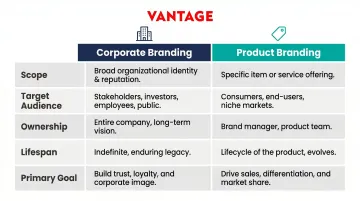
This table is a starting point. The sections that follow break down each approach in depth — covering how they're built, when each applies, and how leading companies use both together to protect enterprise value without sacrificing product-level agility.
What is Corporate Branding?
Corporate branding builds and manages the identity of the entire company—its mission, values, culture, and reputation—rather than any single product or service. A strong corporate brand creates a trust halo that extends across every offering the company makes.
Core Components
The five pillars of a corporate brand:
- Articulates why the company exists beyond profit (purpose and mission)
- Defines logos, colour palettes, and design standards applied company-wide
- Guides tone across all communications through a consistent brand voice
- Addresses investors, employees, customers, and regulators with coherent but distinct messaging
- Aligns internal culture so employees embody brand values daily
Corporate branding guides everything from website design to hiring processes to investor communications. It's not a marketing exercise—it's an organizational framework.
Who Owns Corporate Branding
Corporate branding is a C-suite endeavor. The CEO, HR, Finance, and Corporate Communications all play roles—it cannot be delegated solely to the marketing team.
Richard Branson built Virgin's corporate identity so powerfully that the company generates approximately £120 million annually in brand royalties by licensing the name to partner businesses. The same principle drove Steve Jobs, who shaped Apple's corporate brand around what he called "deep simplicity"—end-to-end responsibility for user experience that became synonymous with the company itself.
Primary Benefits
Corporate branding delivers measurable returns:
- Attracts and retains talent — Organizations with strong employer brands reduce cost-per-hire by up to 50% and see 28% lower turnover
- Builds investor confidence — Strong corporate brands increase market valuation through reputation equity
- Shortens B2B sales cycles — Baseline trust reduces perceived risk in complex purchasing decisions
- Creates hard-to-copy differentiation — Culture-rooted brands resist commoditization
Use Cases of Corporate Branding
Corporate branding is critical for **B2B companies** where buyers evaluate the company as much as the product, for organizations managing diverse portfolios where a unified identity creates efficiency, and for companies entering new markets where brand reputation must do the heavy lifting before products are known.
McKinsey & Company's corporate brand is built around thought leadership. The firm has published the McKinsey Quarterly since 1964, establishing intellectual rigor that carries trust into any engagement regardless of the specific service being sold.
IBM leverages its corporate values—trust and innovation anchored in 110+ years of history—across all product lines, from enterprise infrastructure to AI consulting.
What is Product Branding
Product branding gives a specific product its own distinct identity—including name, logo, packaging, tone of voice, and positioning—to differentiate it in the market and appeal to a targeted consumer segment. The parent company may be invisible or secondary.
Core Components
Each product brand is built from several distinct elements:
- Product name and logo for immediate recognition
- Packaging design that communicates value at the point of purchase
- Product-specific taglines that distill positioning into memorable phrases
- Targeted advertising directed at defined consumer segments
- Messaging shaped around the product's features, benefits, and emotional appeal
Each element is optimized for a single offering, not the broader company portfolio.
Who Owns Product Branding
Product branding is typically owned by a product brand manager and the marketing team. It can be developed and adapted independently of corporate leadership, making it a practical structure for companies managing large product portfolios.
This independence allows faster response to market trends and consumer preferences without requiring C-suite approval for every tactical decision.
Primary Benefits
Product branding enables:
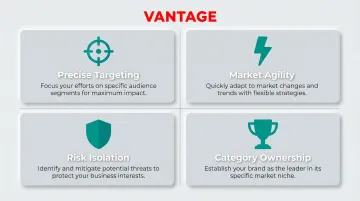
- Precise targeting — Different products can appeal to different segments without brand conflict
- Market agility — Faster response to trends and competitive threats
- Risk isolation — Parent company is protected if one product underperforms or faces reputational issues
- Category ownership — Products can dominate niches without diluting the parent brand
Use Cases of Product Branding
Product branding is most effective for consumer goods companies managing diverse, unrelated product lines serving very different customer segments. According to Kantar data, brands belonging to a House of Brands manufacturer command an average 3.7% category volume share, compared to just 1.1% for Branded House brands—demonstrating the power of targeted product positioning.
Procter & Gamble markets Tide, Pampers, and Old Spice as entirely separate brands with distinct personalities, allowing each to own its category without affecting the others.
Unilever follows a similar model, though it has evolved toward a more endorsed approach where the corporate logo appears on packaging to build broader consumer trust.
Key Differences Between Corporate and Product Branding
Scope and Longevity
Corporate branding is company-wide and permanent—it begins at founding, evolves over decades, but never disappears. Product branding is narrower and tied to the product's lifecycle: it can be retired, rebranded, or replaced as the market demands.
McDonald's golden arches began as an architectural feature in 1952 and were officially incorporated into the company's logo in 1962. This corporate symbol has remained constant for over six decades.
Diet Coke demonstrates product-level agility. Launched in 1982, the brand introduced Diet Coke Plus with vitamins in 2007, launched two million unique bottle designs in Israel in 2014, and underwent a massive restage in 2018 with new packaging and four new flavors to appeal to millennials.
Target Audience
Product brands speak to one defined consumer segment. Corporate brands must simultaneously speak to customers, employees, investors, media, regulators, and the public—each with different expectations.
This complexity demands a more layered strategy. Consider what each stakeholder group needs from a brand:
- Customers expect relevance, quality, and consistency
- Employees want purpose, values they can act on, and pride in the organization
- Investors look for stability, growth narrative, and credible leadership
- Regulators and media respond to transparency and demonstrated accountability
Corporate brands must carry all of these at once. Product brands only have to carry one.
How the Brand is Defined—Inside-Out vs. Outside-In
Product brands are built outside-in, shaped by consumer insights, competitive analysis, and market research. Corporate brands must also reflect inside-out thinking—the organization's legacy, genuine values, and long-term strategic vision.
Getting this wrong creates two failure modes: corporate narcissism (brands built on internal self-perception that ignores market reality) or hollow customer-centricity (brands that chase every trend and lose any sense of what the organization actually stands for).
Brand Impact and Business Value
Product brands primarily drive revenue through conversion. Corporate brands drive enterprise value across multiple dimensions—employee engagement, investor confidence, cross-selling, talent acquisition, and market valuation.
According to Interbrand's 2024 report, Apple holds a brand value of $488.9 billion. Interbrand's methodology shows that a 1% increase in the Role of Brand Index delivers an average 2.3% surge in share price. Corporate brand equity compounds over time in a way product brand equity does not.
The Three Brand Architecture Models
Understanding this spectrum makes the corporate vs. product branding distinction actionable:
| Model | How It Works | Example |
|---|---|---|
| Branded House | One corporate brand applied across all products. New offerings draw on established brand equity with minimal additional investment. | Apple, Virgin |
| House of Brands | Each product operates as an independent brand with no visible parent. Isolates risk; enables precise segment targeting. | Procter & Gamble (Tide, Pampers, Old Spice) |
| Hybrid / Endorsed | Product brands carry visible corporate endorsement, combining distinct positioning with parent brand credibility. | Marriott ("Courtyard by Marriott"), Amazon (Audible, Zappos) |
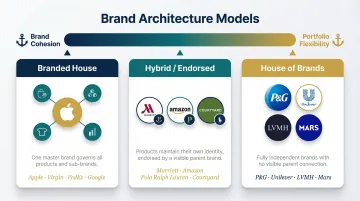
Each model reflects a deliberate trade-off between brand cohesion and portfolio flexibility—and the right choice depends on how closely your products share audiences, price points, and values.
Which Brand Strategy is Right for Your Business?
Situational Decision Guide
Choose a corporate brand (Branded House) strategy when:
- You operate in B2B markets where trust in the company drives purchasing decisions
- You have limited resources to maintain multiple brands
- Your products are closely related and benefit from shared reputation
- Cross-selling is a primary growth driver
Choose a product brand (House of Brands) strategy when:
- Your products serve genuinely different audiences
- One product's risk should not affect others
- You plan to acquire and sell brands independently
- Category-specific positioning is more valuable than corporate trust
The Hybrid Path
In practice, neither list above covers every situation. Most growing companies need elements of both—a strong corporate brand that lends credibility, with product-level branding that connects more directly with specific buyers. The key is intentional architecture, not reactive decisions made as products are added.
According to a 2021 BCG study, B2B companies that reach the highest level of brand marketing maturity generate a long-term ROMI of approximately 640% over four years. This maturity includes clear brand architecture that reduces cognitive load for buyers and makes cross-selling logical.
Without a deliberate strategy, brands accumulate inconsistencies that erode trust over time. Vantage Branding works with organisations across Singapore and Asia to define that architecture first—so investment in both corporate and product branding builds toward a single, coherent direction.
Conclusion
Corporate and product branding operate at different levels of brand architecture. The strategic decision isn't choosing between them — it's defining how they work together within your business.
Match your branding approach to your business model, portfolio complexity, and stakeholder landscape. A well-structured brand architecture, whether Branded House, House of Brands, or Hybrid, protects long-term enterprise value while giving individual products room to compete in their specific markets.
Connect with Vantage Branding to clarify your brand architecture and build on a strategic foundation — before committing to execution.
Frequently Asked Questions
What is the difference between corporate and product branding?
Corporate branding builds the identity and reputation of the entire company across all stakeholders, while product branding creates a distinct identity for a specific product aimed at a targeted consumer segment. The key difference is scope, audience, and strategic intent.
What are the 4 types of branding?
The four main types are corporate branding (managing an organization's identity), product branding (promoting a specific good or service), personal branding (promoting an individual's skills and reputation), and service branding (positioning intangible offerings).
What are the 3 C's of branding?
The 3 C's—Clarity, Consistency, and Constancy—apply to both corporate and product branding, but are especially critical for corporate brands, which must maintain coherence across a wider range of audiences and touchpoints over a longer period.
What is the 3 7 27 rule of branding?
The 3-7-27 rule states that it takes 3 exposures for someone to recognize a brand, 7 to remember it, and 27 to genuinely trust it. For corporate brands managing long sales cycles and multiple stakeholders, reaching that 27-exposure threshold is what separates recognition from lasting credibility.
Can a company use both corporate and product branding at the same time?
Yes, most established companies use both. The corporate brand provides overall reputation and trust, while product brands address specific markets. This is called a Hybrid or Endorsed Brand strategy, used by companies like Amazon and Marriott.
Which branding approach is better suited for B2B companies?
Corporate branding tends to be more effective in B2B contexts because B2B buyers evaluate the company's stability, values, and reputation as much as the product itself. A strong corporate brand shortens the sales cycle and builds the trust required for complex, high-value purchasing decisions.