Introduction
Picture a shopper standing in a supermarket aisle, scanning rows of packaged goods. Their hand reaches for a familiar product without hesitation—drawn to a logo they instantly identify, though they can't recall seeing any recent advertising for it. What just happened? Which aspect of branding drove that split-second decision, and why did that particular brand win the sale?
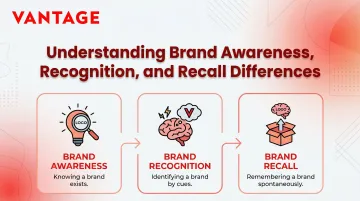
Brand awareness, brand recognition, and brand recall are often used interchangeably in marketing conversations. They aren't the same thing. Each describes a distinct stage in how consumers mentally connect to a brand, and confusing them leads to poorly targeted strategies and wasted investment.
A brand pouring resources into visual identity when recall is what matters, or running mass awareness campaigns without distinctive assets to reinforce recognition, risks being forgotten at the exact moment a purchase decision is made.
This article clarifies what each concept actually means, how they differ, how they interact across the purchase journey, and how targeting the right one at the right time can determine whether your brand is chosen or overlooked.
TLDR:
- Brand awareness is the umbrella: knowing a brand exists in a category
- Brand recognition is cue-triggered identification: seeing the logo and placing the brand
- Brand recall is unprompted retrieval: naming the brand from memory when a category comes to mind
- Recognition shapes in-store choices; recall determines the shortlist formed beforehand
- Effective brand strategy targets all three, matched to how and where your buyers decide
Brand Awareness, Recognition, and Recall: What Each Concept Actually Means
Brand awareness is the umbrella concept—the degree to which consumers are familiar with a brand's existence within a product category. According to marketing scholar Kevin Lane Keller's foundational 1993 framework, brand awareness encompasses both recognition and recall as sub-components. Awareness feeds into brand equity by increasing the probability that a brand enters a consumer's consideration set—the handful of options given serious thought before purchase.
Aided vs. Unaided Awareness
Brand awareness splits into two measurable forms: aided awareness and unaided awareness.
- Aided awareness (prompted): The consumer identifies a brand when shown a cue—such as a logo, name list, or packaging image
- Unaided awareness (unprompted): The consumer recalls a brand spontaneously when thinking of a category, without external prompts
This distinction matters because these two types require different marketing strategies. Aided awareness tests recognition; unaided awareness tests recall.
Brand Recognition
Brand recognition is the consumer's ability to identify a brand upon exposure to a visual, auditory, or sensory cue—a logo, colour scheme, jingle, or packaging—without necessarily recalling the brand name unprompted.
Think of McDonald's golden arches or Coca-Cola's distinctive red and white script. Recognition is cue-dependent and functions as aided recall at the point of purchase. When you see the logo on a shelf or signage, you immediately know the brand—even if it wasn't top-of-mind moments earlier.
Brand Recall
Brand recall is the consumer's ability to retrieve a brand from memory without any external prompts, purely from a category cue—for example, "name a fast-food brand." Keller's research distinguishes recognition as the ability to "discriminate" a brand when exposed to it, versus recall, which requires consumers to "generate" the brand from memory—a cognitively harder task.
Research in cognitive psychology confirms that recall involves accessing information without cues, while recognition involves identifying information after encountering it again. Recall is most critical when the brand isn't physically present—such as:
- Searching for a service provider online
- Writing a shopping list from memory
- Asking a colleague or friend for a recommendation
Top-of-Mind Awareness
Top-of-mind awareness (TOMA) represents the highest tier of brand recall—the first brand that surfaces in a consumer's mind when a category is mentioned unprompted. Keller describes this as the brand most "strongly associated with the product category in memory."
TOMA matters strategically because consumers tend to purchase from a small set of top-recalled brands in any category. The brand recalled first holds a measurable edge in both consideration and final purchase choice.
The Key Differences Between Brand Awareness, Recognition, and Recall
These three concepts sit on a continuum, but each involves a distinct cognitive mechanism. Awareness is passive familiarity. Recognition is triggered identification. Recall is active memory retrieval — and each one shapes brand strategy differently.
Depth of Consumer Memory
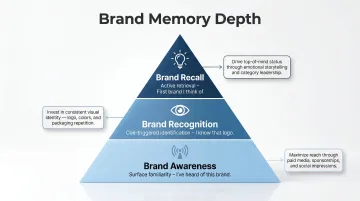
The three concepts represent increasing depth of mental encoding:
- Brand awareness = surface-level ("I've heard of this brand")
- Brand recognition = next layer ("I know that logo")
- Brand recall = deepest level ("That brand is the first name that comes to mind")
Example progression: A consumer sees a Nike advertisement (awareness develops). Later, browsing a shoe shop, they instantly recognise the swoosh logo on a running shoe (recognition). Days later, when a colleague asks "Where should I buy athletic shoes?" Nike is the first brand they mention (recall).
When Each Type Is Triggered
Recognition operates primarily at the point of purchase — when the consumer is exposed to branding elements in-store, in an advertisement, or on packaging. You see the product, you identify it.
Recall operates before the purchase decision, when the consumer is searching, making a list, or comparing options mentally. The brand must already exist in memory to be retrieved.
This distinction directly shapes where brands should focus their marketing energy:
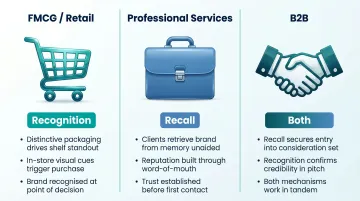
- FMCG brands competing on supermarket shelves prioritise recognition through distinctive packaging
- Professional service firms depend on recall — clients must generate the brand name from memory when a business need arises
- B2B brands often need both: recall to enter the consideration set, recognition to confirm credibility at the pitch stage
Progression and Sequence
A consumer must first know a brand exists before they can recognise it. Repeated recognition, over time, strengthens the memory associations that enable spontaneous recall.
However, this progression is not guaranteed. A brand can have high recognition (strong visual identity, instantly identifiable packaging) but weak recall if its messaging doesn't create strong category associations. Conversely, a brand might achieve recall through mass advertising but fail at recognition if its visual identity is generic or inconsistent.
Summary Comparison
| Dimension | Brand Awareness | Brand Recognition | Brand Recall |
|---|---|---|---|
| Definition | Consumer knows the brand exists | Consumer identifies the brand when exposed to a cue | Consumer retrieves the brand from memory without a cue |
| Consumer Question | "Have I heard of this brand?" | "Do I know what this logo represents?" | "What brands in this category can I name?" |
| When Triggered | Across all exposures and touchpoints | At the point of purchase or brand exposure | Prior to purchase, during mental search |
| Purchase Role | Foundation for consideration | Drives in-store selection and impulse decisions | Determines whether brand enters the consideration set |
Why the Distinction Matters: How Each Shapes Buying Decisions
Understanding which level of brand memory a consumer has reached determines which marketing actions will most effectively move them closer to purchase.
Recognition Drives Impulse and In-Store Decisions
In fast-moving consumer goods (FMCG) and retail environments, where consumers browse rather than search with intent, brand recognition is the dominant purchase driver.
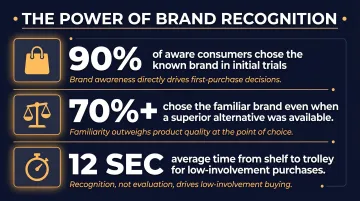
A landmark study by Hoyer & Brown (1990) found that 90% of aware consumers chose the known brand in initial trials. Even when the known brand was paired with an objectively superior-quality unknown brand, over 70% still chose the known brand. Brand awareness functioned as a dominant choice heuristic among inexperienced consumers—familiarity alone drove preference.
Why? Shoppers cut through complexity with a simple rule: "Buy the brand I've heard of." Dickson & Sawyer's research found that for low-involvement purchases like coffee and toothpaste, consumers spent an average of just 12 seconds from first looking at the shelf to placing the item in their trolley—barely enough time for deliberation, making recognition the decisive factor.
Recall Drives Consideration in High-Involvement Categories
For services, considered purchases, or categories where the consumer actively searches—choosing a healthcare provider, financial services firm, or branding agency—recall, not recognition, determines whether a brand even enters the consideration set.
If a brand cannot be retrieved unprompted, it is excluded before comparisons even begin. In time-pressed situations, consumers typically recall just one brand; in high-involvement decisions, about four brands enter serious consideration. A service brand absent from that mental shortlist is effectively invisible to that buyer.
Awareness as the Foundation of Brand Equity
Overall brand awareness, as the broadest measure, underpins brand equity—the additional value a brand name adds beyond functional attributes. Brands with high awareness can command premium pricing, recover more easily from reputational setbacks, and launch new products with less marketing effort because consumer trust is already partially established.
Kantar reports that 94% of pricing power is explained by how meaningfully different a brand is, and consumers are happy to pay double for brands with high pricing power. A 2023 Journal of Marketing meta-analysis found a 60.6% probability of more positive consumer response to a brand extension if parent brand equity improves—demonstrating that awareness facilitates new product launches.
The Risk of Focusing on Only One
But building that equity requires balance. A brand that invests heavily in visual identity (recognition) without building category associations will be noticed in-store but forgotten when the consumer is searching. Conversely, a brand that builds recall through mass awareness campaigns without a coherent visual identity may be remembered by name but fail to be identified when encountered.
Strategic brand-building requires deliberate attention to all three dimensions—awareness, recognition, and recall—each matched to the purchase context.
How to Build Brand Awareness, Recognition, and Recall
Each concept requires a distinct approach—and understanding which lever to pull determines where brand investment actually pays off.
Building Recognition Through Visual Identity and Consistency
Brand recognition is built through a distinctive, consistently applied visual and sensory identity: logo, colour palette, typography, tone of voice, and packaging. Consistency across every touchpoint—digital, print, physical—is non-negotiable.
The Ehrenberg-Bass Institute identifies logos, colours, fonts, and mascots as distinctive brand assets that enable instant consumer identification in crowded markets. These sensory cues allow consumers to pick out both brand and product when time or attention is limited.
This is why brand identity work—covering logo design, complete identity systems, and consistent implementation across touchpoints—forms the structural foundation of recognition. Without coherent, ownable assets, even well-funded campaigns fail to lodge in memory.
Building Recall Through Category Association and Repetition
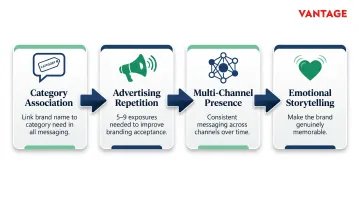
Where recognition depends on visual consistency, recall depends on repetition and meaning. It is built by creating strong, repeated associations between the brand and its product category—through messaging that links the brand name to the category need, across multiple channels over time, and through storytelling that makes the brand genuinely memorable.
Advertising repetition, influencer reach, and content marketing all contribute to strengthening recall. Nielsen research suggests that digital ads need between 5 to 9 exposures to improve branding and increase consumer acceptance—though the exact threshold depends on brand familiarity, message complexity, and message novelty.
Reaching Top-of-Mind Awareness
TOMA is earned through sustained brand presence—being visible, relevant, and consistent enough that the brand becomes the default mental reference for a category. Emotional storytelling, high-reach campaigns, and excellent customer experience all contribute to this status.
Binet and Field recommend approximately 60% brand building versus 40% activation as a baseline budget split, adjustable depending on context. TOMA typically requires long-term investment rather than short-burst campaigns. Binet emphasises: "If companies are going to grow for the long term, they don't need big data, they need long data."
How to Measure Your Brand's Awareness, Recognition, and Recall
Measuring these three distinct concepts requires different methodologies. Tracking them over time reveals where in the consumer's mind the brand currently lives—and where gaps exist.
Measurement Methods by Concept
| Measure | What It Tests | Method |
|---|---|---|
| Brand Recognition | Ability to identify the brand when exposed to visual or auditory cues | Aided test: show logo or name, ask if recognised |
| Brand Recall | Ability to retrieve the brand from memory without prompts | Unaided survey: provide category cue, ask respondent to name brands |
| Top-of-Mind Awareness | First brand named unprompted when given category cue | Unaided recall survey, coded by order of mention |
Brand tracking studies monitor awareness levels as a percentage of the target population over time. Beyond formal studies, search volume trends, social media mentions, and direct website traffic work as secondary proxies — faster to access, though less precise.
Kantar notes that Share of Search correlates with both salience and sales, but warns it "requires careful navigation to extract meaningful insights"—it reflects interest and visibility but doesn't isolate specific cognitive processes like recognition versus recall.
What to Do With the Data
The diagnostic value of these measurements lies in identifying the gap. If recognition is high but recall is low, the brand needs stronger category association in its messaging. If awareness is low across the board, reach and visibility investment is needed.
The most common finding — high recognition but weak recall — usually points to a messaging problem, not a media spend problem. The brand is visible enough; it just isn't anchored to the right category cues in consumers' minds.
Frequently Asked Questions
What is the difference between brand awareness and brand recognition?
Brand awareness is the broader concept—whether consumers know a brand exists. Brand recognition is a sub-component: the ability to identify a brand when exposed to a visual or auditory cue such as a logo or jingle.
What is brand recall and how does it differ from recognition?
Brand recall is the ability to retrieve a brand from memory without any prompt, while recognition requires an external cue. Recall demands more from memory and matters most in complex purchase decisions where the brand isn't physically visible — such as searching for a service provider online.
Which comes first — brand awareness, recognition, or recall?
The sequence typically runs: awareness first (knowing the brand exists), then recognition (identifying it when encountered). With repeated exposure, recognition deepens into recall — retrieving the brand unprompted when thinking of a category.
Can a brand have high recognition but low recall?
Yes. A brand with a strong visual identity may be recognised easily in-store or in an ad. But if its messaging lacks clear category associations, consumers are unlikely to think of it spontaneously when making purchase decisions without a prompt.
How do you measure brand recognition versus brand recall?
Brand recognition is measured through aided recall tests—presenting a logo or name and asking if consumers identify it. Brand recall is measured through unaided recall surveys that ask consumers to name brands in a category without prompts.
Why does brand recall matter more than recognition for service businesses?
For services, consumers typically search and compare options before encountering the brand visually, so recall—not recognition—determines whether the brand enters the consideration set. A service brand not retrieved from memory during the search phase is effectively invisible to potential buyers.