Introduction
More organisations today operate in a gray zone — simultaneously generating revenue and creating social value. A mental health platform serves paying customers while advancing wellbeing access. An investment firm pursues returns alongside ESG commitments. A cultural institution sells tickets and fulfils a public education mandate at the same time.
This convergence makes it genuinely difficult to know what kind of branding approach an organisation should adopt. The stakes are high: choose the wrong framework and you risk alienating core stakeholders, misallocating limited resources, or failing to build the trust necessary for long-term sustainability.
The sections below break down how social enterprise branding and commercial branding differ across mission, messaging, audience, and success metrics — and what each type of organisation should prioritise when building its brand.
TLDR
- Social enterprises brand around mission and impact; commercial brands brand around value, differentiation, and market share
- Commercial branding drives persuasion and conversion; social enterprise branding builds trust and long-term behavioural change
- Social enterprises must speak to beneficiaries, donors, partners, and policymakers — not just paying customers
- Success metrics diverge: commercial branding measures revenue and market KPIs; social enterprise branding measures mission alignment and social outcomes
Social Enterprise vs. Commercial Branding: At a Glance
| Dimension | Social Enterprise Branding | Commercial Branding |
|---|---|---|
| Primary Objective | Communicate mission credibility and earn stakeholder trust | Create preference and drive revenue |
| Target Audience | Multi-stakeholder (beneficiaries, funders, government, community) | Defined customer segments |
| Brand Tone | Warm, authentic, community-oriented | Aspirational, polished, differentiated |
| Success Metrics | Perception shift, stakeholder engagement, funding, volunteer retention | Revenue, market share, NPS, customer acquisition cost |
| Funding Model | Grants, donations, earned revenue reinvested in mission | Investor-backed, profit-driven |
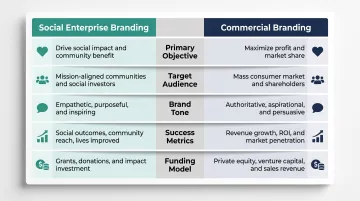
These categories are not always mutually exclusive. Hybrid organisations — B-corps, social ventures, impact-driven healthcare brands — must navigate both worlds simultaneously, building brand systems that signal financial credibility while staying true to their social mission.
This comparison focuses specifically on branding strategy and communication, not the broader business model differences between organisational types.
What is Social Enterprise Branding?
Social enterprise branding is the practice of building an organisation's identity, reputation, and communications around a core social, environmental, or community mission — where the brand itself serves as proof of impact, not just a vehicle for sales.
Mission as the Brand Foundation
Mission centrality shapes every brand decision. The name, visual identity, tone of voice, and language used in impact reports must consistently reflect and reinforce the organisation's "why."
When Vantage Branding worked with the Singapore Symphony Orchestra, the work centred on translating a cultural mission into a brand identity that demonstrated relevance to diverse audiences while maintaining institutional credibility. The result: a vibrant red colour palette, contemporary typography, and campaigns like "Lust. Betrayal. Murder." for Bizet's Carmen that made classical music feel urgent and emotionally resonant.
Research shows that 81% of donors cite belief in an organisation's mission as a major reason for giving, making mission-driven storytelling the single most powerful brand asset for social enterprises. Donors who prioritise mission are twice as likely to increase their donations in the next 12 months.
The Multi-Stakeholder Challenge
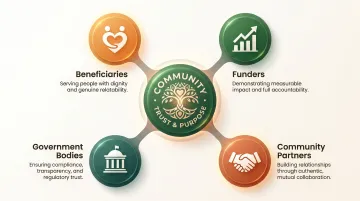
Unlike commercial brands with relatively defined customer personas, social enterprises must communicate simultaneously to:
- Beneficiaries who need dignity and relatability
- Funders who want impact evidence and accountability
- Government bodies who require regulatory compliance and transparency
- Community partners who seek authentic collaboration
Each stakeholder operates under different motivations and evaluation criteria. A homeless shelter must show compassion to clients, demonstrate measurable outcomes to grant makers, and signal operational competence to city councils — often through the same brand identity system.
Brand Storytelling as Currency
Without the ability to offer financial returns to stakeholders, the brand narrative becomes the main mechanism for attracting volunteers, funding, and public goodwill. The story of who is helped, how, and why it matters is what drives engagement.
That external story, however, only holds if the organisation believes it internally. Academic research on nonprofit branding confirms that for labour-intensive social services, internal alignment — through staff training, leadership behaviour, and consistent internal communications — must come first. A brand that staff don't understand cannot be communicated to the outside world with any conviction.
The Budget Constraint Reality
Most social enterprises operate with limited branding budgets. Only 1.2% of UK social enterprise employers sought external marketing advice in the past year, compared to 2.6% of standard SME employers — roughly half the rate. This forces a focus on brand clarity and message discipline over broad media spend.
This constraint can actually produce more durable brand equity. When there is no budget for frequent rebrands, getting the positioning, tone, and visual identity right from the start becomes essential — and the organisations that do this well tend to build recognition that outlasts competitors with far larger marketing budgets.
What is Commercial Branding?
Commercial branding is the strategic development of a brand's identity, positioning, and communications to create preference, drive purchase, and build long-term customer loyalty — with profitability and market share as the ultimate success measures.
Competitive Positioning Drives Strategy
Commercial brands are built to differentiate in crowded markets. Brand strategy is shaped by competitor analysis, consumer insight, and a clear value proposition that answers "why us over them."
Research from Kantar BrandZ shows that brand accounts for approximately one-third of total business value for commercial firms, and over 50% for the world's strongest brands. That makes brand a balance-sheet asset, not a marketing cost centre.
Emotional Connection for Conversion
Commercial brands use aspirational storytelling, lifestyle association, and consistent visual branding to build emotional resonance — but ultimately in service of a transactional outcome. Whether the goal is purchase, subscription, or repeat loyalty, commercial branding frameworks move consumers through awareness, consideration, and conversion stages in sequence.
Measurable Success Metrics
Success in commercial branding is tracked through:
- Net Promoter Score (NPS)
- Brand recall and awareness
- Market share and revenue growth
- Customer acquisition cost (CAC)
- Customer lifetime value (CLV)
These KPIs give commercial brands clear feedback loops to iterate and refine. If a rebrand doesn't move market share within six months, the organisation has data to course-correct — a level of accountability that shapes how commercial brand strategy is built from the start.
Key Differences That Shape Each Branding Approach
Difference 1: Primary Purpose
Commercial branding exists to create preference and drive revenue. Social enterprise branding exists to communicate mission credibility and earn stakeholder trust. This foundational difference shapes every other strategic decision: colour palette choices, headline messaging, channel selection, and beyond.
Difference 2: Brand Audience and Messaging
Commercial brands typically focus messaging on a single defined customer. Social enterprises must maintain multiple "brand conversations" at once, each tailored to a different stakeholder's motivations.
Example: A community health clinic must simultaneously communicate:
- To patients: "We see you, respect you, and provide quality care regardless of ability to pay"
- To donors: "Your contribution delivers measurable health outcomes in underserved neighbourhoods"
- To government: "We meet all regulatory standards and contribute to public health objectives"
Each message requires different evidence, tone, and channel strategy.
Difference 3: Tone, Language, and Visual Identity
Commercial brands often adopt aspirational, polished, or disruptive visual identities to stand out in market. Social enterprise brands prioritise warmth, authenticity, and community to signal approachability and trustworthiness.
Overly corporate-looking branding can undermine a social enterprise's credibility. A food bank with sleek, minimalist branding might unintentionally signal wealth and distance from the community it serves. Conversely, a social venture seeking investment capital cannot rely on amateur design. It must demonstrate professionalism without losing mission authenticity.
Difference 4: Brand Success Metrics
Commercial branding success is measured in revenue-linked KPIs. Social enterprise branding success is measured by perception shift, stakeholder engagement, increased funding, volunteer retention, and public awareness of the cause.
This creates a structural challenge: social enterprise leaders cannot make the same ROI case for branding investment that commercial CMOs can make. When less than half of all countries have publicly available data on social entrepreneurship, organisations cannot benchmark effectiveness or justify budget allocation using standardised metrics.
Difference 5: Brand Longevity and Evolution
Commercial brands evolve to match market trends and consumer preferences. Rebrands and refreshes are expected. Social enterprise brands must evolve carefully to avoid alienating mission-aligned communities who have strong emotional investment in what the brand represents.
Nonprofit stakeholders often carry generational ties to brand identity — a rebrand can simultaneously reinvigorate some audiences and drive others away. When a UK hospice undertook a brand refresh, reactions were sharply divided: some staff felt renewed commitment, while a long-serving team member stated she wouldn't care if the logo "were a banana" as long as clinical care remained competent.
Singapore's ArtScience Museum took a different approach in its 2025 rebrand. The project centred on "convergence": the meeting point of art, science, and community. By anchoring the new identity in the museum's dual mission and launching alongside Singapore's 60th anniversary, the rebrand preserved institutional meaning while modernising visual presence.
The result was a 300-page brand guideline system — proof that mission-driven organisations can achieve commercial-grade brand infrastructure without sacrificing purpose.
Which Branding Approach Is Right for Your Organisation?
The line between social and commercial is blurring. Many modern organisations are hybrids — commercial ventures with deep social purpose, or social enterprises adopting revenue-generating models.
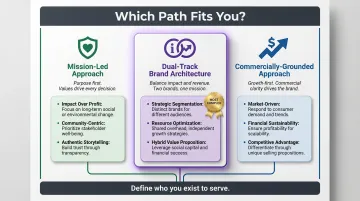
Consider a primarily mission-led approach if:
- Your primary accountability is to beneficiaries and funders
- Success is defined by social outcomes, not profit margins
- Stakeholder trust drives long-term sustainability
Consider a commercially-grounded approach if:
- Conversion and market differentiation are central to survival
- You compete for paying customers in defined markets
- Revenue growth is the primary success metric
Consider a dual-track brand architecture if:
- You operate across both dimensions (e.g., B-corps, social ventures)
- You serve both impact beneficiaries and paying customers
- You must communicate impact mission and entrepreneurial credibility simultaneously
Singapore's social enterprise sector nearly doubled from 357 to 693 members, with collective revenue reaching S$210.3 million. Globally, an estimated 10-11 million social enterprises contribute approximately $2 trillion to GDP. As more organisations operate across both commercial and social dimensions, the strategic challenge isn't just picking a branding model — it's knowing how to position authentically within whichever model you choose.
That's the work Vantage Branding does across commercial and social-impact sectors — from healthcare and government to arts and technology — helping organisations define who they exist to serve, what success looks like, and how the brand needs to communicate to drive it.
Before choosing a branding direction, answer three questions:
- Who does your organisation exist to serve?
- What does success look like for that audience?
- What must your brand make people feel or believe to drive that success?
Conclusion
Social enterprise branding and commercial branding serve distinct purposes — each designed around different goals, audiences, and accountability structures. Choosing between them comes down to who the brand must earn trust with and what action it needs to inspire.
That distinction matters more as purpose-driven models gain ground across Asia. The most resilient brands — whether measured in sales, donations, or social impact — are those that have defined their mission clearly, understood their stakeholders, and built an identity strong enough to hold loyalty over time.
Purpose-led brands saw 175% valuation growth over 12 years compared to 70% for brands uncertain of their role. In Singapore, where NGOs are trusted at 66% and business at 63%, organisations that clearly articulate purpose benefit from both institutional credibility and consumer preference. The organisations that will lead are those that combine genuine mission credibility with the brand infrastructure to communicate it at scale.
Frequently Asked Questions
Frequently Asked Questions
What is the main difference between a social enterprise and a commercial enterprise?
A commercial enterprise is primarily driven by profit for shareholders, while a social enterprise prioritises creating social, environmental, or community value — with profits reinvested into the mission rather than distributed.
What are the differences between social marketing and commercial marketing?
Commercial marketing aims to influence purchase decisions for profit, while social marketing uses marketing techniques to promote behaviour change or social good — often without a transactional end goal.
What is the difference between brand strategy and branding strategy?
Brand strategy defines the long-term positioning, purpose, and meaning of a brand. Branding strategy is the tactical execution used to express that positioning: visual identity, naming, messaging, and tone of voice.
What is the difference between brand strategy and social strategy?
Brand strategy defines how an organisation wants to be perceived overall, while social strategy is how it uses platforms and channels to communicate and engage audiences. The two should always align — social activity is one expression of the broader brand.
Can a social enterprise use commercial branding techniques?
Yes, many social enterprises benefit from adopting commercial branding practices — such as clear positioning, consistent visual identity, and audience segmentation — while ensuring their mission remains central to all communications.
How do social enterprises build brand trust without a large marketing budget?
Social enterprises build trust through authentic storytelling, demonstrated impact, community partnerships, and peer referral. Organisations with a clear, consistently communicated mission tend to earn credibility faster than those relying primarily on paid media.