This article explores what makes medical branding in Vietnam distinct, which elements work, how to navigate cultural and regulatory constraints, and what healthcare leaders can learn from recent Vietnamese rebrands.
TLDR:
- Private hospitals doubled in a decade but hold under 6% of beds, making brand differentiation critical
- Vietnamese patients choose providers based on word-of-mouth, doctor reputation, and staff behavior—not advertising
- Color psychology differs from Western norms: white signals mourning, blue and green convey healing
- New advertising rules removed pre-approval requirements, shifting legal liability to providers
- Successful rebrands pair visual updates with community welfare initiatives
Vietnam's Healthcare Landscape: Why Branding Matters Now
Vietnam's healthcare market is undergoing rapid structural change. Total FDI into Vietnam reached $38 billion in 2024, with health-tech startups experiencing a 391% surge in capital flow. Thomson Medical Group acquired FV Hospital for approximately $381.4 million, signalling confidence in the sector's growth trajectory.
Patient behaviour is shifting just as fast. Private patient volume grew 30% from 2019 to 2023 — outpacing Southeast Asia's 5–20% average. An estimated 74% of Vietnam's population will enter the consuming class by 2030, up from 40.8% in 2020. These patients compare options, seek international-standard care, and actively choose between public, semi-private, and private facilities.
That domestic demand shift has a regional dimension too. Vietnam's medical tourism market reached $700 million in 2024 and is projected to hit nearly $4 billion by 2033, with pre-COVID volumes of approximately 300,000 international visitors annually. Healthcare costs run 30–50% lower than Singapore and Thailand — creating real competitive pressure for Vietnamese providers to project credibility beyond their own borders.
What Makes Medical Branding in Vietnam Unique
Trust Through Reputation, Not Advertising
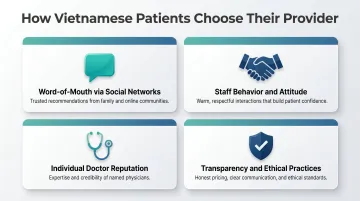
A 2023 study across Hanoi, Hue, and HCMC found that Vietnamese patients prioritize:
- Word-of-mouth via social networks — more emotionally powerful than conventional marketing
- Staff behavior and attitude — private staff perceived as enthusiastic versus public hospitals associated with rudeness
- Individual doctor reputation — patients follow specific doctors from public to private practice
- Transparency — eliminating under-the-table payments common in public hospitals
Brand identity works best when it reinforces physician-level trust and patient experience — not when it tries to substitute for them.
The Traditional Medicine Tension
Deputy PM Le Thanh Long's Directive 25/CT-TTg classifies traditional Vietnamese medicine (Đông y) as a "precious cultural asset" and directs the Ministry of Foreign Affairs to promote its global image and brand value. Healthcare brands that can authentically bridge heritage and innovation—or clearly own one lane—resonate more strongly than those that ignore this cultural dimension.
Regional Visual Expectations
Brand identity that works in Ho Chi Minh City may need adaptation for Hanoi or the central regions. Visual preferences vary meaningfully across Vietnam:
- North (Hanoi): Subdued, traditional hues signal credibility and restraint
- South (Ho Chi Minh City): Bright, vibrant colors reflect the region's entrepreneurial energy
- Central (Hue): Purple holds cultural prominence, rooted in the city's imperial history
Rising International Standards
Vinmec — JCI-accredited and serving nearly 500,000 international patients, with 67% brand recognition among expatriates — has set a high visual benchmark. Thomson Medical Group's entry into the market raises that bar further. Domestic organizations that don't professionalize their brand identity risk being left behind.
Key Elements of a Strong Medical Brand Identity in Vietnam
Logo Design and Visual Symbolism
Vietnamese medical logos frequently draw from internationally recognized symbols—Rod of Asclepius, DNA strands, ECG lines—while incorporating local cultural cues. Each visual element should carry communicable meaning.
Example: Meta Healthcare's logo features two dots—blue (science) and red (humanity)—connected by a rod-like structure inspired by the Rod of Asclepius, with molecular hexagons as secondary elements. Each element maps to a specific value, giving the logo meaning beyond aesthetics.
Example: Thủ Đức General Hospital's August 2025 rebrand uses blue and red, depicting hands cradling a heart with an ECG line, conveying trust, compassion, and patient-centered care.
Color Psychology in the Vietnamese Context
| Color | Vietnamese Cultural Meaning | Healthcare Application |
|---|---|---|
| Blue | Peace, harmony, calm | Most common for hospitals; reduces patient anxiety |
| Green | Nature, health, vitality | Hospital interiors and surgical scrubs; perceived as "cooling" |
| Red | Luck, happiness; also blood/urgency | Generally avoided except Red Cross; can signal emergency |
| White | Mourning, funerals; also purity | Standard for medical uniforms but mixed with other colors to avoid "cold" atmosphere |
| Yellow | Wealth, power (historically royal) | Common in traditional medicine (Đông y) branding |
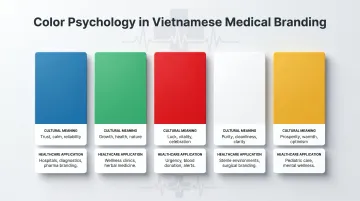
Regional differences matter. Northern facilities favor subdued tones; southern providers use vibrant palettes.
Brand Voice and Messaging Framework
Beyond visuals, medical brands need consistent tone:
- Reassuring and warm for patient-facing clinics
- Authoritative and precise for research or pharmaceutical companies
- Community-oriented for public health initiatives
Messaging should reflect the organization's core mission and be tested for resonance with Vietnamese audiences, who value family-centered decision-making.
Brand Guidelines and Consistency
Formal brand guidelines must cover:
- Logo usage rules and clear spacing requirements
- Typography systems for Vietnamese and English
- Color codes (Pantone, RGB, CMYK)
- Imagery standards and photography guidelines
- Application rules for uniforms, signage, digital platforms, and patient materials
Healthcare branding partners with regional experience bring an important advantage here: they know which guidelines actually hold up in clinical environments. Vantage Branding, for example, has developed brand systems for healthcare clients across Asia including Allium Healthcare, ThoughtFull, and Jurong Health, ensuring each set of guidelines is both strategically grounded and practically workable.
Digital and Environmental Applications
Medical brand identity must extend across:
- Digital channels: websites, social media, health apps, telemedicine platforms
- Physical environments: hospital wayfinding, patient rooms, exterior signage, staff uniforms
When a patient sees the same visual language on a hospital entrance, a nurse's uniform, and a follow-up SMS, that repetition builds recognition — and recognition builds trust.
Cultural and Regulatory Factors That Shape Vietnamese Medical Branding
Family-Centered Healthcare Decisions
Vietnamese patients rarely decide alone. Medical brand identity must communicate to the family unit, using imagery, language, and messaging that acknowledge collective health decisions. Brands that feel cold or overly clinical alienate Vietnamese audiences even if technically competent.
Government Regulations and Marketing Boundaries
Circular 03/2026/TT-BYT (effective February 15, 2026) eliminated pre-approval requirements for advertising medicines, cosmetics, medical devices, and medical examination/treatment services. Companies now bear full legal liability for self-regulated content. This makes brand compliance expertise critical—a single non-compliant campaign can result in regulatory fines and lasting damage to patient confidence.
Intellectual Property Registration
Registering trademarks with Vietnam's Intellectual Property Office (IPVN) protects against copycat brands. The process takes 12-24 months and covers:
- Class 5: Pharmaceuticals, medical preparations
- Class 10: Surgical/medical apparatus
- Class 35: Retail/wholesale medical services
- Class 44: Medical services, healthcare
Infringement fines reach VND 250 million for organizations. Foreign applicants must engage a licensed Vietnamese IP representative.
Bilingual Brand Communication
Protecting your brand legally is only part of the picture — how that brand speaks matters just as much. For institutions attracting international patients or talent, brand identity must function in both Vietnamese and English. This requires transcreation (adapting messaging to preserve emotional intent, not just literal translation). Vinmec's bilingual MyVinmec app and website put this into practice, helping the hospital system earn its top-ranked position among healthcare providers serving expatriates.
Lessons from Medical Rebranding in Vietnam
Thủ Đức General Hospital: Community Welfare Amplifies Brand Credibility
The hospital's August 2025 rebrand paired a new visual identity with:
- VND 1 billion (~$43,715) in medical equipment donations
- 50 wheelchairs from corporate sponsors
- Free medical check-ups and medicines for 300 elderly/disadvantaged people
- Nutritious meals for 300 inpatients through the "Happy Lunch" program
- Planned outreach for 600 beneficiaries with VND 270 million budget
What this means: A rebrand launch should be treated as a trust-building event. Visual changes alone don't move perception; community welfare initiatives demonstrate the brand's values in action.

Meta Healthcare: B2B Brands Need Dual-Audience Symbolism
Meta Healthcare's collaboration with Bean Creative shows how a pharmaceutical distribution company used deliberate visual metaphors — the Rod of Asclepius, molecular hexagons, a 3D visual linking science to wellness — to communicate credibility to business partners and patients simultaneously.
The lesson: For B2B healthcare brands, identity must speak to multiple stakeholders. Symbolism becomes a shortcut to complex values when the visual choices are deliberate and well-researched.
Traditional Medicine's Global Branding Push
Where individual brands operate at the company level, national policy is now shaping the sector as a whole. Directive 25/CT-TTg mandates global promotion of Vietnamese traditional medicine, with the Ministry of Foreign Affairs introducing its image and brand worldwide. The Ministry of Culture will develop medical and healthcare tourism built around traditional medicine.
Key takeaway: The most valuable medical brands in Vietnam will articulate a distinctly Vietnamese identity while meeting international standards of scientific rigour. Local context is an asset — but only when the brand execution is credible enough to hold up on a global stage.
Frequently Asked Questions
Frequently Asked Questions
What is the medical system like in Vietnam?
Vietnam operates a mixed public-private healthcare system, with 684 district hospitals, 419 provincial hospitals, and national hospitals managed by the Ministry of Health alongside a growing private sector. Coverage is provided through national health insurance (95.16% of the population in 2025), but quality and access vary significantly between urban and rural areas, driving demand for better-branded private providers.
Why is brand identity important for healthcare organizations in Vietnam?
In Vietnam's competitive healthcare market, brand identity directly influences patient trust, choice of provider, and long-term loyalty. A professionally developed identity signals clinical credibility and helps organizations stand out among domestic competitors and international players entering the market.
What colors work best for medical branding in Vietnam?
Blue (trust and science), green (wellness and growth), and white (cleanliness) are the most effective choices, while red can be used carefully to convey urgency or humanity. Color choices should account for Vietnamese cultural associations—white signals mourning, so hospitals mix it with warmer tones to avoid a cold atmosphere.
How does Vietnamese culture influence medical brand design?
Vietnamese healthcare decisions are family-driven, meaning brand messaging and imagery must speak to collective values, not just individual patients. Warmth, community, and long-term relationship cues resonate more than purely clinical or technical messaging.
Do Vietnamese healthcare organizations need to register their brand identity legally?
Yes. Trademarks and logo elements should be registered with Vietnam's National Office of Intellectual Property (NOIP) to protect brand equity. Registration takes 12-24 months, and infringement fines can reach VND 250 million.
What should a hospital or clinic consider when rebranding in Vietnam?
Rebranding requires aligning the new identity with the organization's mission, ensuring regulatory compliance across all materials, and building consistent guidelines for physical and digital touchpoints. Community engagement at launch — as Thủ Đức Hospital demonstrated — also builds early public trust.
Vietnam's healthcare sector is no longer competing on capacity alone. With private hospitals holding under 6% of beds but capturing 30% volume growth, and medical tourism approaching $1 billion annually, brand identity is now a core business asset — not a cosmetic one. The providers who get this right will be the ones patients actively choose, recommend, and return to.