Private patient volumes surged 30 percent between 2019 and 2023, signaling a fundamental shift: Vietnamese patients now exercise choice. They compare experiences, scrutinize quality signals, and make active decisions about where to seek care. In this environment, healthcare brands that fail to communicate clearly, build trust systematically, and deliver consistent patient experiences risk being invisible—no matter how competent their clinical teams.
This article draws actionable lessons from observable patterns across public hospitals, private clinics, and specialty providers in Vietnam. The goal is straightforward: help healthcare leaders understand what separates brands that earn loyalty from those that remain overlooked.
TLDR:
- Vietnam's healthcare market is growing rapidly, but many providers lack formal brand strategies—creating opportunity for those who invest intentionally
- Trust is the foundation of healthcare branding, and in Vietnam it's shaped by cultural values, social proof, and institutional credibility signals
- Private providers that adopt patient-centric messaging, designed environments, and digital communication consistently outperform generic competitors
- Mental health branding reveals the hardest test case—requiring brands to normalize help-seeking before promoting services
- Effective healthcare brands in Vietnam align visual identity, messaging tone, and patient experience across every touchpoint to build lasting trust
Vietnam's Healthcare Market: Why Branding Can't Be an Afterthought
The Commercial Stakes Are High—and Rising
Vietnam's healthcare sector is growing fast. The private sector now accounts for 32.2 percent of total outpatient services and 6.3 percent of inpatient services, with roughly 1,300 private clinics and 10 private hospitals entering the market each year.
Foreign investors have taken notice. Thomson Medical Group acquired FV Hospital for USD 381 million, while GIC invested USD 204 million in Vinmec.
With more than 170 million outpatient visits and 17 million inpatient admissions annually, patient volume is enormous—and increasingly, patients are choosing where to go.
The Structural Shift: From Necessity to Choice
A decade ago, most Vietnamese patients had few options and public hospitals dominated by default. Today, patients actively compare public institutions, private clinics, and international-standard facilities. That choice environment means brand perception now directly influences patient decisions in ways it simply did not before.
Wealthier urban patients actively seek international-quality care. In Ho Chi Minh City, 30-40 percent of patients come from other provinces or overseas, demonstrating clear brand pull toward recognized providers.
The Branding Vacuum: Opportunity for the Prepared
Despite this competitive landscape, many providers—especially public institutions and traditional clinics—operate with little to no intentional brand strategy. They rely on:
- Institutional familiarity rather than proactive communication
- Inconsistent visual identities
- Minimal patient engagement beyond clinical necessity
- No clear positioning or messaging framework
This gap is a real opening for providers willing to invest in clear positioning, professional visual identity, and structured patient communication. Branding is not decoration — it is a core operational investment, and in Vietnam's market right now, the first movers stand to gain the most.
The Trust Deficit: Why Healthcare Branding Is Uniquely Challenging in Vietnam
Trust Is the Currency—But It's Hard to Earn
Trust is everything in healthcare. In Vietnam, building that trust is complicated by deeply embedded cultural attitudes:
- Historical authority of state-run institutions
- Social stigma attached to certain conditions (particularly mental health)
- Traditional preference for family referrals over formal marketing
- Collectivist decision-making patterns
These factors shape how patients receive and evaluate healthcare messaging. Authority figures, community endorsement, and social proof matter more than individual-focused advertising.
Cultural Dimensions Shape Brand Perception
Research shows that Social Influence was the strongest driver of satisfaction in Vietnamese private hospitals, followed by Trust and Emotion. Function factors like cleanliness and timeliness were not significant in this model—meaning patients prioritise social proof and emotional resonance over operational details.
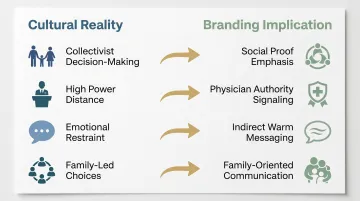
Vietnam's collectivist culture and high power distance create specific branding realities:
- Decision-making often rests with the eldest family member
- Patients defer to physician authority
- Direct, Western-style advertising can feel inappropriate
- Emotional restraint and indirect communication are culturally preferred
The Stigma Challenge: When the Condition Itself Is the Barrier
These cultural dynamics become even more pronounced when the condition itself carries stigma. Mental health and certain chronic conditions face acute stigma in Vietnam. The treatment gap for mental health reaches up to 90 percent, driven by limited capacity and social fear.
When the condition itself is stigmatised, the brand must first normalise the need before it can promote its services. This requires a fundamentally different marketing approach—leading with education and community-building rather than service promotion.
The Credibility Gap for New Entrants
Public hospitals inherit institutional trust by default. Private providers must build it from scratch through brand signals:
- Professional name and visual identity
- Patient testimonials and success stories
- Clinical credentials and international accreditations
- Consistent, empathetic messaging
- Designed physical spaces that signal quality
Without these signals in place, private providers remain at a disadvantage — patients default to public institutions not because they prefer them, but because there is no competing evidence of legitimacy.
Case Study Analysis: Public vs. Private Healthcare Branding in Vietnam
The Public Hospital Pattern: Institutional Familiarity Without Strategy
Public healthcare institutions in Vietnam typically share common characteristics:
- No formal brand strategy or positioning
- Inconsistent visual identities across locations
- Minimal proactive patient communication
- Heavy reliance on proximity and necessity rather than choice
- Low patient engagement beyond clinical transactions
Without a deliberate brand strategy, these institutions lose high-value patients to private competitors — and have few tools to win them back.
The Private Provider Contrast: Patient-Centric Brand Investment
Progressive private providers have adopted a distinctly patient-first model:
- Patient-centric brand messaging that emphasizes care experience, not just clinical outcomes
- Designed spaces and professional visual identity systems
- Digital channels—websites, social media, online appointment platforms—that signal accessibility and quality
- Transparent communication about services, pricing, and credentials
Vinmec Health System exemplifies this strategic approach. As the first healthcare system in Vietnam to achieve JCI certification, Vinmec operates nine hospitals and four general clinics nationwide. The system has served more than 500,000 foreign patients from 200+ countries, demonstrating the power of clear international-standard positioning.
Vinmec's brand strategy emphasises patient relationships over transactional care — not just clinical competence. At Vinmec Ocean Park 2, resort-like amenities extend the brand into how patients feel throughout their stay, not just how they're treated.
The Branding Lesson: Experience and Perception Are Inseparable
Patients are not evaluating clinical outcomes in isolation. They are evaluating:
- How easily they can find information online
- How they feel walking into reception
- Whether staff communicate warmly and clearly
- Whether the space feels clean, modern, and professional
- Whether the brand signals international quality
Brand design and patient experience are inseparable. Private providers that understand this reality gain market share, build referral networks, and command premium pricing.
The International Positioning Advantage
Data shows that wealthier and more educated Vietnamese patients actively seek international-standard care. Health and wellness tourism in Vietnam grew by an average of 12 percent annually from 2017-2024, generating approximately USD 2 billion per year.
Brands that communicate international quality—through JCI accreditation, partnerships with global networks like Cleveland Clinic, English-language services, or visual design cues—capture a outsized share of this high-value segment.
Vinmec is not alone in recognising this. FV Hospital, the first JCI-accredited hospital in South Vietnam, recently issued an RFP for an integrated marketing and communications campaign targeting brand awareness and patient acquisition. That a leading private hospital is actively budgeting for brand development — not just clinical expansion — reflects how competitive the market has become.
The Strategic Takeaway: Branding Is Operational, Not Cosmetic
Private and international healthcare providers must treat branding as a core operational investment—one that:
- Reduces patient decision friction
- Builds referral networks through trust and reputation
- Differentiates in a crowded, growing market
- Converts first-time patients into long-term advocates who drive referrals
Case Study Analysis: Mental Health Branding and the Stigma Challenge
The Hardest Test Case for Healthcare Branding
Mental health represents the most demanding branding challenge in Vietnamese healthcare. Point prevalence of the ten most common mental disorders reaches 14.4-20 percent, yet stigma describes mental illnesses as unpredictable, threatening, and incurable—discouraging help-seeking.
With approximately 900 psychiatrists nationwide and a treatment gap of up to 90 percent, the sector needs effective branding to normalize the conversation before promotion can even work.
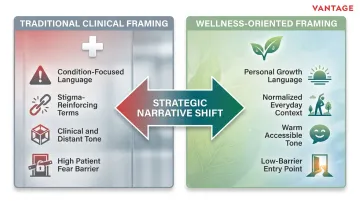
The Narrative Shift: From Clinical to Wellness-Oriented
Forward-thinking private mental health providers in Vietnam have moved away from condition-focused, clinical messaging toward wellness-oriented, accessible communication. Instead of promoting treatment for mental illness, they frame mental health as:
- Part of personal growth, not a sign of weakness
- A resource for navigating everyday life challenges
- Normal — something anyone might need at any point
- Accessible, low-barrier support rather than clinical intervention
This shift in brand narrative proves more effective at patient acquisition and retention because it reduces the fear and stigma barrier that prevents initial engagement.
Tangibilizing the Intangible: Education Before Promotion
Mental health services are intangible—patients don't know what to expect. Successful mental health brands address this by:
- Offering online information sessions
- Creating educational content that explains processes
- Providing demo experiences or first-contact consultations
- Using clear, jargon-free language
- Sharing patient stories (with permission) to normalize experiences
This is a branding and communication challenge as much as a service design one. Patients must understand what to expect — and trust that it's safe — before they'll take the first step.
The Digital Dimension: Community Over Advertising
With 72.70 million social media users in Vietnam—73.3 percent of the population—progressive mental health brands have used Facebook and other platforms not primarily for advertising, but for:
- Community building around mental wellness
- Destigmatization content and stories
- Low-stakes first contact and peer support
- Educational posts that normalize help-seeking
Vietnam's mobile-first culture makes these platforms a natural fit. Social proof does the heavy lifting that clinical messaging cannot: seeing peers discuss mental wellness openly shifts perception faster than any advertisement.
Building a Vietnam-Ready Healthcare Brand Identity
The Core Components That Work
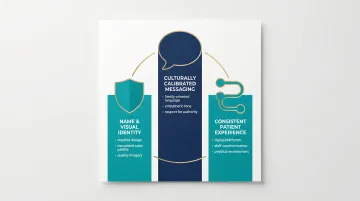
A healthcare brand identity that succeeds in Vietnam requires three integrated elements:
1. Name and Visual Identity That Convey Trust
- Professional, credible name selection
- Clean, modern visual design
- Consistent color palette and typography
- Quality photography and imagery
- Physical spaces that reflect brand values
2. Messaging Calibrated to Local Cultural Values
- Community and family-oriented language
- Respect for authority and expertise
- Recognition of progress and innovation
- Empathetic, warm tone
- Clear, accessible communication
3. Consistent Patient Experience Across All Touchpoints
- Signage and wayfinding
- Website and digital platforms
- Social media content
- Staff communication and service delivery
- Physical environment design
Tone of Voice: Empathy Over Clinical Distance
Clinical, cold messaging alienates Vietnamese patients — warm, community-oriented communication is what builds genuine trust.
Brands should use the language of care and relationship, not just competence. This means:
- Addressing family concerns, not just patient needs
- Using inclusive pronouns ("we," "our community")
- Showing respect for life experience
- Avoiding medical jargon or explaining it clearly
- Emphasizing long-term partnership over transactional service
The Vantage Branding Standard
Vantage Branding's work with healthcare organizations—including clients such as Allium Healthcare and ThoughtFull—demonstrates how brand strategy rooted in patient psychology and cultural context produces identities that earn lasting loyalty.
For Allium Healthcare, the brand emphasized personalized care through messaging like "Seeing you for a lifetime of experience," reflecting individual dignity and life history. For ThoughtFull, the positioning "Simplifying mental health for your growth" reframed mental health as a positive growth opportunity rather than clinical intervention—reducing stigma across Southeast Asian markets.
Vietnam's healthcare brands that invest in this kind of culturally grounded strategy don't just look credible — they become the providers patients return to and recommend.
Frequently Asked Questions
Why is healthcare branding particularly important in Vietnam right now?
Vietnam's healthcare market is growing rapidly, with rising patient expectations and increasing private sector competition. Patients can now choose their provider, making brand differentiation essential for any healthcare organisation that wants to build loyalty and hold its market position.
How does cultural stigma affect healthcare branding strategy in Vietnam?
Stigma—especially around mental health and certain chronic conditions—requires brands to lead with normalisation and education before promoting services. Brand narrative and community communication become the primary patient acquisition tools, with trust-building content taking precedence over direct advertising.
What separates successful private healthcare brands in Vietnam from those that struggle?
Successful private healthcare brands deliver consistent patient experiences, maintain clear visual identities, and use proactive digital communication to earn the trust that public institutions receive by default. Brand experience and clinical quality must align at every touchpoint.
How should international healthcare brands enter the Vietnam market from a branding perspective?
International brands must localise messaging while preserving international quality signals, partner with locally trusted figures or institutions, and invest in patient education as part of the brand strategy. Cultural calibration goes beyond translation; it is what ultimately determines trust and market acceptance.
What role does digital marketing play in healthcare branding in Vietnam?
With 79.1 percent internet penetration and 73.3 percent social media usage, digital channels are critical for healthcare brands in Vietnam. Vietnamese providers use Facebook and other platforms for community building, destigmatisation content, and accessible first-contact experiences—not just promotional advertising—reflecting mobile-first behaviour and the central role social proof plays in building patient trust.