Introduction
Malaysia's education sector has become intensely competitive. With 384 private higher education institutions competing alongside public universities, international branch campuses, thousands of tuition centres, and growing ed-tech platforms, prospective students and parents face overwhelming choice.
Academic quality alone no longer guarantees enrolment—institutions must differentiate in a market where 13 private institutions compete for every million people, more than double the density of Singapore and Taiwan.
Branding has become the differentiator that separates thriving institutions from those struggling to fill seats. What follows is a practical guide to education branding strategies tailored to Malaysia's multicultural, multi-segment landscape—covering what institutions of all sizes can do to build a brand that earns trust and drives sustainable enrolment growth.
TLDR
- Malaysian education brands must speak to a multilingual audience—Malay, Chinese, Tamil, and international segments each respond to different brand signals
- Strong education brands combine clear positioning, consistent visual identity, and messaging that resonates with both students and parents
- TikTok, YouTube, Facebook, and education listing platforms are where Malaysian students discover and evaluate schools—digital presence is essential
- Branding is an ongoing investment requiring consistent implementation, not a one-time logo exercise
Why Branding Matters for Malaysian Education Institutions
Market Saturation and Institutional Decline
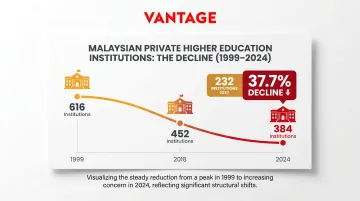
Malaysia's private education sector has undergone dramatic consolidation. The number of private higher education institutions has fallen from a peak of 616 in 1999 to just 384 in 2024—a loss of 232 institutions. This 37.7% decline signals that undifferentiated institutions are being eliminated by market forces. Recent years have accelerated this trend, with 68 institutions disappearing between 2018 and 2024 alone.
The survivors face intense pressure. Private institutions enrolled 558,692 students in 2023, representing 44.8% of total higher education enrolment, but demographic decline, increased public university places, and rising living costs are eroding the traditional student pool. For many institutions, international recruitment—particularly from China—has become a financial lifeline.
Branding Directly Influences Enrolment Decisions
Research confirms that Malaysian students evaluate institutions through multiple lenses beyond academics. A study of 200 Malaysian students identified four primary decision factors:
- Campus characteristics
- Academic quality
- Financial considerations
- External reputation and employer perception
Brand perception shapes all four factors. Visual identity signals campus quality before a prospective student steps on campus; messaging communicates academic credibility; and reputation—built through consistent brand execution—determines whether parents trust their investment and whether employers value the credential.
The High Cost of Brand Weakness
Malaysian private institutions commonly spend 10-20% of revenue on marketing activities, yet many struggle with enrolment. This gap points to one core problem: marketing spend without brand strategy is waste. When every institution makes the same claims—"world-class education," "industry-relevant curriculum," "holistic development"—they become interchangeable in prospective students' minds. The only differentiator left is price, which no institution can win sustainably.
Institutions that invest in brand strategy hold a durable advantage: they attract students on the strength of a distinct identity, not just a lower fee.
Understanding Malaysia's Unique Education Landscape
The Multicultural Brand Challenge
Malaysia's education system reflects deep cultural and linguistic diversity. The country operates:
- Malay-medium national schools
- 60 independent Chinese secondary schools enrolling 79,033 students who follow Mandarin-medium curriculum
- Tamil national-type schools (SJKT)
- International schools serving diverse expatriate and local communities
- Universities attracting students across all ethnic backgrounds
This creates a branding paradox: a single monolithic message rarely works. Chinese-Malaysian families evaluating independent schools operate within different cultural frameworks than Malay families choosing national universities. International students from China prioritise different signals than those from Bangladesh or Indonesia.
Effective education brands must address language, cultural values, and community-specific expectations—often running parallel messaging strategies rather than relying on simple translation.
The Parent-Student Dual Audience
In Malaysia, parents—particularly in Chinese and Indian communities—play decisive roles in education decisions. The Unified Examinations Certificate (UEC) from Chinese independent schools is not accepted at Malaysian public universities, creating a natural pipeline toward private institutions. These families evaluate options through both student aspiration and parental assurance lenses.
An effective education brand must at the same time:
- Build trust with parents through stability signals, outcome data, career prospects, and community reputation
- Engage students directly through identity alignment, peer community, campus experience, and personal growth narratives
Brands that speak only to students' lifestyle aspirations while neglecting parental trust signals frequently lose enrolments at the final decision stage.
Malaysia as Regional Education Hub
This domestic complexity is only part of the challenge. The Malaysian government actively promotes the country as an international student destination through Education Malaysia Global Services (EMGS), and total international enrolment reached 104,315 students in 2023, with private institutions capturing 60,363 of these.
The most dramatic growth comes from China. Chinese student enrolment exploded from 2,382 in 2013 to 56,198 in 2024—a 23-fold increase representing 41% of all foreign students and generating an estimated RM1.2 billion in annual fee income.
QS forecasts 8.5% growth in international student numbers by 2030. Yet institutions still face a perception gap against the "Big Four" destinations (US, UK, Australia, Canada). Competing for international students means projecting global credibility without losing the local authenticity that differentiates Malaysian institutions in the first place.
Key Pillars of an Effective Education Brand Strategy in Malaysia
Brand Positioning: Define Your Category and Your Promise
Before designing a logo or launching a campaign, education institutions must define their positioning—what they are, who they serve, and why they differ meaningfully from alternatives.
Common positioning axes in Malaysian private education:
- Academic prestige and rankings (Taylor's: #253 globally, #1 private university in Southeast Asia)
- Purpose-driven education (Taylor's "meaningful impact" narrative)
- Sustainability and values (Sunway's not-for-profit SDG focus)
- Technology integration (APU: "Malaysia's best technology university")
- Applied knowledge and industry connection (UCSI's "Praxis University")
- Affordability and accessibility
- Career outcomes and employability (APU's "100% Employed by Graduation" claim)
- International pathways (dual degree programmes, branch campus partnerships)
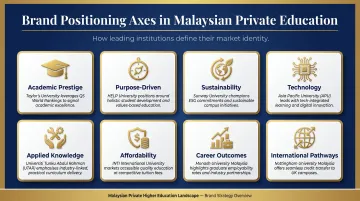
The top five Malaysian private universities have carved out distinguishable positions. Taylor's stakes purpose, Sunway sustainability, APU technology, UCSI praxis, HELP personal significance. But the remaining 379 institutions largely compete without comparable differentiation.
Example: A mid-tier private university cannot credibly position as "world-class" when competing against Taylor's global ranking. But it could own a specific niche—perhaps "Malaysia's leading hospitality management university" or "the STEM university for underrepresented communities"—creating a niche it can credibly own.
Brand Messaging: Speaking to a Multilingual Audience
Malaysian education brands often need to communicate in multiple languages—Bahasa Malaysia, Mandarin, Tamil, and English. Translation alone is insufficient. Brand messaging must be culturally adapted so that tone, values references, and emotional appeals resonate authentically.
Consider cultural messaging differences:
- Malay-Muslim families may respond to values messaging around community contribution, stability, and alignment with national development goals
- Chinese-Malaysian families often prioritise academic reputation, career outcomes, and pragmatic return on investment
- International Chinese students prioritise graduate employment rates (60%) and safety (62%) above all other factors
Across all segments, effective messaging balances student aspiration with parental assurance. Students seek identity and belonging; parents control financial decisions. Both need to feel heard.
Brand Architecture: Managing Multiple Offerings
Many Malaysian institutions have multiple programmes, faculties, or campuses under one umbrella. Clear brand architecture determines how these elements relate:
Three common models:
- Monolithic brand — all programmes share one master brand (e.g., "Sunway University" across all faculties)
- Endorsed brand — sub-brands endorsed by master brand (e.g., "Taylor's School of Hospitality, Tourism & Culinary Arts")
- House of brands — separate brands for different offerings (less common in education)
Without clear architecture, institutions risk brand fragmentation—where different programmes communicate inconsistent identities, confusing prospective students and diluting brand equity.
Once the structural architecture is clear, institutions are better positioned to build the one thing no organogram can manufacture: a compelling story.
Brand Story and Institutional Narrative
An institution with a compelling founding story, clear mission, or notable alumni builds emotional resonance that functional claims ("98% employment rate") cannot achieve alone. Heritage and narrative are often what convert a shortlisted option into a first choice.
Effective institutional narratives include:
- Founding purpose — why the institution was created and what problem it solved
- Mission evolution — how the institution has adapted to serve changing student needs
- Notable alumni — proof that the education transforms lives and careers
- Community impact — how the institution contributes beyond credential delivery
These narratives must be deployed across all communications—from website about pages to admissions officer talking points to campus signage.
Visual Identity: Designing a Brand Students and Parents Trust
First Impressions Are Made Before a Campus Visit
Visual identity is often the first touchpoint prospective students and parents encounter—on a banner, social media ad, or university portal. They make instant judgements about quality and legitimacy based on what they see.
Research from Sunway University reveals a critical insight: lesser-known brands benefit significantly from unconventional visual design through perceived novelty, while established brands benefit more from designs that align with audience expectations. For mid-tier Malaysian institutions competing against top universities, visual distinctiveness can create competitive advantage.
Core Components of Education Brand Visual Identity
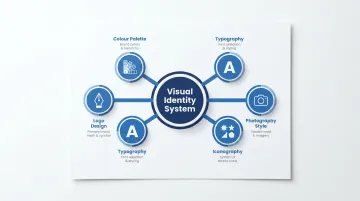
A visual identity system typically spans five elements:
- Logo design — the iconic symbol representing the institution
- Colour palette — colours communicate culturally: green signals growth and Islamic alignment, blue trust, red Chinese cultural resonance
- Typography — fonts that reflect institutional personality (traditional serif vs. modern sans-serif)
- Iconography — supporting visual elements and graphic devices
- Photography style — guidelines for authentic student imagery versus stock photos
Consistency Across All Brand Touchpoints
Inconsistency erodes trust and makes institutions appear less established—particularly damaging when competing against prominent universities.
Every touchpoint shapes perception:
- Prospectuses and printed materials
- Website and student portal
- Open day booths and exhibition displays
- Outdoor signage and wayfinding
- Staff uniforms and ID cards
- Social media profiles and advertising
- Merchandise and graduation materials
Vantage Branding works with institutions across Singapore and Malaysia on brand strategy and visual identity systems — from initial positioning through to implementation across all touchpoints.
Digital Channels and Content Strategy for Malaysian Education Audiences
Where Malaysian Students Discover Education Brands
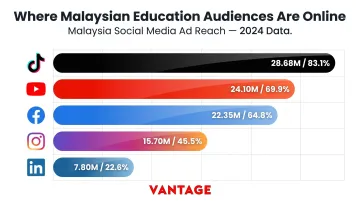
Malaysia has 28.68 million active social media user identities (83.1% of population), with near-universal digital penetration creating unprecedented reach opportunities. DataReportal data from February 2024 reveals platform-specific reach:
| Platform | Ad Reach | % of Population |
|---|---|---|
| TikTok (18+) | 28.68 million | 83.1% |
| YouTube | 24.10 million | 69.9% |
| 22.35 million | 64.8% | |
| 15.70 million | 45.5% | |
| 7.80 million | 22.6% |
Key channel insights:
- Facebook remains dominant in parent demographics (64.8% reach) despite younger platforms' growth
- Instagram skews female (56%), potentially more effective for reaching mothers
- TikTok and YouTube have near-universal reach across student and parent segments
- Chinese international students use WeChat (72%), Weibo (42%), and Instagram (41%) for research
Beyond social platforms, education listing sites like EduAdvisor, Afterschool.my, EasyUni Malaysia, and StudyMalaysia.com serve as critical discovery points where students compare options and read reviews.
Content Marketing as Brand Building
Content types that build education brand equity:
- Student success stories — authentic testimonials showing transformation
- Faculty spotlights — demonstrating academic credibility and expertise
- Campus life content — helping students visualise belonging
- Outcome data — employment rates, salary ranges, alumni career paths
- Behind-the-scenes — admissions process transparency builds trust
In Malaysia's context, content in multiple languages—particularly Mandarin and Bahasa Malaysia alongside English—significantly expands reach and cultural resonance.
Search Visibility and Reputation Management
That content also needs to be found. Prospective students and parents actively search for reviews, comparison articles, and rankings — and how an institution appears on third-party platforms directly shapes first impressions. Managing this digital reputation is not a side task; it is part of the brand itself.
This includes:
- Monitoring and responding to reviews
- Ensuring consistent NAP (name, address, phone) data across listings
- Creating comparison content that positions the institution favourably
- Building authority through thought leadership and media presence
Common Education Branding Mistakes Malaysian Institutions Make
Generic Positioning and Identical Claims
Many Malaysian institutions fall into the trap of making identical claims—"excellent academics," "holistic development," "industry-relevant curriculum"—without specific, ownable differentiation. This makes institutions interchangeable in the minds of students and parents, forcing competition solely on price.
How to identify genuinely distinct positioning:
- Does your positioning claim apply equally to competitors? (If yes, it's not distinctive)
- Can you defend this positioning with specific proof points competitors cannot match?
- Would removing your institution's name from the claim make it unattributable?
Treating Branding as a One-Time Visual Exercise
Some institutions invest in logo redesigns or website updates but neglect the brand strategy that should underpin them—then wonder why enrolment doesn't improve. Branding is an ongoing strategy requiring:
- Consistent implementation across all touchpoints
- Periodic refresh as the market evolves
- Alignment across every staff interaction (admissions officers, lecturers, support staff)
- Measurement and refinement based on brand perception data
The 232 institutions that disappeared between 1999 and 2024 likely failed not from lack of marketing spend, but from absence of strategic brand differentiation.
Ignoring the Parent Audience
Malaysian parents—especially in Chinese and Indian communities—are often the primary decision-makers in education choices, not just passive observers. Institutions that market exclusively to students frequently lose enrolments at the final stage, when parents aren't convinced.
Building parent trust means addressing different concerns than those of students:
- Quality signals: accreditation, graduate outcomes, industry partnerships
- Assurance: financial stability, pastoral care, safety on campus
- Community fit: values alignment, cultural sensitivity, peer network
Effective brands run both tracks in parallel: student-facing channels emphasise aspiration, while parent-facing channels emphasise assurance.
Frequently Asked Questions
How much does branding design cost in Malaysia?
Branding costs in Malaysia range from basic logo packages (RM3,000–5,000) by freelancers to full brand strategy and identity programmes (RM35,000+) by agencies. Look for transparent pricing and a clear strategic process — branding directly affects enrolment revenue and compounds over time.
What is the difference between a university's marketing and its brand?
Marketing drives short-term awareness and enrolment campaigns, while branding is the long-term strategic foundation—the identity, values, and reputation—that makes marketing more effective and ensures the institution is remembered and trusted over time.
How long does it take to build a strong education brand in Malaysia?
Brand recognition and trust typically take two to four years of consistent implementation to establish. However, institutions can begin seeing improvements in perception and enrolment once a clear strategy, visual identity, and messaging are deployed across key channels.
Do Malaysian education brands need to communicate in multiple languages?
Communicating in English alone limits reach in Malaysia. Institutions targeting Chinese-background families benefit from Mandarin touchpoints, and reaching Malay communities requires Bahasa Malaysia content — the right mix depends on your target segment.
How can a small tuition centre or private school build a brand on a limited budget?
Small institutions should start with brand clarity—defining their positioning and target audience—then invest in a few high-impact touchpoints: a professional logo, consistent social media presence, and genuine student/parent testimonials. Doing three things well consistently outperforms spreading a tight budget across every channel.
Why is branding especially important for private education institutions in Malaysia?
Private institutions cannot rely on government reputation or public university prestige. Branding becomes their primary tool to signal quality, earn the trust of cost-conscious families, and compete against both local public universities and international branch campuses.