Introduction
You've built brand equity — now you want to grow. The question is how far to push it. Pick the wrong path and you don't just miss an opportunity; you risk eroding the trust it took years to build.
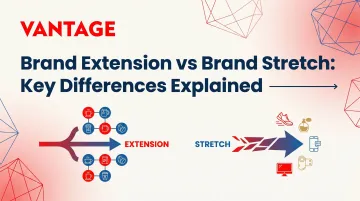
Brand extension and brand stretch are often used interchangeably, but they describe very different moves. One expands into adjacent territory where your credibility transfers naturally. The other crosses category lines, asking consumers to follow you somewhere entirely new.
This article clarifies what separates these strategies, examines real wins and failures, and helps you decide which path fits your brand's strength and ambitions.
TL;DR
- Brand extension launches new products in related categories with lower risk and natural consumer acceptance
- Brand stretch enters distant or unrelated categories, carrying higher risk but capable of reshaping—or damaging—brand meaning
- Success hinges on "brand permission"—whether consumers believe your brand belongs in the new space
- Extensions reinforce existing identity; stretches can elevate or dangerously dilute it
- Your choice hinges on brand equity strength, category fit, and distance from your core
What is Brand Extension?
Brand extension uses an established brand name to introduce new products within the same or adjacent category. The new offering doesn't break consumers' mental model of what the brand represents—it expands it logically.
Two primary types define this strategy:
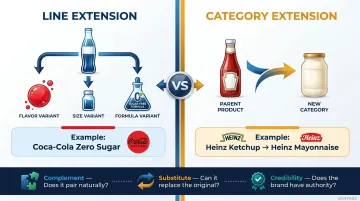
Line Extensions introduce new variants of existing products—different flavours, sizes, or formulations. Think Coca-Cola Zero Sugar or Heinz Tomato Ketchup in squeeze bottles versus glass bottles.
Category Extensions enter new but related product categories where the brand's core associations remain credible. When Heinz moved from ketchup to mayonnaise, consumers understood the logic: both are condiments, both require quality ingredients, both sit on the same shelf.
The foundation of successful extension is extendable equity—the brand must already own associations (quality, trust, specific functional benefits) that transfer naturally to the new category.
Research published in the Journal of Marketing identifies three dimensions that predict consumer acceptance: whether products complement each other, whether they substitute in similar usage contexts, and whether consumers believe the company can credibly make the new product.
Key Advantages
- Existing brand recognition lowers consumer scepticism, reducing launch risk from day one
- The brand equity halo cuts advertising spend needed to build awareness and credibility
- Retailers are significantly more willing to stock new products carrying established names with proven demand
- Consumers who already trust the parent brand try extensions faster, accelerating market penetration
The core risk remains cannibalisation—when the extension steals sales from existing products rather than expanding total category consumption—and identity dilution when extensions feel like "me too" moves rather than meaningful additions. Both risks grow sharper the further the extension moves from the parent brand's core territory—which is where brand stretch begins.
Use Cases of Brand Extension
Brand extension works best when a company with a clearly defined brand promise seeks to capture a wider share of its current consumer base or serve the same consumer in different consumption moments.
Successful Extension: Starbucks Bottled Frappuccino
Starbucks and PepsiCo formed the North American Coffee Partnership in 1994, launching bottled Frappuccino in 1996. By 2012, annual Frappuccino sales exceeded $2 billion, with the line expanding to 19 flavoured variants.
Why it worked:
- Strong perceived fit — Starbucks owned coffee expertise, and bottled coffee was a natural extension
- Same brand lifestyle promise — premium quality and café experience translated to ready-to-drink format
- Distribution partnership — PepsiCo's retail network placed Starbucks in channels where the coffeehouse brand had zero presence
- Same target audience — existing Starbucks loyalists encountered the brand in new consumption moments (grocery shops, petrol stations)
Failed Extension: Crystal Pepsi
Created by David Novak (later CEO of Yum Brands), Crystal Pepsi tested in 1992 and launched nationally in 1993. It peaked at 0.5% market share versus a 2% target and was discontinued by year's end.
Why it failed:
- Consumers held century-old associations between cola flavour and dark brown liquid — the clear appearance triggered immediate cognitive dissonance
- Pepsi offered no compelling reason for the atypical appearance, leaving shoppers with no frame of reference
- Coca-Cola launched Tab Clear as a direct spoiler product, further muddying the emerging clear cola category
The lesson: extensions must honour the sensory associations that underpin a brand's promise. When the product experience contradicts what consumers have been trained to expect, no amount of distribution or marketing spend can bridge that gap.
What is Brand Stretch
Brand stretch takes an established brand into categories meaningfully different from—or entirely unrelated to—the original product territory. The brand name becomes the bridge, but the product category is unfamiliar ground.
Companies pursue brand stretching to access new consumer segments, diversify revenue streams, and evolve from product brands into lifestyle or platform brands. Successful stretches require the brand to stand for a value system or emotional territory, not just a product attribute.
Brand Permission: The Make-or-Break Factor
Brand permission measures the degree to which consumers believe your brand has the right and credibility to operate in a new space. Permission is earned through strong associations, values alignment, and deep trust—not just awareness.
A beverage brand can't stretch into athletic footwear simply because it sponsors athletes. Red Bull succeeded in extreme sports media not because it sold energy drinks, but because its brand identity centered on human potential, adrenaline, and pushing limits—a foundation strong enough to credibly enter entirely new categories.
The Risk Spectrum
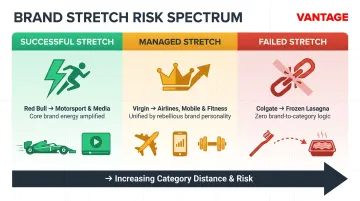
The outcome of a brand stretch depends almost entirely on whether the brand's core identity can anchor the new category:
- Successful: Red Bull's expansion into motorsport, aviation events, and content creation transformed it from a functional beverage into a lifestyle platform—reinvesting 25-30% of annual revenue to maintain coherence.
- Failed: When Colgate launched frozen beef lasagna in 1982, the toothpaste association made the food product repellent and reportedly damaged core toothpaste sales.
- Managed: Virgin uses a consistent brand name across airlines, mobile, and fitness, unified by "challenger spirit" rather than any shared product attribute.
Brand architecture decisions—sub-branding, endorser branding, or stand-alone branding—help manage risk when category distance is significant. Choosing the right structure before stretching can mean the difference between expanding brand equity and eroding it.
Use Cases of Brand Stretch
Brand stretch works when a brand stands for something beyond its product — a lifestyle, ethos, or emotional territory. It requires consumers to already associate the brand with values that feel relevant in the new category. Two cases show exactly what that means in practice: one that got it right, and one that didn't.
Successful Stretch: Red Bull Media Empire
Red Bull expanded from energy drinks into extreme sports events, media production, motorsport teams, and aviation competitions. The brand operates Red Bull Media House (a full media company with 20+ owned platforms), Red Bull Racing (Formula 1), and produced the 2012 Stratos space jump that generated approximately 1 billion video views globally.
Why it worked:
- The brand stood for human potential and adrenaline — not beverage attributes — making the leap to media and sport feel natural
- Extreme sports and high performance aligned directly with what consumers already believed Red Bull represented
- Reinvesting 25-30% of revenue into content and events sustained brand coherence across every new category
- Proprietary events and media properties created genuine category leadership, not just visibility
Failed Stretch: Colgate Kitchen Entrees
In 1982, Colgate-Palmolive launched Colgate Kitchen Entrees, including beef lasagna. The product was inducted into Sweden's Museum of Failure in 2017.
Why it failed:
- Consumers couldn't mentally separate the Colgate name from toothpaste — the minty association followed the brand into the food aisle
- The frozen food venture damaged Colgate toothpaste sales through negative spillover
- There was no perceived permission: no logical reason for a dental hygiene brand to produce meals
Research analysing nearly 20,000 product launches between 2000 and 2012 uses Colgate Kitchen Entrees as the paradigmatic case of "odd fit" destroying brand credibility and harming the parent.
Brand Extension vs Brand Stretch: Key Differences at a Glance
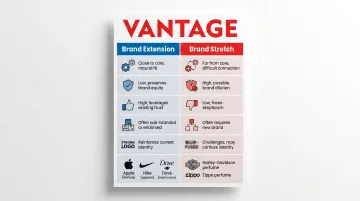
The primary difference is category distance. Brand extension stays near the brand's existing territory; brand stretch leaps across category boundaries. With an extension, consumers already have a reference point. With a stretch, they're being asked to trust the brand somewhere entirely unfamiliar.
Three dimensions set them apart in practice:
- Risk: Extensions carry lower inherent risk — consumer expectations are partially met. Stretches ask consumers to transfer trust into unfamiliar territory with no pre-existing reference points.
- Brand identity: Extensions reinforce the parent brand's positioning by demonstrating depth within a familiar domain. Stretches can elevate brand meaning when successful, but introduce confusion when they miss.
- Execution: Extensions draw on existing channels, retailer relationships, and operational capabilities. Stretches typically require new go-to-market approaches, new partnerships, and fresh proof points — certifications, design signals, expert endorsement — to establish credibility.
The table below captures how these differences play out across six key dimensions.
Side-by-Side Comparison
| Dimension | Brand Extension | Brand Stretch |
|---|---|---|
| Category distance | Adjacent/related (ketchup to mayonnaise) | Distant/unrelated (energy drink to F1 racing) |
| Risk to parent brand | Moderate—failure unlikely to damage core | High—failure can cause negative spillover |
| Consumer acceptance | Higher when perceived fit is strong | Requires abstract brand values, not product attributes |
| Brand architecture | Often uses parent brand name directly | May require sub-brands or endorsed architecture |
| Brand identity impact | Reinforces existing meaning | Redefines or elevates brand meaning |
| Success examples | Starbucks Frappuccino | Red Bull Media House |
| Failure examples | Crystal Pepsi | Colgate Kitchen Entrees |
Real-World Examples: When It Works and When It Doesn't
Two contrasting stories illustrate what separates success from failure.
Extension Success vs Failure
Starbucks bottled Frappuccino succeeded because coffee expertise transferred naturally to a ready-to-drink format — consumers said "of course." Crystal Pepsi is the opposite story: its clear appearance violated every sensory expectation of cola, and consumers couldn't reconcile the two.
The difference wasn't category proximity alone. Both were beverages. The critical factor was whether the extension honoured established brand associations or violated them. Starbucks reinforced its coffee expertise; Crystal Pepsi contradicted cola's sensory identity.
Stretch Success vs Failure
Red Bull built a media empire because the brand stood for human potential and adrenaline — values that carry across extreme sports, aviation, and content creation without losing coherence. Colgate Kitchen Entrees is the cautionary counterpoint: toothpaste associations don't disappear at the dinner table, and consumers never got past the mental conflict.
Successful stretches anchor deeply in core values. Failures try to leverage brand awareness without brand fit — assuming recognition equals permission.
The unifying lesson: consumer-perceived fit predicts success. One diagnostic question cuts through the noise — does the new product make the brand feel more complete, or more confused? That question, answered honestly before launch, is what separates a calculated move from a costly misstep. Vantage Branding's brand strategy work helps clients in Singapore and across Asia work through exactly this kind of decision before committing resources to either path.
How to Decide: Brand Extension or Brand Stretch?
Before choosing a growth strategy, answer three diagnostic questions:
1. What associations do consumers currently hold about your brand—are they product-specific or value/lifestyle-based?
If consumers associate your brand primarily with product attributes (Starbucks = coffee), extension into related categories works well. If they associate it with broader values (Red Bull = human potential), stretch becomes viable.
2. How far is the new category from your core—do existing consumers already associate your brand with this space, even loosely?
Natural adjacency creates permission. Starbucks in bottled coffee feels logical. Colgate in frozen food feels absurd. Research shows that perceived fit (beta = 0.781) influences customer behaviour toward extended brands far more than parent brand equity alone (beta = 0.153).
3. What proof points would you need to make the new product credible—and does your brand already have those, or would you need to build them from scratch?
If your brand already owns the necessary associations, extend. If you'd need to build credibility through sub-branding, partnerships, or certifications, you're contemplating a stretch. Plan for that investment before committing to the category.
Situational Guidance
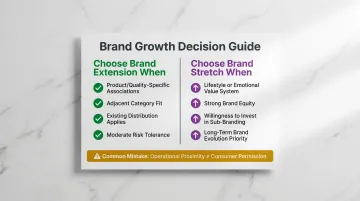
Choose brand extension when:
- Your brand's associations are product- or quality-specific
- The new category is adjacent enough that consumer logic transfers naturally
- Existing distribution channels and retailer relationships apply
- Risk tolerance is moderate and speed to market matters
Choose brand stretch when:
- Your brand already stands for a broader lifestyle or emotional value system
- You have strong brand equity to carry the category leap
- You're willing to invest in sub-branding or proof points to close the credibility gap
- Long-term brand evolution is more important than short-term ROI
The Most Common Mistake
Don't confuse operational proximity (your company can make the product) with consumer permission (your audience believes you should). Colgate could manufacture frozen food. Consumers still rejected it. The decision must be driven by what consumers think and feel, not what internal teams are capable of executing.
One analysis found that approximately 80% of brand extensions from consumer goods companies fail, with failure rates climbing as category distance increases. Before launching, validate your assumptions with real consumers—not just internal teams who are too close to the product to see the credibility gaps.
Frequently Asked Questions
What is the difference between brand extension and brand stretch?
Brand extension expands into related or adjacent categories where the brand's existing associations transfer naturally. Brand stretch enters new, often unrelated categories requiring consumers to grant permission based on values rather than product attributes. The key distinction is category distance from the brand's original territory and the level of consumer permission required.
What does brand extension mean?
Brand extension uses an established brand name to launch new products in the same or closely related category. It leverages existing equity to reduce launch risk and enter adjacent markets more efficiently than building a new brand from scratch.
What are the two types of brand extensions?
There are two primary types. Line extensions introduce new variants — new flavours, sizes, or formulations — within the same category. Category extensions move into a related but distinct category under the same brand name, expanding reach while maintaining perceived fit with the parent brand's core associations.
What are the biggest risks of brand stretching?
Brand dilution weakens clarity about what the brand stands for when category distance is too great. Consumer confusion occurs if the new category doesn't align with brand expectations. Negative spillover can damage the core brand's reputation when failed stretches create embarrassing associations or sensory mismatches that transfer back to the parent product.
How do you know if your brand has permission to enter a new category?
Brand permission is determined through consumer research: whether target audiences associate the brand's values and equity with the new space. It's tested through association transfer studies and qualitative research into how consumers mentally categorise the brand — not through internal assumptions about what the brand could theoretically do.