The brands consumers remember aren't just seen. Research shows that emotionally engaging brand experiences are 4x more impactful in building long-term brand equity than those relying on visual elements alone. As digital noise saturates consumer attention, brands that activate multiple senses create differentiated experiences that are harder to replicate and easier to recall.
This article breaks down exactly how multisensory branding works, what each sense contributes to brand perception, and how businesses can build it into their strategy deliberately and consistently.
TL;DR
- Multisensory branding engages sight, sound, touch, smell, and taste to shape brand perception and memory—going beyond logos and visual identity
- Each sense triggers distinct psychological responses: scent connects directly to memory, sound sets emotional tone, touch signals quality, and sight anchors recognition
- Brands activating multiple senses create stronger emotional connections and higher recall than single-channel approaches
- A multisensory strategy starts with core brand identity, then maps consistent sensory cues across every customer touchpoint
- Singapore Airlines, Lush, and BMW show how deliberate sensory design becomes a measurable competitive advantage
What Is Multisensory Branding?
Multisensory branding is the deliberate practice of engaging more than one human sense—sight, sound, touch, smell, and taste—to shape brand perception, memory, and emotional response. It extends brand identity beyond visual elements like logos and colour palettes into auditory, tactile, olfactory, and gustatory dimensions.
That distinction matters, because multisensory branding is not about layering random stimuli onto a campaign. It differs from experiential marketing in a specific way: experiential is an execution format (events, activations), while multisensory branding is a strategic identity layer that defines how a brand should consistently feel, sound, and smell across every touchpoint. The two can work together, but they serve different functions.
Visual advertising saturation has reached a tipping point. Sonic branding elements appear in fewer than 10% of ads, despite audio assets outperforming visual-only content in brand recall. Brands that engage additional senses create differentiated experiences that are harder to replicate—and far more memorable for consumers navigating crowded markets.
The Psychology Behind Multisensory Branding
Engaging multiple senses simultaneously activates more areas of the brain, intensifying emotional impact and strengthening memory encoding. The mechanism is well-documented in neuroscience.
The neurological advantage: When sensory inputs converge, the brain processes brand information through multiple pathways. Research indicates scent and sound are processed directly in the limbic system—the brain's emotional and memory centre—bypassing conscious thought. A brand scent or sonic logo triggers emotion and recognition before consumers process the brand name cognitively.
Why scent is uniquely powerful: Unlike all other senses, olfactory information bypasses the thalamus (the brain's relay station for conscious attention) and connects directly to the limbic system. This direct anatomical pathway gives scent an outsized influence on mood and memory formation that other sensory channels simply don't have.
Studies show olfactory memory is remarkably durable: accuracy drops sharply after 30 seconds but then holds stable for months, even years.
How consistency builds trust: When consumers encounter the same sensory cues repeatedly across touchpoints—in-store, online, in packaging—it creates familiarity and reliability that deepens brand loyalty. Research on sensory brand experience confirms that consistent multisensory cues across touchpoints positively mediate the path from brand experience to brand loyalty.
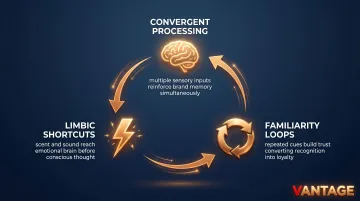
Taken together, three psychological mechanisms drive this effect:
- Convergent processing — multiple sensory inputs reinforce the same brand memory simultaneously
- Limbic shortcuts — scent and sound reach the emotional brain before conscious cognition engages
- Familiarity loops — repeated cross-touchpoint cues build the trust that converts recognition into loyalty
The Five Senses and Their Role in Brand Experience
Most brands leverage only one or two senses, leaving significant brand-building potential untapped. Each sense contributes differently to brand perception—here's how.
Sight: The Foundation, Not the Finish Line
Visual identity remains the entry point of brand recognition, but in multisensory branding, it serves as the anchor around which all other sensory elements are built.
Colour psychology and spatial design communicate brand values before customers interact with products. Apple's minimalist store design exemplifies this: powered-on devices arranged on open tables eliminate physical barriers between employees and customers, proving "it just works" before purchase.
Ron Johnson, former SVP of Apple Retail, described stores as experiences designed to "enrich lives," not merely distribute products. Placing stores in premium locations like Grand Central Station turned them into 3D billboards for the brand itself.
Colour choices influence perception, though not as universally as once believed. The widely cited "80% brand recognition" statistic has been debunked—it originated from a study about colour improving document readability, not brand recall. Effective colour strategy depends on brand alignment and audience data, not generic percentages.
Sound: The Underused Brand Signature
Sonic branding—from ambient music to recognisable audio logos—sets emotional tone and triggers instant recognition.
Engineered sounds as brand identity: Netflix's "ta-dum" sound took one year to create, with sound designer Lon Bender producing 20-30 options. The final three-second signature was selected by VP Todd Yellin's 10-year-old daughter from a shortlist of five.
Yellin wanted a sound signalling "entertainment" rather than "technology," using descriptors like "tension," "release," and "quirky." Focus groups associated the final choice with "dramatic," "interesting," and "movie."
Even product sounds matter: a car door closing, a keyboard tap—these are brand decisions.
Real-world application: Starbucks curates unique playlists for each store, partnering with Spotify to extend the brand experience beyond physical locations. Music creates "intuitive associations" rather than functioning as background noise.
Touch: How Texture Communicates Quality
Tactile elements—packaging weight, material finishes, in-store display textures—influence perceived brand quality before products are even tried.
Academic research confirms that touch significantly improves evaluation of luxury branded products through a mechanism called "brand contagion"—a perceived transfer of "luxury essence" to the consumer through physical contact. The effect holds regardless of brand familiarity or individual preference for touch.
Example: Luxury cosmetics brands use heavy, matte packaging with pharmaceutical-grade amber glass bottles (like Aesop), while budget brands opt for lightweight plastic. The weight and material communicate quality hierarchies before consumers read ingredient lists.
Smell: The Most Direct Route to Memory
Scent is the most potent sensory tool for brand memory due to its direct limbic system connection.
Singapore Airlines—the benchmark: Since 1990, Singapore Airlines has infused Stefan Floridian Waters—a blend of rose, lavender, and citrus—across cabin air, hot towels, flight attendant uniforms, and premium linens. Passengers associate this olfactory signature with quality and comfort. In 2022, the airline introduced a second scent, Batik Flora, stating officially: "Scent has always been a key part of the Singapore Airlines experience."
The neuroscience: Olfactory memory research shows that scent memories lose only 3% accuracy after one year—far more durable than visual or verbal recall. Odours first activate emotion, then trigger memory reconstruction tied to specific places and times—which is precisely what makes scent such a reliable vehicle for long-term brand association.
Taste: Beyond Food and Beverage Brands
While native to hospitality and F&B, taste extends brand storytelling in unexpected contexts—branded refreshments at events, co-branded collaborations, in-house cafés.
IKEA's Swedish meatballs: IKEA sells over 1 billion meatballs annually. Former head of IKEA US food operations called them "the best sofa-seller." Founder Ingvar Kamprad worried customers left stores prematurely due to hunger. Cafeterias placed mid-store force customers to build appetite while shopping before taking a food break—research shows hungry shoppers spend 64% more than satiated ones.
The Swedish food offering reinforces cultural brand identity, transforming furniture shopping into an immersive brand experience.
How to Build a Multisensory Brand Strategy
Building a multisensory brand requires systematic planning. Follow these steps:
Step 1: Anchor in Brand Identity First
Define what the brand should make people feel and what values it embodies before choosing sensory elements. A brand built on calm and trust should select soft textures, muted soundscapes, and subtle scents that reinforce those qualities. Sensory choices must extend core positioning, not decorate it.
Step 2: Map the Full Customer Journey
List every customer interaction — first digital touchpoint, packaging arrival, in-store visit, post-purchase communication. Assess which senses are currently engaged and which are dormant. This audit reveals sensory opportunities.
Step 3: Design Consistent Sensory Cues and Document Them
Just as visual brand guides specify Pantone colours and type sizes, a multisensory brand system should specify:
- Sonic logos and approved audio signatures
- Scent profiles for physical environments
- Packaging material standards
- Texture guidelines for touchpoints
Documentation ensures sensory identity remains recognisable across channels and locations.
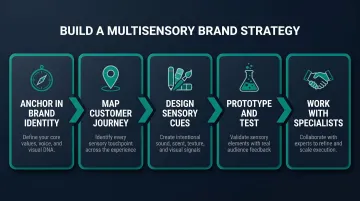
Step 4: Prototype and Test Before Scaling
Introduce sensory elements in controlled environments — a single store, limited product run, or pilot event. Measure consumer response: gather feedback on whether sensory cues feel aligned with brand perception and whether they improve dwell time, emotional engagement, or purchase intent.
Step 5: Work With Specialists in Integrated Brand Systems
Translating brand positioning into consistent sensory experiences requires specialist knowledge of how brand identity maps to physical and experiential touchpoints. A full-service branding agency like Vantage Branding can identify which sensory dimensions align with a brand's identity and chart them across the full customer journey. This goes beyond visual standards to include tone of voice, touchpoint specifications, and implementation guidance.
Real-World Examples of Multisensory Branding Done Right
Lush Cosmetics
Lush describes entering its shops as "a full sensory experience"—signature fragrances fill the air before customers enter (smell), abundant unpackaged product displays invite direct touch (touch), bright handcrafted visuals dominate the floor (sight), and active staff demonstrations create constant sound. Open-testing invites customers to try products directly — turning a retail visit into something worth talking about. Lush has deliberately withdrawn from social media to reinvest that budget into in-store sensory engagement instead.
BMW
BMW partnered with Academy Award-winning composer Hans Zimmer to develop the driving sound for electrified M models under BMW IconicSounds Electric. The sound shifts dynamically with driving mode and acceleration, giving real-time emotional feedback — framed as brand experience, not an engineering afterthought. Showroom environments reinforce this through lighting and material choices that communicate performance and luxury — every element a deliberate brand decision.
Singapore Airlines
Singapore Airlines has built one of the most consistent sensory identities in aviation. Its proprietary cabin scent appears across all passenger touchpoints, paired with curated in-flight music and tactile attention to seat materials. Together, these choices create a sensory signature that separates the brand from competitors at the same price tier — and have done so consistently for over 30 years.
Frequently Asked Questions
What is multisensory branding?
Multisensory branding is the strategic practice of engaging more than one human sense—sight, sound, touch, smell, and taste—to shape how consumers perceive, remember, and connect with a brand, extending identity beyond logos and visuals.
What are the 5 sensory branding elements?
Each sense plays a distinct role in building brand perception:
- Sight anchors recognition through visual identity
- Sound sets emotional tone via sonic logos and ambient audio
- Touch communicates quality through textures and materials
- Smell triggers memory through olfactory signatures
- Taste creates immersive experiences, particularly in hospitality and retail
How does multisensory branding improve brand recall?
Engaging multiple senses simultaneously activates more brain areas and deepens memory encoding. Consumers are more likely to remember and recognise brands when they encounter consistent sensory cues across different touchpoints, as multisensory integration intensifies emotional impact.
Can multisensory branding work for B2B or digital-first brands?
Yes—B2B brands can apply sensory branding through office environments, event experiences, and packaging design. Digital-first brands can use sonic logos, UI sound design, and tactile packaging to create sensory moments at key customer interactions, building recognition beyond visual channels.
What is the difference between multisensory branding and experiential marketing?
Multisensory branding is a strategic identity layer defining how a brand should consistently feel, sound, and smell across all touchpoints. Experiential marketing is an execution format—events, activations—that draws on that foundation. The two complement each other but serve different purposes.
How do you start building a multisensory brand strategy?
Begin with a sensory audit of your existing touchpoints, then map the customer journey to identify sensory gaps. Anchor every decision in your core brand identity, and introduce new elements incrementally — testing each before scaling across channels.