Introduction
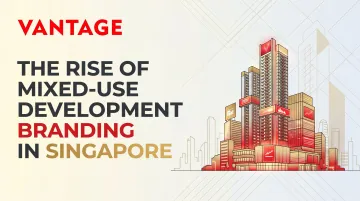
Singapore's skyline no longer tells a story of single-purpose towers. Walk through the Bugis-Ophir corridor, and DUO's honeycomb facades curve to create public gathering spaces between residential, office, and retail zones. Stand at Shenton Way, and bamboo-inspired gardens climb 63 storeys at the upcoming Skywaters.
Then there's Holland Village, where One Holland Village blends shophouse-inspired retail with three distinct residential brands under one master identity.
Each represents a new urban typology — living, working, retail, and leisure coexisting under one brand. Yet while developers invest heavily in architectural ambition, most underinvest in the branding that gives these spaces meaning, community attachment, and long-term value.
That gap is what this article addresses: why mixed-use branding has become a strategic priority in Singapore, what makes it complex, and what a strong brand identity for these developments actually requires.
TLDR:
- URA's CBD Incentive Scheme 2.0 (25–30% bonus GFA) is actively driving mixed-use conversion across Singapore
- One brand must span conflicting emotional registers: home, workplace, retail destination, and hospitality
- Strong mixed-use brands are built on an ownable place narrative grounded in location and heritage
- Early branding engagement — before architectural finalisation — produces more coherent identity systems
Why Mixed-Use Developments Are Reshaping Singapore's Urban Landscape
Policy Creates the Canvas
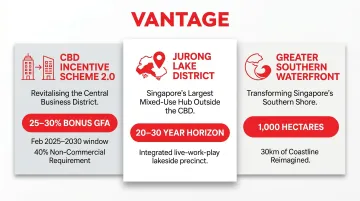
Singapore's Urban Redevelopment Authority (URA) has embedded mixed-use development into the city-state's DNA through three major planning initiatives:
CBD Incentive Scheme 2.0 (effective February 2025 to February 2030) offers developers 25-30% bonus gross floor area (GFA) for converting mono-use office buildings into mixed-use developments. To qualify, projects must include at least 40% non-commercial uses and a mandatory serviced apartment component—the goal being to transform Singapore's CBD into a "great city to live, work and play."
Jurong Lake District, designated as the largest mixed-use business district outside the city centre, spans four precincts with a 20-30 year development horizon for offices, housing, retail, hotel, and entertainment in a car-lite, park-like environment.
Greater Southern Waterfront unlocks approximately 1,000 hectares of land and 30km of coastline as port consolidation moves to Tuas—Singapore's largest single placemaking opportunity in history.
Why Singapore's Mixed-Use Landscape Is Distinctive
Three factors set Singapore apart from other Asian cities:
- Vertical density driven by land scarcity: The URA explicitly states Singapore's brownfield strategy makes development "possible through the redevelopment of previously developed areas." This constraint drives mixed-use development vertically, not laterally
- 24/7 city-living vision: Policy aligns with mixed-use convenience—live, work, shop, and play without leaving the development
- Multi-audience consumer base: Residents, expats, tourists, and business travellers create natural demand for developments serving multiple user groups simultaneously
Developer Ambition Has Shifted
Developers no longer just build structures—they create destinations with names, narratives, and community identities. EdgeProp reports approximately 20 private residential launches anticipated in 2026, with mixed-use and MRT-linked projects dominating the pipeline. Suburban projects are taking "centrestage" as infrastructure improvements shrink perceived distance, extending mixed-use demand beyond the CBD into heartland centres.
When projects occupy similar URA-zoned sites with comparable amenities, brand identity becomes the deciding factor for buyers, tenants, and investors alike.
The Branding Challenge That's Unique to Mixed-Use Developments
The Core Paradox: One Brand, Many Identities
A mixed-use development must simultaneously be:
- A home offering exclusivity and community for residents
- A workplace projecting prestige and productivity for office tenants
- A retail destination promising footfall and brand alignment for merchants
- A hospitality experience delivering a sense of place for hotel guests
Single-use branding (an office tower, a shopping mall) targets one clear audience. Mixed-use branding must work across radically different emotional registers while maintaining coherence.
Multi-Stakeholder Complexity in Detail
Each user group brings conflicting priorities:
- Residents seek privacy, security, and community belonging — they want to feel the development is theirs
- Office tenants prioritise corporate prestige and accessibility — the address needs to signal status to clients
- Retail brands require footfall, visibility, and demographic alignment — they need vibrant, discoverable spaces
- Hotel guests expect a sense of place and service excellence — the development must feel like a destination, not infrastructure
When each component is branded separately without an overarching identity, the development loses its ability to command a premium or build lasting loyalty. This is brand dilution across mixed uses — where fragmented messaging erodes the whole.
These competing demands make the foundational naming decision more consequential than most developers anticipate.
The Place-Naming Challenge
A development's name carries enormous weight. It must be:
- Distinctive enough to stand out in a crowded market
- Culturally resonant in Singapore's multilingual context (English, Mandarin, Malay, Tamil)
- Flexible enough to anchor multiple sub-brands (e.g., "DUO Residences," "DUO Galleria," "DUO Tower")
DUO's name elegantly captures duality — two towers, two nations (Malaysian-Singaporean joint venture), two functions. One Holland Village signals unified location ("One") while allowing sub-brands (Sereen, Leven, Quincy) to target different demographics within the master identity.
A name that works across all these layers is rarely arrived at quickly — it requires heritage research, neighbourhood character analysis, and multilingual testing that single-use projects simply don't demand.
The Extended Brand Lifecycle Challenge
Unlike a product launch, a mixed-use development brand must evolve through three distinct phases:
- Pre-launch: Build investor confidence and secure early buyer and tenant commitment before a single brick is laid
- Opening activation: Generate public discovery and media buzz at the moment of debut
- Long-term community management: Sustain relevance through ongoing programming, tenant curation, and brand governance — the phase that determines whether the development becomes a neighbourhood institution or fades into the background
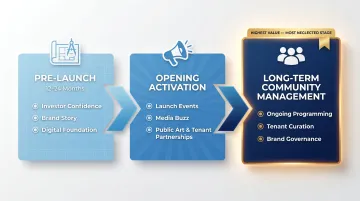
Most developers budget only for phases one and two. The third phase — where brand becomes embedded in community life — is often neglected, leaving long-term asset value unrealised.
The Building Blocks of a Strong Mixed-Use Development Brand
Start With a Singular, Ownable Place Narrative
Every successful mixed-use brand begins with a story about what this development stands for in Singapore's urban fabric. This narrative must be rooted in:
- Location: Where it sits geographically and culturally
- Heritage context: What came before, and what this development honours or transforms
- Vision for the future: What community need it fulfils
Kampung Admiralty demonstrates narrative-led identity. Designed as a "vertical kampung (village)", the development layers a community plaza, medical centre, and senior apartments into a "club sandwich" structure. The brand promise—intergenerational living in a modern kampung—shaped every design decision.
It won the 2018 World Architecture Festival Building of the Year and the 2020 President's Design Award, demonstrating how brand and design coherence creates compounding value.
Define Your Brand Architecture
Brand architecture determines how the master brand (overall development identity) relates to sub-brands for each component. Two primary models apply:
Branded House: One dominant identity across all uses. DUO operates this way—DUO Residences, DUO Tower, DUO Galleria, and Andaz Singapore all carry the DUO master brand. Consistency reinforces recognition.
House of Brands: Each use maintains its own identity under an umbrella. One Holland Village uses this endorsed model: Sereen, Leven, and Quincy each target distinct buyer segments while sharing the "One" location promise.
The choice depends on:
- Whether users across different components want association (branded house) or differentiation (house of brands)
- How much flexibility future tenant mix requires
- Whether the master developer retains long-term control or sells components to different operators
ULI's Placemaking report identifies a two-tier structure: the Master Developer creates vision, brand, and infrastructure; Builders act as manufacturers of individual products. In Singapore's mixed-use context, this translates to master brand (developer vision) and sub-brands (residential, retail, office expressions).
Visual Identity and Experiential Design
In mixed-use developments, physical brand experience often matters more than digital. Before anyone visits a website, they experience:
- The lobby's materiality and tone
- Wayfinding clarity and visual language
- Retail corridor atmosphere
- Rooftop park design and accessibility
Environmental branding—embedding brand identity into physical spaces through signage, colour, typography, and spatial design—creates consistent touchpoints across zones. A ULI placemaking study found that 80% of professionals rank distinctive design as the most important factor for "sense of place."
Brand guidelines for mixed-use developments must extend beyond logo usage into architectural detailing, materials, lighting, and wayfinding systems.
Community Programming Sustains the Brand
Brand guidelines set the foundation—but a development becomes a living brand when programming keeps activating it beyond the opening buzz. Jewel Changi Airport exemplifies this: more than 2,000 trees and palms in the Forest Valley, the Rain Vortex waterfall, and rotating art installations keep locals returning. It's positioned not as "a terminal, not a mall, not an attraction in the conventional sense—it is a place."
Mixed-use developments can sustain brand energy through:
- Partnerships with local artists, hawker operators, or cultural institutions
- Seasonal events tied to neighbourhood identity
- Public programming that invites non-residents to experience the development
- Tenant mix curation that reinforces brand positioning
The Role of Specialised Branding Expertise
Developers working on complex mixed-use projects benefit from partnering with agencies experienced in both brand strategy and identity systems—teams that can translate a multi-layered development vision into a coherent, compelling brand.
Agencies like Vantage Branding help developers align brand architecture, place narrative, and identity systems with business and community objectives from the earliest planning stages. Getting branding strategy in place before construction begins means every design decision—from lobby materiality to wayfinding—reinforces a coherent vision rather than compensating for one that was never defined.
Singapore Case Studies: What Standout Mixed-Use Branding Looks Like
DUO — Branding Through Architectural Narrative
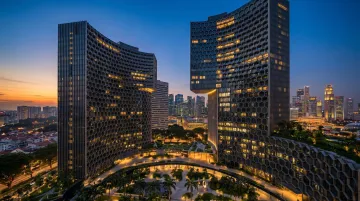
DUO's branding is inseparable from its architectural story. Designed by Büro Ole Scheeren, the twin 49-storey and 39-storey towers feature concave curves creating public spaces—a design concept described as "urban surgery." The honeycomb façade and civic nexus positioning bridge historic Kampong Glam and modern Marina Bay.
The name "DUO" captures multiple dualities:
- Two towers
- Two nations (Khazanah Nasional Berhad and Temasek Holdings joint venture)
- Two functions (residential and commercial)
This narrative informed every sub-brand:
- DUO Residences: 660 premium units
- DUO Tower: 568,000 sqft Grade A office space
- DUO Galleria: 56,000 sqft retail
- Andaz Singapore: 340+ room boutique lifestyle hotel
DUO appointed digital agency 8tarordinary in 2020 specifically for its commercial tower, covering content, social media, email, and website management. Each component brand needed its own voice — yet all had to reinforce the master brand. That tension between coherence and differentiation sits at the heart of mixed-use branding strategy.
DUO won CTBUH Urban Habitat Award (2021) and MIPIM Asia Best Mixed-Use Development (Gold), validating its integrated branding and placemaking approach.
One Holland Village — The Neighbourhood-First Brand
One Holland Village leaned into established neighbourhood identity rather than imposing a new one. The development embraced the "city meets village" positioning—blending urban energy with kampung warmth.
The brand architecture reflects demographic segmentation:
- Sereen, Leven, and Quincy Private Residences target different buyer profiles under the "One" master brand
- The "One" moniker signals unity—"everyone and everything as one"
The project achieved full sell-through, suggesting market receptiveness to this integrated branding approach. EdgeProp described it as "a strong representation of how lifestyle-driven design can enhance comfort, community and engagement."
That identity wasn't manufactured — it was preserved. Shophouse-inspired proportions, timber railings, and an outdoor-first layout gave the physical environment the same character that the brand promised, making the positioning credible rather than cosmetic.
The Emerging Benchmark — 8 Shenton Way (Skywaters)
8 Shenton Way, developed by Perennial Holdings and Alibaba Singapore, anchors its identity in a clear values system: sustainability, wellness, and urban greenery. Designed by SOM, the 305-metre supertall draws from bamboo forest forms.
Seven garden terraces placed every 5-6 floors and over 10,000 sqm of elevated public green space make the brand promise tangible at every level of the building.
The branding opportunity is rooted in biophilic narrative:
- Targeting BCA Green Mark Platinum with 55% energy reduction
- Engineered bamboo and zero-waste terracotta materials
- Rainwater irrigation and biodiversity landscaping
- Reuses existing AXA Tower foundation
This values-led brand identity resonates across all user groups—residents seeking wellness-centred living, office tenants prioritising sustainability credentials, and visitors valuing public green access.
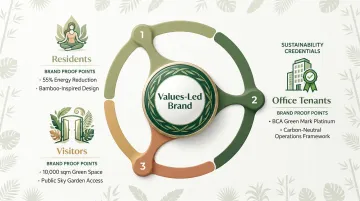
Sitting at the convergence of CBD, Marina Bay, and the Greater Southern Waterfront, Skywaters makes a case that the most defensible brand position for a supertall isn't prestige or address — it's a clearly held set of values that every floor, material choice, and public amenity reinforces.
From Launch Campaign to Living Brand: Sustaining Identity Over Time
The Three Phases of Mixed-Use Brand Lifecycle
Phase 1: Pre-Launch (12-24 months before opening)
Build investor confidence and early buyer/tenant commitment through:
- Compelling brand story and visual identity
- Digital foundation (website, social channels) — DMR Media's framework recommends this begins 12-24 months before launch
- Stakeholder communication frameworks
- Pre-sales materials aligned with master brand
Phase 2: Opening Activation
Generate public discovery and media buzz through:
- Launch events and programming
- Media partnerships and influencer engagement
- Public art installations or heritage activations
- Strategic tenant partnerships that reinforce brand positioning
Phase 3: Long-Term Community Brand Management
Maintain brand relevance and long-term asset value through:
- Ongoing programming and seasonal activations
- Tenant mix curation aligned with brand promise
- Brand governance frameworks ensuring consistency
- Digital community platforms extending physical experience
Most developers budget only for phases one and two. The third phase—where brand becomes embedded in community life—determines long-term premium and loyalty.
Brand Governance in Mixed-Use Contexts
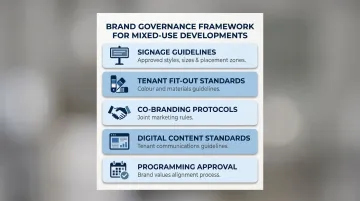
As retail tenants, hospitality operators, and office occupants bring their own brands into the development, the master brand requires clear governance to prevent dilution.
Brand governance frameworks should define:
- Approved signage styles, sizes, and placement zones
- Colour palette and material guidelines for tenant fit-outs
- Co-branding protocols for joint marketing initiatives
- Digital content standards for tenant communications referencing the development
- Programming approval processes ensuring alignment with master brand values
ULI's governance models reference community associations (large-scale nonprofits enforcing architectural guidelines) and data-driven monitoring (using social media analytics to track visitor experience and vibrancy in real-time).
Digital Presence Sustains the Physical Brand
A development's website, social media, and community platforms must reflect and extend the physical brand experience. Content strategy should differentiate across audiences:
| Audience | Content Focus |
|---|---|
| Residents | Community updates, amenity bookings, neighbourhood guides, resident stories |
| Retail/F&B visitors | Event calendars, tenant highlights, parking/access information, experiential content |
| Office tenants | Building services, corporate event spaces, sustainability reporting, professional networking |
DUO's appointment of a dedicated digital agency two years post-completion shows that digital brand management is an ongoing community engagement function, not something that ends at launch.
Frequently Asked Questions
What is mixed-use development branding and how does it differ from regular property marketing?
Mixed-use development branding creates a unified identity, narrative, and experience connecting multiple user groups—residents, office tenants, shoppers, hotel guests—under a single brand. It builds long-term community attachment and asset value, whereas property marketing focuses on promoting features to drive immediate sales or leasing.
Why does branding matter for mixed-use developments in Singapore specifically?
Singapore's land scarcity and URA planning push toward high-density mixed-use means more projects compete for the same residents, tenants, and visitors. A distinctive, well-positioned brand identity differentiates projects in this crowded market and supports premium pricing across residential, commercial, and retail components.
When in the development process should branding begin?
Branding should ideally begin at the concept stage, before architectural design is finalised. A strong place narrative and identity system can inform design decisions, naming, and community positioning rather than being retrofitted as an afterthought.
How do you create a brand that works for both residential buyers and commercial tenants in the same development?
Through brand architecture: a master brand carries the development's overarching identity (values, story, visual language), with sub-brands or tailored expressions for each component. This ensures cohesion without forcing every audience into the same positioning.
What role does place naming play in mixed-use development branding?
A development's name is its most enduring brand asset. It shapes first impressions, signals positioning (aspirational, community-centred, heritage-led), and must work across Singapore's multilingual context while being flexible enough to anchor multiple sub-brands.
Can smaller or mid-scale mixed-use projects in Singapore benefit from professional branding?
Yes—smaller mixed-use developments in suburban or heartland centres near MRT hubs can use focused brand strategy to build community loyalty, attract quality tenants, and achieve stronger leasing or sales outcomes. Differentiation matters at every scale.