Introduction
Brand strategy consulting is a crowded field. Hundreds of firms across Singapore and Asia claim the title, yet their methods, depth of expertise, and cultural fit vary widely. For business leaders, that variation makes the selection process high-stakes.
Choose the wrong firm, and you risk wasted budget and a brand identity that fails to connect with your audience. Research shows that 40% of rebrands fail to deliver positive ROI, largely due to insufficient consumer testing or misaligned strategy.
The cost isn't just financial — a failed rebrand can mean redoing the work within two years, eroding internal confidence and stakeholder trust in the process.
What follows is a practical framework for evaluating brand strategy firms on what actually matters: their process, expertise, and cultural fit, not just their client list or the visual appeal of their portfolio.
TLDR
- Brand strategy covers positioning, messaging, identity, and audience alignment — not just logo design
- Clarify your goals first: launching, repositioning, rebranding, or expanding markets?
- Prioritise firms with rigorous, research-led processes rather than those leading purely with creative execution
- Assess cultural fit alongside portfolio quality — you'll work closely with this team for months
- Look for transparent scope definitions and clear deliverables, not open-ended engagements
What Is a Brand Strategy Consulting Firm?
A brand strategy consulting firm is a specialist partner that helps businesses define, develop, and differentiate their brand at a strategic level — covering positioning, messaging frameworks, visual and verbal identity, audience personas, and market differentiation.
This is distinct from two commonly confused alternatives:
- Marketing agencies — which execute campaigns using your existing brand foundations
- Graphic design studios — which handle aesthetics without the underlying strategy
According to the American Marketing Association, marketing promotes products to drive immediate action, whereas branding is the long-term effort that shapes how customers perceive your business.
Core Service Pillars
Most brand strategy firms offer some combination of four core services:
- Brand Research: Uncovers market gaps through competitive audits and customer insights
- Brand Strategy: Defines positioning, messaging, architecture, and naming
- Brand Identity: Builds the visual and verbal systems that express the brand
- Brand Activation: Manages implementation, rollout, and stakeholder training
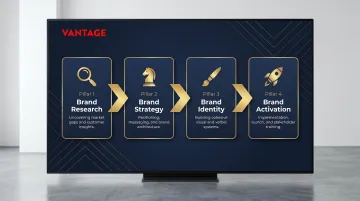
Not every firm offers all four. Understanding which pillar you need most helps narrow your search.
Types of Brand Strategy Firms
Firms vary by focus:
- Some focus exclusively on rebranding
- Others specialise in corporate brand architecture or naming
- Full-service firms offer integrated strategy and creative execution
Clarify your specific need before evaluating firms. A specialist in brand architecture brings a different set of skills than a naming consultancy — and selecting the wrong type is a common, avoidable mistake.
When Do You Need a Brand Strategy Consulting Firm?
Common Business Trigger Points
You likely need external brand strategy expertise when you're:
- Launching a new business or product and need to establish market positioning
- Entering a new market or geography — particularly relevant for companies expanding across Southeast Asia
- Undergoing a merger or acquisition that requires integrating brand identities
- Experiencing brand inconsistency across customer touchpoints and channels
- Facing stakeholder confusion about what makes your brand distinct
Why Internal Teams Can't Lead This Objectively
Internal marketing teams are typically too close to the brand to evaluate it without bias. Harvard Business Review research identifies this as the "inside view" — executives making decisions based on optimism rather than a clear-eyed assessment of the odds.
Internal teams also lack specialised tools like customer research frameworks, competitive brand audits, and positioning methodologies that external consultants bring.
The Business Case for Strategic Branding
McKinsey's research tracking 300 companies over five years found that top-quartile design and brand performers delivered 32 percentage points higher revenue growth and 56 percentage points higher total returns to shareholders compared to industry peers.
Those returns don't happen in isolation. 81% of consumers will not purchase without trusting a brand first, and 90% are willing to pay a premium for brands they trust. The financial upside of strong branding comes directly from how deeply customers believe in what you stand for — which is precisely what a brand strategy engagement is designed to build.
What to Look for When Choosing a Brand Strategy Consulting Firm
The right firm isn't necessarily the most well-known or the largest. It's the one whose expertise, process, and values best match your business's specific situation and goals.
Strategic Process and Methodology
Why this matters: A well-defined, evidence-based process separates credible firms from those treating branding as decoration. A clear methodology — research → strategy → identity → activation — reduces risk, keeps projects on scope, and prevents costly rework.
Red flag to watch for: Firms that jump straight to creative output without a research and discovery phase are treating branding as decoration, not strategy.
What to ask: "Walk me through your process from first brief to final delivery."
Look for firms that conduct discovery and stakeholder interviews before any visual work begins. ISO 20671 standards for brand evaluation establish a rigorous framework based on inputs (marketing investment), equity (stakeholder perceptions), and outputs (financial performance). Credible firms align with these principles.
Research Depth and Insight Generation
The strongest brand strategy firms anchor their work in customer research, stakeholder interviews, competitive analysis, and market segmentation — not gut instinct or generic frameworks.
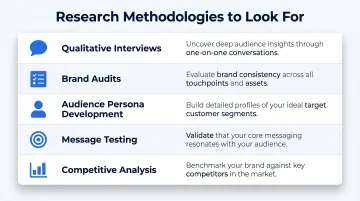
Research methodologies to look for:
- Qualitative interviews — understanding customer motivations and perceptions
- Brand audits — comprehensive examination of brand equity sources
- Audience persona development — detailed customer segmentation
- Message testing — validating positioning with target audiences
- Competitive analysis — mapping market differentiation opportunities
McKinsey emphasises data-driven brand equity management as a core source of brand strength, using sentiment analysis, agile qualitative research, and granular growth mapping.
Without this research foundation, brand strategy rests on assumptions rather than evidence — and assumptions rarely survive contact with the market.
Industry Experience vs. Cross-Industry Versatility
Direct industry experience is useful, but it shouldn't be your primary selection criterion. A firm working exclusively within one sector often lacks the fresh perspective needed to differentiate a brand within that same crowded space.
Why cross-industry experience matters: Cross-industry versatility enables firms to import fresh approaches and avoid category conventions — which is often the source of genuine brand differentiation.
Academic research on strategic reasoning shows that analogical reasoning allows strategists to transfer problem-solving techniques from one industry to another, fostering conceptual change and novelty.
Real-world example: Cirque du Soleil successfully reinvented the structurally unattractive circus industry by drawing upon distinctive strengths from alternative industries (theatre, Broadway, opera) to target a new buyer group (adults rather than children).
What matters most is whether the firm has solved strategically similar challenges across different sectors — not whether they've worked with your exact competitors.
Portfolio Quality and Measurable Outcomes
A portfolio tells you what a firm can do. How they talk about their work tells you how they think.
How to assess portfolios beyond aesthetics:
- Confirms strategic thinking — the work reflects a clear positioning idea, not just visual polish
- Demonstrates creative range — style adapts to each brand's context rather than applying one template
- Shows measurable outcomes — rebrands that led to increased visibility, market expansion, or stakeholder trust
What to ask: Request case studies that describe the brief, the strategic challenge, and the outcomes — not just the finished creative.
Client testimonials that speak to process quality and results carry more weight than design awards. Look for evidence aligned with ISO 10668 (monetary brand valuation) principles, which link brand strength to commercial value.
Collaboration Style and Cultural Fit
A brand strategy engagement spans months and involves senior leadership, internal teams, and sometimes customers. Technical capability matters, but so does the firm's ability to listen, challenge respectfully, and work alongside your team without friction.
Evaluate collaboration style during initial consultation:
- Do they ask incisive questions about your business, or present generic credentials?
- Do they push back when warranted, or just agree?
- Can you envision working closely with this team for months?
Budget Transparency and Scope Clarity
Collaboration quality means little if scope and pricing are unclear from the start. Brand strategy engagements vary significantly in cost depending on depth of work — from focused positioning projects to full rebrands.
Indicative cost ranges (USD — US market estimates):
- Brand identity only: $1,000–$5,000
- Market research component: $1,000–$7,000
- Brand strategy component: $7,500–$40,000
- Mid-market strategy & identity: $25,000–$75,000
- Full branding (strategy + assets): $20,000–$100,000+
- Enterprise rebrand: Up to $200,000+
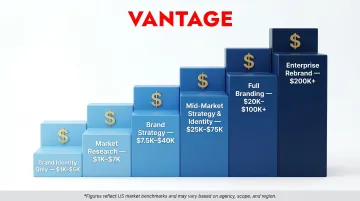
Source: DesignRush and Clutch 2025–2026 platform data. Figures reflect US market benchmarks; actual investment in Singapore and Asia may differ based on agency scale and scope.
What to avoid:
- Choosing a firm solely on price (under-investing typically leads to rework within one to two years)
- Open-ended retainers with vague outputs
- Proposals without clearly defined scope documents or milestone-based deliverables
Look for transparent pricing structures and scope clarity. The best firms articulate exactly what you'll receive at each stage.
How Vantage Branding Approaches Brand Strategy
Vantage Branding is a Singapore-based, full-service branding agency with deep experience across diverse industries including healthcare, government, B2B, technology, eldercare, and investment — positioning them to serve businesses across Singapore, Malaysia, Vietnam, and broader Asia.
Insight-Led Approach
Vantage's work begins with discovery and research before any creative output, ensuring brand strategy is grounded in genuine understanding of the client's market position, audience needs, and competitive landscape.
This insight-led process covers two structured phases:
- Brand Discovery — structured interviews and workshops that surface organisational purpose, vision, values, culture, and competitive position
- Brand Research — market analysis, competitor brand audits, audience research, and stakeholder research, all translated into a strategic framework that guides every brand decision
Collaborative Ethos
Vantage works as a long-term strategic partner — present from the earliest discovery sessions through to implementation. Collaborative workshops, regular communication, and stakeholder alignment processes keep every project on track.
This participatory approach gives internal teams genuine ownership of the brand, ensuring institutional knowledge shapes the final strategy rather than being overlooked.
Key Differentiators
- End-to-end brand development — research, strategy, visual identity, and implementation handled by a single team
- Highly collaborative process — structured workshops, stakeholder interviews, and co-creation sessions
- Trusted client portfolio — including Enterprise Singapore, Singapore Symphony Orchestra, Sentosa, NUS, and Allium Healthcare, demonstrating trust from both private and public sector organisations across a range of complexity levels
Vantage's cross-industry experience lets them bring fresh perspectives to each engagement, helping clients avoid category conventions and build more distinctive brands.
Conclusion
Choosing the right brand strategy consulting firm comes down to fit — how well a firm's methodology, expertise, and working style align with your specific challenge and where your business is right now.
When evaluating firms, prioritise:
- Rigorous, research-led methodology over firms that lead with creative execution
- Cross-industry versatility that brings fresh perspectives
- Cultural fit and collaboration style — you'll work closely with this team
- Transparent scope and deliverables — clear milestones and outputs
Brand strategy shapes how your market sees you for years. The firm you choose should be a partner capable of growing alongside your brand — not just delivering a one-time output and stepping away. That kind of relationship takes time to find, and it's time well spent.
Frequently Asked Questions
What is the difference between a brand strategy consulting firm and a marketing agency?
A brand strategy firm defines who you are — your positioning, messaging, identity, and market differentiation. A marketing agency uses those foundations to execute campaigns. Branding establishes the strategic platform first; marketing amplifies it through tactical activation.
How long does a brand strategy consulting engagement typically take?
Timelines vary by scope. A focused positioning exercise may take 6-8 weeks, while a full rebranding engagement including research, strategy, identity, and guidelines typically runs 4-9 months. Rushing it typically leads to weaker results and costly revisions.
Do I need a brand strategy firm with direct experience in my industry?
Industry experience is helpful but not essential, and can sometimes limit creative thinking. Cross-industry exposure often produces more distinctive differentiation. What matters most is the firm's ability to apply rigorous research and strategic thinking to your specific challenge.
What deliverables should I expect from a brand strategy consulting engagement?
Typical outputs include a brand positioning statement, messaging framework, audience personas, competitive analysis, and brand guidelines. Scope varies depending on whether the engagement covers strategy only or strategy plus identity design. Request a detailed scope document during the proposal phase.
How do I know if my business is ready to invest in brand strategy consulting?
Common readiness signals include entering a new market, experiencing brand inconsistency across touchpoints, undergoing a leadership change or merger, or finding that current messaging no longer resonates with your target audience. If stakeholders struggle to articulate what makes your brand distinct, that's a strong indicator you need strategic brand work.