Introduction
Knowing you have a brand problem is rarely the hard part. Knowing when to bring in outside expertise — and whether the timing is actually right — is where most businesses get stuck. Act too early and you'll outgrow the work within two years. Wait too long and a fragmented identity quietly erodes trust and revenue. Research shows that 74% of S&P 100 companies rebrand within their first seven years, often because early brand investment lacked strategic rigour or business alignment.
This guide is for business owners and marketing decision-makers who want to get that timing right — and avoid the cost of getting it wrong.
TL;DR
- Hiring too early or too late compounds costs — timing your engagement to a clear strategic moment matters
- The best time is at a business inflection point: launch, rebrand, market expansion, post-merger, or when inconsistency visibly hurts growth
- Observable signs include fragmented visual identity, low engagement despite marketing spend, leadership misalignment, and a brand that no longer reflects current direction
- Hiring without clear goals, budget commitment, or stakeholder buy-in reduces impact, even from the best consultant
- The right consultant delivers both strategic direction and design execution, creating a framework that drives long-term performance
Why the Timing of Hiring a Brand Design Consultant Matters
Brand design is not a cosmetic exercise—it's a strategic decision whose value is magnified or diminished based on where the business is in its growth cycle. A rebrand too early can be outgrown quickly; one delayed too long allows a deteriorating brand to erode trust and revenue.
Premature Investment Leads to Expensive Rework
Investing in brand design before product-market fit or leadership alignment often results in costly rework. Nearly half of funded startups undergo a complete rebrand after their seed round, creating audience disconnection and internal disruption.
Around 40% of rebrand efforts fail to deliver positive ROI because the underlying business strategy wasn't stable enough to support brand investment.
Delayed Investment Compounds the Cost
Delaying a fragmented identity problem rarely saves money. Organisations that wait tend to spend more over time on patchwork fixes than a single structured engagement would have cost:
- Inconsistent collateral across departments and markets
- Conflicting messaging at key customer touchpoints
- Poor conversion rates from an incoherent brand story
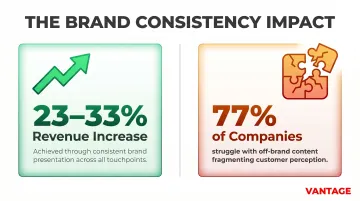
Consistent brand presentation increases revenue by 23% to 33%, yet 77% of companies deal with off-brand content that actively fragments customer perception.
Strategic Moments Produce Stronger Brand Outcomes
When a brand design consultant is brought in during a moment of organisational clarity—a new strategic direction or a leadership transition—the work lands stronger because leadership is aligned and committed to the output. Good consultants begin with a structured alignment process, helping teams reach a shared brand direction before any design work begins. That foundation is what separates a brand that lasts from one that needs revisiting in two years.
The Right Business Scenarios to Hire a Brand Design Consultant
The right moment to bring in a brand design consultant depends on context. Specific business triggers — not arbitrary timelines — determine when external expertise will have the greatest impact.
Starting or Launching a Business
New businesses benefit from brand design consultation early—before marketing channels, websites, or sales materials are built. Establishing a coherent brand identity from the start avoids expensive retrofitting and creates a consistent first impression across all touchpoints.
Many businesses skip this step and pay for it later. Those that launch without strategic direction often find themselves rebranding within two to three years. The cost of retrofitting typically includes:
- Rebuilding digital properties to reflect the updated identity
- Reprinting collateral across all formats
- Re-educating customers on what the brand now stands for
Each of these costs far exceeds the original investment in getting the brand right at launch.
Rebranding or Refreshing an Existing Brand
A rebrand is warranted when:
- The current visual identity no longer reflects the company's positioning
- A merger or acquisition requires integration of two brand identities
- Customer research reveals a disconnect between perception and reality
A brand design consultant provides the objectivity that internal teams often cannot. Vantage Branding has successfully guided clients like CrimsonLogic and Golden Equator Group through portfolio consolidation and strategic repositioning, addressing the challenge of unifying disparate business units under a cohesive brand framework.
High-profile rebrand failures like Tropicana's $30 million loss and Gap's reversed $100 million redesign underscore the importance of expert guidance during brand transitions.
Entering a New Market or Expanding Geographically
Market expansion—especially across cultural boundaries common in Asia—demands a fresh assessment of whether the existing brand identity will resonate with a new audience. A brand design consultant with regional expertise can evaluate:
- Cultural fit and symbolism
- Naming conventions and translations
- Visual language appropriate for the new context
Research shows that phono-semantic translations—which endow the localised name with cultural meaning while keeping the original sound—generate the highest engagement among Chinese consumers. Contrary to Western assumptions about Asian colour preferences, blue is actually the most common theme colour for both Eastern Asian and Western firms, used to strengthen brand image and convey spaciousness.
Experiencing Stalled Growth or Declining Engagement
When a business is executing tactically — advertising, content, social media — but results remain weak, the problem often sits at the brand level. Fragmented identity, unclear positioning, or a visual system that has lost relevance can quietly erode campaign performance regardless of spend.
Observable symptoms include:
- High traffic but low conversion on digital channels
- Marketing campaigns underperforming relative to spend
- Difficulty articulating what makes the brand different in sales conversations
Vantage Branding's work with the Singapore Symphony Orchestra demonstrates this diagnostic capability: the agency identified that declining concert attendance wasn't a tactical execution problem but a brand relevance issue requiring comprehensive strategy and identity redesign.
Signs It's the Right Time to Hire a Brand Design Consultant
Most businesses don't hit a single dramatic tipping point — they accumulate small, nagging symptoms that quietly erode brand effectiveness. Recognising these signals early makes the difference between a proactive rebrand and a reactive one.
Visual and identity signals:
- Logo inconsistency across platforms
- Multiple versions of brand materials in circulation
- No formal brand guidelines
- A visual identity that feels misaligned with current market positioning
Left unaddressed, these create downstream friction: teams debate colour codes instead of executing strategy, and inconsistent presentation erodes customer confidence.
Business performance signals:
- Marketing campaigns underperforming relative to spend
- High traffic but low conversion on digital channels
- Difficulty articulating what makes the brand different in sales conversations
These indicators reveal that the brand isn't doing the work it should. Despite tactical execution, the brand fails to build trust or differentiate effectively.
Internal alignment signals:
When leadership gives different answers to "Who is our customer?" or "What does our brand stand for?", that internal misalignment will show up externally — in messaging, visuals, and sales conversations. A brand design consultant typically surfaces these disconnects early through structured discovery, before any design work begins.
External pressure signals:
- A competitor has rebranded and is gaining market share
- The industry is evolving and the existing brand no longer signals relevance
- A major new partnership or client is raising expectations of professional brand presentation
When Hiring a Brand Design Consultant Won't Help
Knowing when not to hire is just as important as recognising the right moment. Some internal conditions make engagement premature:
- The business model is still being validated
- Leadership hasn't committed to acting on recommendations
- There is no budget to implement what the consultant recommends
In these situations, engaging a consultant produces a strategy document that never gets executed — the investment is spent, but nothing changes.
Reactive hiring creates a different problem. When a business engages a consultant because a competitor rebranded — or because leadership wants "something new" without being able to name the actual problem — the consultant has little to work with. The engagement lacks focus, and the outputs feel generic.
What Goes Wrong When Timing Is Off
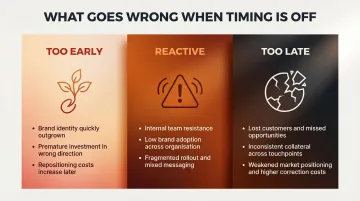
- A premature engagement leads to a brand identity the business quickly outgrows
- A reactive engagement without alignment leads to internal resistance and low adoption
- A delayed engagement means the business has already paid the cost of brand confusion in lost customers, inconsistent collateral, and weakened positioning—and now must spend more to correct it
How to Get the Most Out of Your Brand Design Consultant
Businesses that see the strongest results from brand design engagements come in prepared. They have documented their goals, identified internal stakeholders who need to be involved, and committed both budget and leadership attention to the process.
What "prepared" looks like in practice:
- Having a clear brief covering business goals, target audience, competitive landscape, current brand pain points, and budget parameters
- Being able to share business strategy documents
- Being open to challenging existing assumptions
- Granting the consultant access to real customer insight and internal data
Preparation sets the foundation — but how you show up throughout the engagement matters just as much.
Participate Actively, Not Passively
Consultants produce better work when clients participate actively in discovery and share honest feedback throughout. Vantage Branding operates on a collaborative model for exactly this reason — brand outcomes depend directly on the quality of inputs clients bring to the table.
Think Beyond the Single Project
A consultant who understands your business over time can advise on future launches, brand extensions, and shifts in your market — not just the project at hand. Businesses that treat branding as a recurring investment, rather than a one-time fix, end up with a brand that holds up as the company grows.
Frequently Asked Questions
How much does a brand design consultant cost?
Costs vary based on scope, agency size, and geography. In Singapore, project-based identity engagements typically range from S$10,000 to S$50,000 for most SMEs, while comprehensive rebrands can exceed S$100,000.
What is the 3-7-27 rule of branding?
The 3-7-27 rule suggests a prospect needs roughly 3 exposures to recognise a brand, 7 to remember it, and 27 to develop trust. While widely cited, the exact numbers lack peer-reviewed validation. What it does confirm is that brand recognition builds through repetition — which means a consistent, professionally designed identity needs to hold up across every touchpoint, every time.
What is the difference between a brand design consultant and a branding agency?
A brand design consultant may operate independently or as part of a larger agency, often focusing on strategic guidance and design direction. A full-service branding agency like Vantage Branding typically provides end-to-end delivery across strategy, identity, and implementation. The right choice depends on the scope and complexity of your business's needs.
How long does a brand design project typically take?
Timelines vary by scope. A focused brand identity project may take 6 to 12 weeks, while a comprehensive rebrand involving strategy, identity, and rollout can span several months. Clarify scope and timeline expectations at the outset of any engagement to ensure alignment.
Can a startup afford to hire a brand design consultant?
Investing in brand before building out marketing infrastructure saves costly rework later. Many consultants and agencies offer tiered or phased engagements sized to startup budgets without cutting corners on strategy. Singapore's Enterprise Development Grant (EDG) also covers up to 50% of eligible branding costs for local SMEs.
What should I prepare before my first meeting with a brand design consultant?
Prepare a clear brief covering business goals, target audience, competitive landscape, current brand pain points, and budget parameters. Include any existing brand materials, customer research, and strategic documents. A one-page summary of where your brand stands today and where you want it to go is often the most useful document you can bring.