Introduction
E-commerce businesses face a brutal reality: in saturated digital marketplaces where products are easily copied, strong brands are not.
A competitor can replicate your product features overnight, undercut your pricing with algorithmic precision, and match your customer service standards within weeks. They cannot replicate your brand's emotional connection with customers, the trust you've built, or the identity that makes your business memorable.
That gap — between what competitors can copy and what they can't — is where brand equity lives. Choosing the right agency determines whether your brand occupies that space or gets left competing on price.
This guide walks you through what a brand development agency actually does, the criteria that separate strong partners from superficial ones, and how to make a selection decision that compounds over time — not just at launch.
TL;DR
- A brand development agency shapes your brand's strategy, identity, and positioning—not just your campaigns or ads
- E-commerce brands gain stronger customer loyalty, higher perceived value, and reduced price sensitivity through strategic branding
- The right agency will have e-commerce-specific portfolio experience, a clear strategic process, and a structured process for client collaboration
- Strong agencies define their discovery process, post-launch brand stewardship, and measurable outcomes upfront
- Avoid agencies that skip the strategy phase or can't explain how brand decisions translate into real customer impact
What Is a Brand Development Agency?
A brand development agency is a specialist firm that helps businesses define who they are, what they stand for, and how they communicate that consistently across every customer touchpoint. This work encompasses brand strategy, visual identity, brand voice, positioning, and the frameworks that guide how your brand shows up everywhere—from product pages to packaging to social media.
How Brand Development Differs from Marketing
Marketing drives short-term awareness and acquisition. Brand development builds the foundation that makes marketing more effective over time.
For e-commerce businesses, this distinction matters enormously. Marketing campaigns run on top of your brand identity. If that identity is unclear, inconsistent, or forgettable, every dollar spent on ads works harder than it should. Customers click through and land on a product page that doesn't reinforce why they should care—and they leave.
Without a clear brand foundation, you're spending acquisition budget on a brand customers can't remember or return to.
A full-service brand development agency typically provides:
- Defining your market position and value proposition through brand strategy
- Building a visual identity system: logo, colour palette, typography, and design language
- Developing messaging frameworks covering voice, tone, key messages, and storytelling
- Creating brand guidelines that keep internal teams and external partners aligned
Why E-commerce Businesses Need Brand Development
E-commerce brands face a straightforward problem: product listings can be copied and prices undercut overnight. The Asia-Pacific e-commerce market is projected to reach USD $4.86 trillion in 2026, with millions of sellers competing for attention. Algorithmic pricing can drive prices down by more than 20%, making brand equity a critical, non-replicable strategic asset.
According to the 2025 Edelman Trust Barometer, trust is now equal to cost and quality as a purchase consideration. This shift fundamentally changes how e-commerce businesses must compete.
Specific e-commerce touchpoints where brand development has direct impact:
- Product pages: visual identity, messaging hierarchy, tone of voice, and trust signals
- Packaging and unboxing: physical brand experience that drives social sharing and repeat purchase
- Post-purchase email flows: brand voice and visual consistency that deepens the relationship
- Social presence: content tone, visual identity, and community engagement style
- Paid advertising: brand recognition and message consistency across platforms
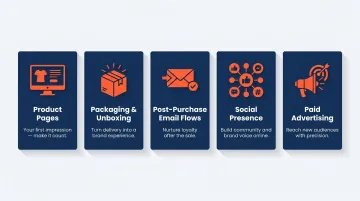
When every touchpoint tells the same story, customers recognise you faster—and trust you enough to buy.
Key Factors to Consider When Choosing a Brand Development Agency for E-commerce
Selecting a brand development agency is different from hiring a general marketing vendor. It requires evaluating strategic depth, not just creative output. These factors connect agency selection to business outcomes like customer retention, conversion lift, and brand recall.
E-commerce Industry Experience and Portfolio Relevance
Prior experience in e-commerce contexts matters because brand development for an online retailer involves understanding customer journeys, platform constraints, and digital-first touchpoints in ways that general branding work may not address.
When evaluating agencies, ask to see portfolio work for brands that sell products online—not just corporate or institutional clients. Look for evidence they understand:
- How brand identity translates to product listing pages
- Platform-specific constraints (Shopify, Lazada, Amazon)
- Mobile-first visual hierarchies
- Conversion-oriented brand messaging
- Post-purchase brand experience design
Portfolio depth matters more than portfolio breadth. An agency with five well-executed e-commerce brand projects demonstrates more credible expertise than one with fifty unrelated logos. Look for case studies that show the strategic challenge, the brand solution, and the business outcome.
Strategic Depth, Not Just Visual Output
Many agencies position themselves as branding firms but deliver primarily visual work—logos, colour palettes, and style guides—without the upstream strategy work that makes those assets meaningful.
A strong brand development agency will lead with brand discovery, competitive analysis, and audience positioning before any design work begins. This strategic foundation ensures that visual identity decisions are grounded in business reality, not just aesthetic preference.
The key question to ask: "What strategic process do you follow before any design work starts?"
A rigorous answer includes:
- Customer research and audience segmentation
- Competitive landscape analysis
- Brand positioning workshop with stakeholder alignment
- Defined brand architecture (relationship between parent brand and sub-brands)
- Strategic brief that guides all creative development
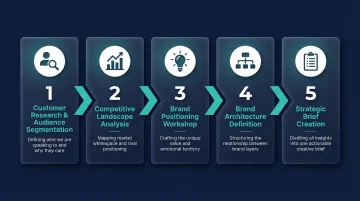
If an agency jumps straight to mood boards and logo concepts without this foundation, they're selling design services, not brand development.
Understanding of Digital Brand Touchpoints
For e-commerce brands, brand identity must translate fluidly across website, product listings, social media, email, paid ads, and mobile.
An agency that builds brands primarily for print or physical environments may not understand how a visual identity system behaves at small sizes, in motion, or under the constraints of a Shopify or Lazada product page.
Modern e-commerce requires brand identities built natively for screens and motion. Static, print-first guidelines fail to address the interactive and responsive needs of digital platforms.
Verify whether the agency provides digital-first brand guidelines that account for:
- Responsive logo variations for different screen sizes
- Colour specifications for digital (RGB/HEX) with accessibility compliance
- Typography that renders clearly on screens
- Motion and animation principles for social and UI
- Platform-specific brand application rules
A static PDF alone leaves your internal team without the tools to apply the brand consistently across digital channels.
Collaboration Style and Process Transparency
Brand development is inherently a collaborative process. The agency cannot successfully define your brand without deep access to your business, your customers, and your internal team.
Evaluate how structured and inclusive the agency's discovery and feedback process is. Strong agencies build collaboration into every phase:
- Discovery workshops that engage your leadership and customer-facing teams
- Regular check-ins at defined milestones
- Structured feedback loops with clear revision rounds
- Transparent timelines showing when decisions are needed
Poor client-agency communication affects project outcomes significantly. Frequent agency turnover disrupts strategy continuity and adds cost — transparency on timelines, deliverables, and revision rounds is a practical marker of how smoothly the engagement will run.
Post-Launch Brand Support and Scalability
Brand development doesn't end at brand guidelines delivery. E-commerce businesses evolve—they launch new product lines, enter new markets across Southeast Asia and beyond, and expand across new channels.
The right agency should offer ongoing brand stewardship or at minimum a clear handoff that equips your internal team to apply the brand consistently.
The practical question to ask: "How have you helped clients manage brand consistency as they've scaled, changed platforms, or expanded into new markets?"
Look for agencies that provide:
- Brand training for internal teams
- Digital asset libraries with version control
- Ongoing brand consultancy or retainer options
- Clear documentation that enables self-sufficiency
Questions to Ask Before Hiring—And Red Flags to Watch For
The discovery call or pitch process is a two-way evaluation. The quality of an agency's answers to hard questions reveals more about their capabilities than their credentials page.
Key Questions to Ask
"What does your brand discovery process involve, and who from your team leads it?"
A solid answer describes a structured process — stakeholder interviews, customer research, competitive analysis, collaborative workshops — and names the strategist who will own discovery, along with their background. Be cautious if you hear vague language about "getting to know your business" with no mention of specific methods or deliverables.
"Can you show us examples of brand work you've done for e-commerce businesses at our scale and in our category?"
Look for 2-3 detailed case studies that show the strategic challenge, brand solution, and measurable business outcome for comparable businesses. Visual-only portfolios or case studies from entirely different business models are a poor substitute.
"How do you define success for a brand development engagement—and what metrics or outcomes do you track post-launch?"
A strong answer covers both qualitative outcomes (brand clarity, internal alignment) and quantitative indicators (awareness lift, retention, conversion improvement). If an agency only talks about delivering guidelines on time, they're not thinking about business impact.
"What happens if we are not satisfied with the initial strategic direction?"
They should explain their revision process clearly — how many rounds are included, and what happens if there's a fundamental mismatch (for example, additional discovery or alternative strategic directions). Defensive responses or vague reassurances without a defined process are a warning sign.
Red Flags to Watch Out For
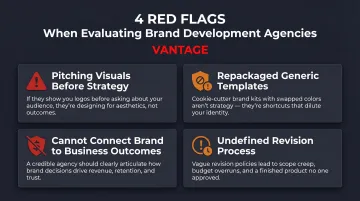
Not every agency that talks about brand strategy actually practises it. These are the patterns worth catching early:
- They skip strategy and pitch visuals first. If logo concepts come before any discussion of your customers, competitors, or positioning, they're selling design — not brand development.
- Their "strategy" is a repackaged template. Generic frameworks applied without real discovery rarely produce positioning that stands apart. Ask what's custom about their process.
- They can't connect brand decisions to business outcomes. If an agency can't explain how brand choices affect customer acquisition or retention, they don't understand e-commerce business models.
- Their revision process is undefined. Agencies that finalise deliverables without a clear revision or approval process suggest poor project management — and future frustration.
Before signing anything, scrutinise the contract for:
- Long lock-in periods with no performance review checkpoints
- Proposals that don't name who will actually work on your account
- Unclear scope definitions that leave room for significant cost overruns
How Vantage Branding Helps E-commerce Brands Build for the Long Term
Vantage Branding is a Singapore-based full-service brand development agency with a track record across retail, food and beverage, technology, and investment — industries that share many of the same competitive pressures as e-commerce. Their research-grounded process is built for brands navigating the Asia-Pacific market, where audience expectations and regional nuances vary significantly.
Key differentiators for e-commerce businesses:
- Research-grounded brand strategy: The Brand Discovery process uses structured interviews, workshops, and research to build strategy on genuine insights — not assumptions
- Collaborative from start to finish: Vantage works closely with clients through every stage, from discovery to guidelines delivery, ensuring internal alignment and stakeholder buy-in
- Regional market depth: With experience across Singapore, Malaysia, Vietnam, and broader Southeast Asia, they understand the cultural and market nuances e-commerce brands need to navigate
- Single partner, full scope: Brand strategy, visual identity, brand narrative, and ongoing stewardship — no need to coordinate across multiple agencies
If you're evaluating your brand development options, reach out to Vantage Branding for a consultation at +65 6698 9257 or hello@vantagebranding.com.sg.
Conclusion
The right brand development agency for an e-commerce business is not necessarily the most well-known or the most affordable. It is the one whose process, e-commerce track record, and working style align with where your brand needs to go.
That fit matters even more over time. Brand development is not a one-time project — as your e-commerce business grows, enters new categories, or expands into new markets, your brand will need to evolve with it. The best agency relationships are built for that ongoing work, not just a launch deliverable. Choose one that stays invested in your outcomes well after the first brief is closed.
Frequently Asked Questions
How to choose the right branding agency?
Define your specific brand needs first, then evaluate agencies on strategic depth and relevant portfolio experience. Assess their discovery process, prioritise cultural fit and communication transparency over price alone, and verify they understand your business model and customer touchpoints.
What does a brand development agency do for an e-commerce business?
A brand development agency defines your brand strategy, positioning, visual identity, brand voice, and digital brand guidelines. These outputs help your e-commerce brand stand out in crowded marketplaces, build customer trust, and drive repeat purchases through consistent brand experiences.
How is brand development different from performance marketing?
Brand development builds the foundational identity that makes marketing more effective over time, while performance marketing drives short-term acquisition through campaigns and ads. Brand equity compounds — a well-defined brand lowers customer acquisition costs and improves retention in ways campaigns alone cannot.
How much does brand development typically cost for an e-commerce business?
In Singapore, comprehensive brand development projects typically range from S$15,000 to S$100,000, depending on scope, complexity, and agency size. Eligible SMEs can offset up to 50% of costs through Enterprise Singapore's Enterprise Development Grant (EDG). Evaluate value and strategic depth over the lowest price.
How long does the brand development process take?
A comprehensive brand identity project typically requires 12 to 20 weeks, covering research, strategy, design, and guidelines delivery. Rushing the discovery and strategy phase typically results in weaker brand outcomes that fail to differentiate your business in competitive markets.
What should I prepare before approaching a brand development agency?
Have clarity on your business goals, target audience, competitive context, and current brand pain points. Document your approximate budget range and gather any existing brand assets. This preparation allows the agency to assess fit quickly and build a tailored proposal.