Introduction
Many business leaders face a familiar frustration: marketing campaigns that generate clicks but no conversions, or a beautifully designed brand that fails to drive revenue. When these scenarios repeat, the root cause usually isn't a creative problem or a budget shortfall—it's a misunderstanding of what brand strategy and marketing strategy actually do.
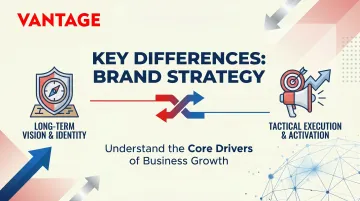
These two terms are often used interchangeably, yet they serve distinct purposes and operate on different timescales. Brand strategy establishes the foundation: who you are, what you stand for, and how you want to be perceived.
Marketing strategy builds on that foundation — determining how you promote your offerings, which channels you use, and what measurable outcomes you're driving toward.
This article clarifies the distinction between these two critical business functions. You'll learn their core definitions, understand their key differences, discover how they work together, and identify when to prioritise one over the other.
TL;DR
- Brand strategy defines your identity, values, positioning, and long-term promise
- Marketing strategy determines how you promote through campaigns, channels, and tactics to drive measurable results
- Brand strategy always comes first; marketing strategy executes on top of it
- These strategies are interdependent, not interchangeable—strong marketing amplifies a clear brand
- Businesses with a clear brand strategy are 2x as likely to meet or exceed growth goals, according to Gartner
Brand Strategy vs. Marketing Strategy: At a Glance
| Aspect | Brand Strategy | Marketing Strategy |
|---|---|---|
| Focus | Perception, identity, and positioning | Promotion, conversion, and acquisition |
| Primary Goal | Build long-term equity and emotional connection | Drive measurable results and ROI |
| Time Horizon | Long-term (3-5+ years) | Short-to-medium term (quarterly to annual) |
| Key Components | Purpose, values, positioning, voice, visual identity | Campaigns, channel mix, conversion goals, budgets |
| Success Metrics | Brand awareness, sentiment, NPS, perceived value | Sales, leads, traffic, conversion rates, ROAS |
| Frequency of Change | Evolves slowly during major milestones | Adapts regularly to market conditions |
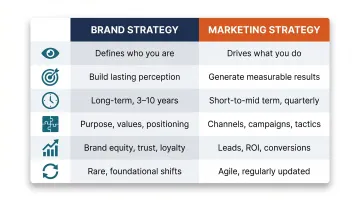
The two strategies work together: brand strategy defines who you are and why it matters, while marketing strategy determines how you reach and convert the right audience.
What is Brand Strategy?
Brand strategy is the long-term plan that shapes how a business is perceived by customers, competitors, and the broader market. It encompasses your purpose, positioning, values, personality, and promise to customers.
This foundation informs every business decision — from product development to customer service to communications.
Unlike marketing campaigns that change quarterly, brand strategy remains stable across years. It's the bedrock that ensures consistency—when customers encounter your business across different touchpoints, they experience a unified identity that builds recognition and trust.
Core components of brand strategy include:
- Defines why your business exists beyond profit and connects it to broader impact
- Builds deep understanding of customer needs, motivations, and decision-making factors
- Establishes the unique space you occupy in customers' minds relative to competitors
- Sets how you communicate across channels to maintain personality consistency
- Creates the logo, colour palette, typography, and design system that make your brand recognisable
Each component directly impacts business performance. Consistent brand voice builds trust over time. Clear positioning reduces price competition by establishing differentiation. Strong visual identity can improve brand recognition by up to 80%.
Brand strategy isn't a one-time exercise. Initial development may take several months, involving stakeholder interviews, market research, and strategic workshops. Once established, revisit it at major milestones: market expansion, mergers, significant product launches, or new customer segments.
Components of a Strong Brand Strategy
A brand positioning statement articulates the unique space your brand occupies in customers' minds. It answers a critical question: why should someone choose you instead of a competitor? A simple structural framework helps clarify this:
For [target audience], [brand name] is the [category] that [unique benefit] because [reason to believe].
This statement isn't marketing copy—it's an internal strategic tool that guides all communications, product decisions, and customer experience design.
For businesses in competitive markets like Singapore and across Asia, where consumer trust and relationship-building carry particular weight, clearly defined brand strategy becomes a significant differentiator. Singapore ranks as a "trust stalwart" in the Asia-Pacific region, with 56% of consumers willing to stop doing business with brands they don't trust. Vantage Branding works with organisations across Singapore and Asia to develop this foundation — through stakeholder research, competitive analysis, and positioning workshops — so the resulting brand strategy is grounded in genuine market insight rather than assumptions.
What is Marketing Strategy?
Marketing strategy is the actionable plan that drives awareness, engagement, and conversions. It determines which audiences to reach, through which channels, with what messages, and toward which measurable objectives. While brand strategy asks "who are we?", marketing strategy asks "how do we tell people about it and drive results?"
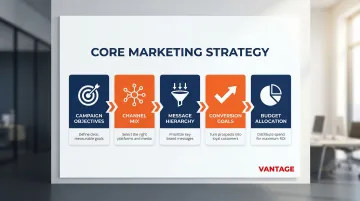
Core marketing strategy components include:
- Campaign objectives — Specific, measurable goals using SMART frameworks (e.g., generate 500 qualified leads in Q2)
- Channel mix — Platforms selected for reach: social media, content marketing, paid advertising, email, PR, and events
- Message hierarchy — What to say to different audiences at different stages of the customer journey
- Conversion goals — Desired actions such as form submissions, purchases, demo requests, or downloads
- Budget allocation — How resources are distributed across channels and campaigns to maximise return
Marketing strategy operates on shorter timescales than brand strategy. Campaigns typically run for weeks or months, not years. This time-bound nature demands flexibility—marketing strategies must adapt quickly to market conditions, consumer behaviour shifts, competitive moves, and platform algorithm changes.
Use Cases of Marketing Strategy
Businesses should lean into marketing strategy when facing specific, time-sensitive objectives:
- Launching a new product or service to market
- Entering a new market segment or geography
- Responding to competitive threats or market disruption
- Meeting quarterly or annual revenue targets
- Testing new audience segments or value propositions
Data plays a central role in marketing strategy. Success is tracked through quantitative KPIs: conversion rates, customer acquisition cost (CAC), return on ad spend (ROAS), and lead generation quality.
The numbers reflect this precision-focus. Google Ads deliver an average ROAS of 200% (two dollars returned for every dollar spent), with top performers reaching 800% on search networks. In 2024, average Google Ads conversion rates reached 6.96% across industries.
Brand strategy takes the opposite approach — success there is measured through qualitative indicators like brand awareness, sentiment, and Net Promoter Score (NPS), not conversion dashboards.
Key Differences: Brand Strategy vs. Marketing Strategy
Difference 1 — Time Horizon
Brand strategy is long-term and changes infrequently. Once established, the core elements—your purpose, values, and positioning—remain stable for years. Marketing strategy, by contrast, is short-to-medium term and must adapt continuously.
Think of brand strategy as your compass—it points you toward your destination and rarely changes direction. Marketing strategy is the route you take on any given journey, adjusting for road conditions, traffic, and weather. One stays fixed; the other keeps moving.
Difference 2 — Focus and Goals
Brand strategy focuses on perception, loyalty, and emotional connection. It shapes how customers feel about your business and whether they trust you. Marketing strategy focuses on promotion, conversion, and measurable ROI—driving specific actions that contribute to revenue.
Both goals are valid and necessary. However, confusing or conflating them leads to misalignment: marketing campaigns that achieve short-term clicks but erode long-term brand trust, or beautiful brand identities that fail to drive any customer action.
Difference 3 — Components and Outputs
Brand strategy produces foundational documents and systems:
- Brand positioning document outlining your market position and differentiation
- Brand guidelines governing visual identity, voice, tone, and messaging
- Messaging frameworks for different audiences and touchpoints
- Identity systems including logos, colour palettes, typography, and design elements
Marketing strategy produces execution-focused deliverables:
- Campaign plans with timelines, channels, budgets, and objectives
- Media schedules detailing when and where ads run
- Ad creatives, landing pages, email sequences, and social content
- Performance dashboards tracking KPIs in real-time
The former feeds into the latter. Brand guidelines ensure every marketing campaign reinforces the same identity, voice, and positioning—building cumulative recognition rather than starting from scratch each quarter.
Difference 4 — Measurement
Marketing strategy success is measured through quantitative KPIs: sales revenue, lead volume, website traffic, and conversion rates. These metrics are immediate and concrete.
Brand strategy success is measured through qualitative indicators: brand awareness (do people know you?), customer sentiment (how do they feel about you?), perceived value (are you worth more than competitors?), and Net Promoter Score (would customers recommend you?).
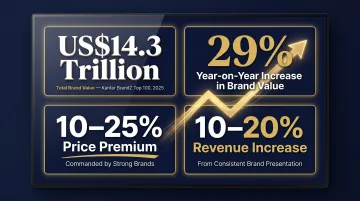
The business impact of strong brand equity is substantial. The 2025 Kantar BrandZ Global Top 100 reached a record US$14.3 trillion in total brand value—a 29% year-on-year increase. Over 20 years, the world's most valuable brands consistently outperformed the S&P 500 and MSCI World Index, acting as financial shields during the 2008 crisis and COVID-19 pandemic.
Businesses with high customer satisfaction and strong brands can charge 10-25% price premiums compared to competitors. Consistent brand presentation across channels increases revenue by 10-20%, with 68% of companies reporting that brand consistency contributed at least 10% to revenue growth.
Difference 5 — Adaptability
Marketing strategy must respond quickly to trends, platform algorithm changes, and customer feedback. Campaigns are tested, optimised, paused, or scaled based on performance data. That agility is non-negotiable.
Brand strategy requires deliberate, careful evolution. It's not static, but any changes need careful consideration — inconsistency erodes the trust and recognition you've built.
Fragmented brand systems increase production costs by more than 30% through duplicated work and inefficiencies. A California retail brand audit revealed 12 different logo variations in paid ads, 6 colour palette variations in social content, and 5 agencies creating conflicting brand versions. Ad performance dropped 9% despite increased spend—until assets were centralised and brand consistency restored within 60 days.
95% of companies have brand guidelines, yet only 25-30% actively enforce them across the organisation. That gap between having a brand strategy and living it consistently is where marketing effectiveness quietly breaks down.
How Brand Strategy and Marketing Strategy Work Together — And Which Comes First
Brand strategy comes first. It is the foundation on which all marketing is built. Without it, campaigns feel inconsistent, messaging confuses audiences, and every new push starts from scratch rather than building cumulative equity.
Leading companies use their brand identity as the lens through which all marketing decisions are made. DBS Bank's "Trust your spark" campaign in Singapore demonstrated this integration—15% of new business loans and SME products originated directly from brand campaign viewers, proving that brand investment drives measurable demand.
Unilever's Power Brands strategy puts numbers behind the same principle. In 2025, Power Brands delivered 4.3% underlying sales growth, outperforming the group average, with Dove and Vaseline both achieving double-digit growth.
Practical Integration
Brand guidelines—covering voice, tone, visual identity, and messaging pillars—should inform every marketing asset. From ad copy to social media content to email subject lines, consistency across touchpoints builds recognition and trust over time.
This doesn't mean every campaign looks identical. Marketing campaigns can be creative, timely, and channel-specific while remaining rooted in the same brand foundation. Brand sets the boundaries. Marketing decides how to move within them.
When to Prioritise Each Strategy
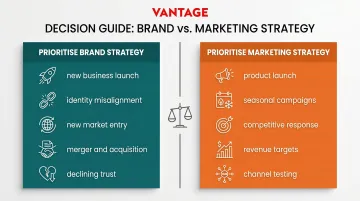
Focus on brand strategy when:
- Launching a new business or undergoing significant repositioning
- Experiencing internal misalignment about company identity or values
- Entering new markets where brand perception will determine success
- Merging with or acquiring another organisation
- Facing declining customer trust or loyalty
Focus on marketing strategy when:
- Launching a specific product or service
- Running seasonal or promotional campaigns
- Responding to competitive market dynamics
- Meeting short-term revenue or lead generation targets
- Testing new channels or audience segments
84% of top-performing marketers effectively manage both short-term and long-term KPIs—balancing brand building with demand generation—compared to only 57% of average performers. The gap between those two numbers is where brand strategy does its work.
Frequently Asked Questions
What is the difference between brand strategy and marketing strategy?
Brand strategy defines who a business is—its identity, values, and positioning—and is long-term. Marketing strategy defines how a business promotes itself through campaigns, channels, and tactics, operating on shorter timescales. Brand strategy informs marketing strategy, not the other way around.
What is the difference between a marketing strategist and a brand strategist?
A brand strategist focuses on shaping brand perception, positioning, and identity over the long term, working on foundational elements like purpose and values. A marketing strategist plans and executes campaigns to drive measurable business outcomes such as leads and sales.
Does brand strategy or marketing strategy come first?
Brand strategy comes first. It establishes the foundation—purpose, positioning, and identity—that marketing strategy then activates through campaigns and channels. Marketing without brand strategy risks inconsistency, wasted spend, and fragmented customer perception.
Can a small business have both a brand strategy and a marketing strategy?
Yes. Brand strategy doesn't require large budgets—only clarity of purpose and positioning. Even a simple brand framework significantly improves marketing effectiveness by ensuring consistency and focus, making it worthwhile for businesses of any size.
How often should you update your brand strategy vs. your marketing strategy?
Marketing strategy should be reviewed regularly, quarterly or per campaign cycle, to adapt to market conditions. Brand strategy is revisited only during significant milestones: rebranding, mergers, market expansion, or major shifts in business direction.
What happens if you run marketing without a brand strategy?
Without brand strategy, marketing tends to be reactive, inconsistent, and harder to scale. The compounding effect shows up quickly:
- Messaging varies across channels with no unifying voice
- Campaigns generate short-term activity but don't build loyalty
- Customer perception becomes fragmented, eroding brand equity