Introduction
In 2026, brand strategy has evolved from a creative afterthought to a core business decision — particularly for companies competing across Asia's crowded, high-stakes markets. Brand values in Southeast Asia have grown 10% year-over-year to reach $131.3 billion, according to Kantar BrandZ.
Indonesian bank BCA's brand value soared 21% to $28.3 billion. Singapore's DBS commands $11.8 billion in brand equity. The returns on strategic branding are measurable and significant.
The challenge is that hundreds of agencies claim to "do branding," but few can demonstrate the research rigor, strategic methodology, and cross-market cultural fluency needed to build brands that perform. Separating strategic partners who deliver measurable impact from style-only vendors who produce beautiful work with no business outcomes is where most companies go wrong.
The cost of getting it wrong is steep. Tropicana's rushed packaging redesign cost $30 million in just two months. Best Buy's failure to localize in China forced a complete market exit despite substantial investment.
This guide walks through a practical decision framework for choosing the right brand strategy agency — covering what to evaluate, what to avoid, and how to match an agency's capabilities to your specific market context in Asia.
TL;DR
- Brand strategy agencies build long-term positioning foundations — marketing agencies activate them through campaigns
- Selection depends on six factors: methodology, portfolio quality, market experience, cultural fit, service scope, and budget transparency
- Research-first agencies (e.g., those using Kantar's MDS framework) deliver up to 5x greater market penetration than visual-led ones
- Singapore branding costs range from S$30,000–S$80,000+ for strategy-led work, with up to 50% EDG grant support available for SMEs
- Red flags: skipping discovery, vague processes, narrow portfolio styles, and no ability to link work to business outcomes
What Is a Brand Strategy Agency?
A brand strategy agency helps businesses define who they are, who they serve, and how they show up in the market — through research, positioning, messaging, and identity systems. Brand strategy firms build the long-term foundation that makes all marketing more effective.
That distinguishes them from both marketing agencies (focused on short-term campaign activation) and pure design agencies (focused on visual polish). Strategy-led firms ensure every creative decision flows from market insight and competitive positioning.
Put simply: branding establishes why you matter and who you are. Marketing uses that foundation to drive awareness and sales — the architecture first, then the activation built on top.
Core Services to Expect
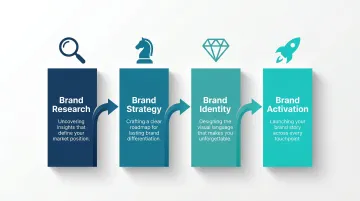
Most brand strategy agencies organize their work around four pillars, though not every firm offers all four:
- Brand Research — Market analysis, competitor audits, stakeholder interviews, and consumer behavior studies that uncover strategic insights
- Brand Strategy — Positioning frameworks, brand architecture, messaging hierarchies, and differentiation strategies grounded in research findings
- Brand Identity — Visual systems (logo, color, typography) and verbal identity (tone of voice, brand narrative) that express the strategy
- Brand Activation — Implementation across touchpoints, from websites and collateral to internal training and customer experience design
In 2026, leading agencies are integrating AI-assisted research tools into their standard offering. Prophet's partnership with Aaru, for example, simulated 12,500 patient journeys in 48 hours to uncover insights impossible to capture through traditional methods. Interbrand invested $300 million in AI technologies to enable real-time consumer data access and sharpen brand valuation modeling.
These research capabilities matter beyond the strategy phase. Top agencies now build omnichannel identity systems from the start, recognizing that brands live across digital platforms, physical spaces, and cultural contexts simultaneously — a necessity in Southeast Asia's diverse, multi-language markets.
Key Factors to Consider When Choosing a Brand Strategy Agency
Choosing the right agency shouldn't be a gut decision. These six factors provide an evidence-based framework aligned with your business goals.
Strategic Methodology: Does the Agency Lead with Research?
Agencies that skip discovery and stakeholder interviews produce generic outputs that collapse under competitive pressure. Research-first methodology is what separates strategic partners from production vendors. Gartner predicts that by 2027, over 40% of CMOs who push for larger brand budgets will lose C-suite influence because they cannot demonstrate sufficient returns—a direct consequence of strategy built on assumptions rather than insight.
Look for agencies with clearly documented processes:
- Brand audit and market analysis conducted before creative work begins
- Stakeholder interviews that capture internal and external perspectives
- Competitor positioning maps and differentiation frameworks
- Strategic briefs that explicitly show how research findings inform creative decisions
Ask specifically: "How do your research insights translate into positioning and identity recommendations?" Agencies with mature methodologies will walk you through their framework confidently. Those without will deflect to creative concepts.
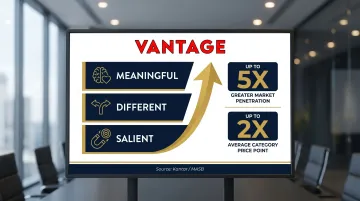
Kantar's Meaningful Different Salient (MDS) Framework—certified by the Marketing Accountability Standards Board—proves the ROI of research-driven branding. Brands scoring high on meaningful differentiation command up to 5x greater market penetration and justify up to 2x the average category price point.
Portfolio: Quality, Range, and Relevance
A strong portfolio demonstrates both creative range and strategic impact—not just visual polish. Look for evidence that the agency's work solved real brand problems:
- Case studies that articulate the business challenge, strategic approach, and measurable outcomes
- Creative diversity across industries showing adaptability rather than a single house style
- Examples of strategic repositioning, not just logo refreshes
Don't place too much weight on exact industry match. An agency with diverse experience often brings fresher thinking than one trapped in sector conventions. A firm that successfully repositioned a healthcare provider and a financial services company typically understands strategic fundamentals better than one with ten similar retail clients.
Warning sign: Portfolios showcasing only award-winning work or recognizable brand names without explaining the strategic rationale or business results. Good branding should be traceable to outcomes—increased market share, improved customer retention, successful market entry, or enhanced stakeholder trust.
Industry and Market Experience
For companies operating in Asia, cultural fluency matters as much as creative capability. 81% of Southeast Asian consumers believe local brands outperform Western competitors in innovation and responsiveness—generic global positioning fails in these markets.
Look for agencies with demonstrated experience in:
- Regional cultural nuances — Understanding how brand messaging resonates differently across Singapore, Malaysia, Vietnam, and other Southeast Asian markets
- Multi-market brand architecture — Managing portfolio brands, sub-brands, and endorsement strategies across geographies
- Sector-specific stakeholder expectations — Healthcare brands require different credibility markers than B2B tech companies; government organizations face unique regulatory and communication constraints
Ask for case studies that reflect your growth context. A startup positioning brief is fundamentally different from an established institution refreshing its brand. If you're preparing for acquisition, you need an agency that understands brand valuation—67% of corporate brands are mispriced in M&A deals due to lack of brand valuation fluency.
Cultural Fit and Collaboration Style
Branding engages leadership teams, internal stakeholders, and sometimes external research participants. The agency relationship works best when both sides operate as genuine collaborators with shared accountability for outcomes.
Assess cultural fit during initial conversations:
- Are they asking smart questions about your business, or pitching immediately?
- Do they challenge assumptions respectfully, or just affirm everything you say?
- Is their communication style transparent and collaborative, or defensive and closed?
- Do they demonstrate genuine curiosity about your market and customers?
A serious agency will have clear expectations around stakeholder access, feedback cycles, and decision-making timelines. This signals process maturity. Vague timelines or reluctance to discuss project governance leads to scope creep, delays, and misaligned outputs.
Full-Service Capabilities vs. Specialist Focus
A full-service agency (strategy + identity + activation) offers continuity across the entire engagement. A specialist firm may go deeper in one area but requires you to manage multiple partners and maintain strategic consistency yourself.
Match agency type to your actual need:
- If you have strong in-house designers but lack strategic positioning clarity, a strategy specialist delivers more value
- If you're starting from scratch or entering a new market, a full-service partner ensures every touchpoint flows from the same strategic foundation
- If your brand architecture is complex (multiple sub-brands, regional variations, portfolio management), choose an agency with demonstrated multi-brand governance experience
Ask directly: "Which services do you deliver in-house versus through partners?" Understanding their operational model helps you assess whether coordination complexity will fall on your team or theirs.
Budget Transparency and Long-Term ROI
Understanding cost structures upfront prevents misalignment later. In Singapore and broader Asia, strategy-led branding projects typically fall into these ranges:
| Engagement Scope | Estimated Cost (SGD) | Typical Deliverables |
|---|---|---|
| Boutique/Mid-Tier | $10,000–$45,000 | Brand positioning, messaging framework, visual identity system |
| Strategy-Led | $30,000–$80,000+ | Deep research, positioning, narrative, identity, web UX planning |
| Enterprise/Global | $150,000–$500,000+ | Multi-market research, stakeholder workshops, brand governance, implementation |
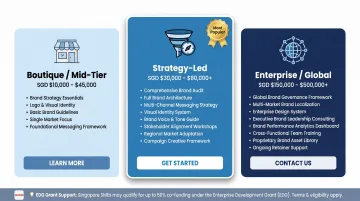
Cost drivers include research depth (adding 15–25% to upfront costs), physical collateral, brand architecture complexity, and intellectual property registration. Eligible SMEs can access up to 50% grant support through Enterprise Singapore's EDG programme, making premium services substantially more accessible.
The real cost equation extends beyond the project fee. Rushed or poorly researched branding carries severe penalties: Netflix lost 800,000 subscribers during its 2011 Qwikster debacle, and J.C. Penney's pricing rebrand led to a $985 million net loss. Savings from choosing a cheaper agency rarely offset the cost of redoing the work—or rebuilding lost market trust.
Questions to Ask a Brand Strategy Agency Before You Commit
The right questions separate agencies that can actually deliver from those that are good at pitching. Ask these before signing anything:
"Who specifically will lead our project day-to-day, and will we have access to senior strategists throughout — or only during the pitch?" Many agencies sell with senior talent but staff projects with juniors. Get names, roles, and involvement commitments in writing.
"How do you define and measure success for a branding engagement?" Look for agencies that tie outcomes to business objectives — market share, customer retention, lead quality, talent attraction — not just delivery of assets.
"What do you expect from us in terms of stakeholder access, feedback turnaround, and decision-making timelines?" A serious agency will have clear answers. Vague responses here often signal chaotic project management on their end.
"Can you show us how research findings shaped creative decisions in a recent project?" This reveals whether their process is genuinely insight-led or whether research is window dressing for directions they had already decided.
"Which services do you deliver in-house versus through external partners?" Knowing their operational model helps you gauge coordination complexity and where quality control could slip.
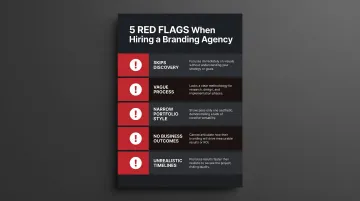
Red Flags to Watch Out For When Hiring a Branding Agency
Agencies that jump straight to creative concepts or logo options before conducting discovery — Skipping discovery means any creative output is built on assumptions, not evidence. If mood boards appear before stakeholder interviews are complete, walk away.
Vague or non-existent process documentation — Ask to see their methodology framework. If they can't clearly map the path from brief to final deliverables, expect scope creep and misaligned outputs.
Narrow style range in their portfolio — If every case study looks visually similar or follows the same creative formula, the agency is likely imposing a house style rather than developing brand expressions rooted in each client's distinct positioning.
Inability to point to business outcomes beyond aesthetics — Good branding should be traceable to results. If case studies only highlight awards or visual before/after comparisons — with no mention of market performance, customer perception shifts, or business growth — the agency likely isn't measuring strategic impact at all.
Overpromising on timelines — Comprehensive rebrands typically require 4–9 months including research, strategy, identity, and activation. Agencies promising full transformations in 6–8 weeks either deliver superficial work or will miss deadlines entirely.
How Vantage Branding Can Help
Vantage Branding is a Singapore-based full-service branding agency built for organisations seeking research-grounded, strategically rigorous brand solutions. With deep experience across healthcare, government, B2B, arts, and technology sectors throughout Singapore, Malaysia, and Vietnam, Vantage combines strategic rigour with creative excellence to build brands that perform.
The agency's collaborative approach keeps clients engaged from strategy through identity development. Rather than working from assumptions, every brand decision is grounded in market research and stakeholder insight.
This methodology has produced successful transformations across sectors:
- Public sector & government: Enterprise Singapore, NUS
- Cultural institutions: Singapore Symphony Orchestra, Sentosa
- Healthcare: Allium Healthcare, ThoughtFull
- Enterprise B2B & technology: CrimsonLogic
Vantage delivers strategy and identity through a single integrated team — no hand-offs between separate agencies, no strategic drift between brief and execution. Their cross-sector experience across Asia also means they bring relevant parallels from adjacent industries while staying grounded in each client's specific market context.
If you're preparing for growth, entering new markets, or seeking to build lasting differentiation in competitive spaces, get in touch to explore how Vantage can support your brand goals.
Frequently Asked Questions
What is the difference between a brand strategy agency and a marketing agency?
A brand strategy agency defines who you are, why you matter, and how you show up—building the long-term foundation through research, positioning, and identity. A marketing agency uses that foundation to drive awareness, leads, and sales through campaigns and channel activation. Both disciplines serve distinct functions; one builds the foundation, the other activates it.
How much does it cost to hire a brand strategy agency in Singapore?
Costs vary based on scope. Strategy-led engagements typically range from S$30,000 to S$80,000+, while comprehensive rebrands can exceed S$150,000. Eligible SMEs can offset up to 50% through Enterprise Singapore's EDG grant. The work typically generates returns across 3–5 years of brand-led growth, making it one of the higher-ROI investments a business can make.
Do I need a brand strategy agency if I already have an in-house marketing team?
Yes—internal teams are often too close to assess the brand objectively. A specialist agency brings external perspective, proven methodology, and cross-industry insight that most in-house teams don't have the bandwidth or cross-sector exposure to develop independently.
How long does a brand strategy project typically take?
Timelines depend on scope. A brand positioning engagement may take 6–10 weeks, while a full rebrand including research, strategy, identity, and activation typically requires 4–9 months. Ask for a phased milestone schedule at proposal stage so expectations are aligned from day one.
What should I look for in a branding agency's portfolio?
Look for strategic range over industry match. Seek evidence of sharp positioning differentiation, a distinct brand voice, and measurable outcomes—not just polished visuals or logos from recognizable names. Case studies should articulate the problem solved, not just the creative produced.
When is the right time to hire a brand strategy agency?
Key triggers include entering new markets, post-funding repositioning, inconsistent brand perception across touchpoints, leadership transitions, or when marketing spend isn't converting. If revenue has plateaued for 18+ months or most deals are being won on price rather than brand preference, your foundation needs professional attention.