
Introduction
Hotels, restaurants, and F&B operators across Asia are competing in a market where offerings increasingly look alike — and guests have endless options at their fingertips. Amenities and location alone no longer set you apart. Travelers consume an average of 141 pages of travel content over 303 minutes in the 45 days before booking, making first impressions and brand clarity more critical than ever.
Standing out requires a brand that creates genuine emotional resonance and builds lasting loyalty. What follows is a practical framework for doing exactly that — across hotels, restaurants, F&B, and service businesses throughout the region.
TLDR:
- Strong hospitality brands achieve 18-23% RevPAR premiums over unbranded competitors
- Acquiring new guests costs 5 to 25 times more than retaining existing ones
- Effective brand strategy covers identity, positioning, storytelling, and guest experience
- Strong branding cuts OTA dependency and creates room for premium pricing
- Track performance through NPS, repeat visit rates, ADR, and online sentiment
What is Hospitality Brand Strategy?
Hospitality brand strategy is the deliberate process of shaping how your business is perceived by guests — spanning identity, values, messaging, visual language, and the end-to-end guest experience. It defines who you are, what you stand for, and why guests should choose you over the alternatives.
Why Hospitality Branding is Uniquely Complex
Unlike product brands where quality can be controlled before purchase, service brands are experienced in real time by people. A hotel room is inspected while staying in it. A restaurant meal is judged bite by bite. Every human interaction—from the front desk greeting to how staff handle a complaint—becomes part of the brand promise.
This makes consistency across every touchpoint far more critical in hospitality than in other sectors. Your brand is not just communicated through marketing; it's lived by your staff and felt by your guests through dozens of micro-moments during each visit.
Brand Strategy as Your Internal Compass
Brand strategy shapes the decisions that guests actually notice — not just what you say, but how you operate:
- How staff greet and interact with guests
- The language used in email confirmations and follow-ups
- Which amenities to prioritize and how to present them
- How the business responds to negative reviews online
- The design of physical spaces and digital touchpoints
Without this clarity, hospitality businesses default to inconsistency. And inconsistency is typically what drives guests to competitors.
Why Brand Strategy is the Competitive Edge in Hospitality
Distinct Identity Drives Guest Choice
Strong branding creates competitive advantage by establishing a distinct identity that helps guests choose your business over competitors offering similar price points or amenities. Independent hotels with documented, clear market positioning achieve RevPAR premiums of 18-23% over unbranded competitors in comparable locations.
The reason is simple: when guests can't differentiate between options based on tangible features alone, brand perception becomes the deciding factor.
The Economics of Guest Loyalty
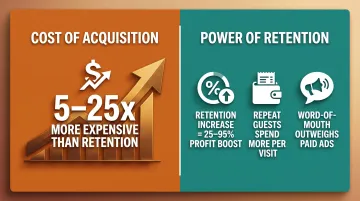
Acquiring a new customer costs 5 to 25 times more than retaining one, yet the hospitality sector retains only 55% of customers—well below the 84% rate in professional services. Independent hotels average only 10-15% repeat guests on any given night, compared to nearly 60% at major hotel chains.
When guests know what to expect—and that promise is consistently delivered—they return and recommend. The compounding effect is significant:
- A 5% increase in retention can boost profits by 25–95% for restaurants on thin margins
- Repeat guests spend more per visit and require less marketing investment
- Word-of-mouth from loyal guests carries more weight than paid acquisition
Premium Pricing Without Discounting
Customers whose emotional needs are met pay a 15% premium for hotel rooms. A 1-point increase in a hotel's review score also allows a property to raise prices by 11.2% without losing market share.
A well-positioned brand supports premium pricing and reduces reliance on discounts or OTA platforms. This matters especially in Singapore, where OTAs captured 52.77% of hospitality market share in 2025—making brand differentiation a direct revenue lever, not just a marketing consideration.
The Core Elements of a Strong Hospitality Brand
Brand Identity: Beyond Visual Design
Brand identity goes far beyond a logo. It encompasses tone of voice, personality, and the values your business stands for. A cohesive visual identity—logo, colour palette, typography, imagery—signals quality and builds recognition before a guest even arrives.
Visual consistency across digital channels shapes booking decisions. User-generated images and guest photos add credibility that branded content alone can't achieve—they show prospective guests what the experience actually looks and feels like.
Key identity components:
- Logo and mark variations for different applications
- Colour palette that evokes the right emotional response
- Typography that reflects personality (modern, classic, approachable, luxurious)
- Photography style and imagery guidelines
- Tone of voice across all written communications
Brand Positioning: Owning Your Space
Positioning defines what your hospitality business stands for in the minds of target guests and why it is the preferred choice. A clear positioning statement guides how the brand communicates across all channels.
Effective positioning answers three questions:
- Who are we for?
- What do we offer?
- Why choose us?
Independent hotels without clear positioning average 8-12% lower RevPAR than positioned competitors. Your positioning must be distinctive, defensible, and deliverable—something competitors can't easily replicate.
Audience Segmentation: Beyond Demographics
Hospitality brands must go beyond demographic data (age, income, location) to understand the emotional drivers and behavioral patterns of their ideal guests.
Critical questions to answer:
- What do guests want to feel when they choose this experience?
- What problems are they trying to solve? (Convenience, status, relaxation, adventure)
- How do they make booking decisions?
- What touchpoints influence their choice?
These insights shape everything from messaging to amenity selection. A business traveller seeking efficiency needs a different experience than a leisure couple seeking romance—and your positioning should clearly signal which you serve best.
Brand Storytelling: Building Emotional Connection
Storytelling builds emotional connection in ways that logos and taglines cannot. A hospitality brand story should communicate why the business exists, what it believes, and what guests become part of when they choose it.
When storytelling is done well, it shapes how guests perceive, remember, and recommend a brand. Singapore's Odette and Raffles Hotel demonstrate this clearly—both draw on heritage, place, and culinary excellence to create narratives that competitors can't simply copy.
Effective brand stories:
- Are authentic, not fabricated
- Connect to guest aspirations or values
- Are told consistently across all touchpoints
- Include staff, founders, heritage, or mission-driven elements
- Make guests feel part of something meaningful
Guest Experience as Brand Proof Point
Every interaction a guest has—from the booking process to check-out to post-visit follow-up—either reinforces or undermines the brand promise. What you communicate must match what you deliver.
Global guest satisfaction reached 86.7% in 2025, driven by responsiveness and consistent service delivery. Yet even small gaps create friction. A beautifully branded website means little if the check-in experience is chaotic or staff don't reflect the brand's promised personality.
Critical experience touchpoints:
- Digital: Website, booking flow, confirmation emails
- Pre-arrival: Communication, directions, preparation
- Arrival: First impressions, greeting, check-in process
- During stay: Service delivery, amenities, problem resolution
- Departure: Check-out, farewell, follow-up communication
The 5 C's of Hospitality Branding
The 5 C's framework breaks down what drives strong hospitality brand strategy:
- Culture — the internal values and behaviors shaping how your team operates and serves guests
- Consistency — the same brand promise delivered across every touchpoint, without exception
- Competence — the training and operational excellence that lets staff actually fulfill those promises
- Communication — clear, authentic messaging that reinforces your positioning across all channels
- Customer-centricity — every decision designed around guest needs, preferences, and emotional drivers
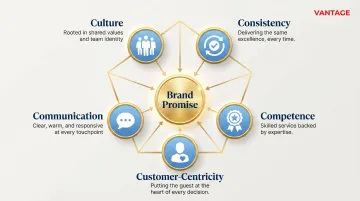
None of these elements works in isolation. Culture without consistency breeds confusion; communication without competence breeds disappointment. Customer-centricity is the thread that holds the rest together — it keeps the brand anchored to what guests actually need, not what the organization assumes they want.
How to Build a Hospitality Brand Strategy: A Step-by-Step Approach
Step 1: Research Your Market and Competitors
Before defining your brand, understand the landscape. Identify how competitors position themselves, what language they use, what promises they make, and where gaps exist.
Research activities:
- Competitive brand audits (visual identity, messaging, positioning)
- Guest review analysis (what guests praise and criticize)
- Price positioning and value perception mapping
- Market trend analysis (shifting guest preferences and behaviors)
The goal is not imitation but informed differentiation—finding the space only your brand can own. Singapore's F&B sector shows consumers dining out less frequently but shifting budgets to premium options, with 42% spent on higher-priced venues. This insight might inform positioning around quality over convenience.
Step 2: Define Your Brand Foundation
Articulate why your business exists (mission), where it's headed (vision), and what unique value it offers that no one else does (USP). These three elements form the strategic core that all branding decisions flow from.
Mission statement example: "To create memorable stays that restore and inspire travelers seeking authentic local experiences."
Vision statement example: "To become the preferred boutique hotel choice for culturally curious travelers across Southeast Asia by 2028."
Unique Selling Proposition example: "The only heritage hotel in the district offering curated neighborhood walking tours led by local historians."
Step 3: Choose a Brand Strategy Approach
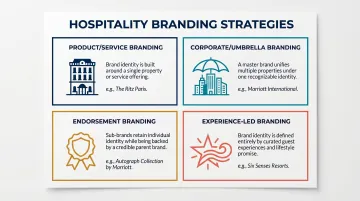
Four branding strategies commonly apply in hospitality, depending on your scale and growth ambitions:
Product/Service Branding: Individual properties or restaurants branded independently (e.g., a single boutique hotel with its own distinct identity).
Corporate/Umbrella Branding: All properties carry the parent company name (e.g., Marriott, Accor). Builds equity at scale but limits individual property flexibility.
Endorsement Branding: Parent brand endorses individual properties (e.g., "A Hilton Hotel"). Balances local identity with corporate credibility.
Experience-Led Branding: Brand built around a specific guest experience or lifestyle rather than corporate structure (for example, lifestyle hotel concepts or themed restaurant groups).
Choose the strategy that reflects your current scale and long-term growth ambitions. Independent operators typically benefit from product/service branding that allows maximum differentiation. Independent operators typically benefit from product/service branding that allows maximum differentiation. Once that strategic direction is set, the next step is translating it into a visible, consistent identity.
Step 4: Develop Brand Identity and Messaging
Translate strategic foundations into visual and verbal expression—logo, color palette, tone of voice, and key messages that speak directly to your target guest. This stage determines how consistently and memorably your brand shows up across every touchpoint.
For hospitality businesses, professional identity development matters more than in most industries: guests form impressions within seconds of seeing a menu, a room, or a social post. Working with a branding agency experienced in destination and F&B contexts—such as Vantage Branding, which has worked with hospitality and destination clients across Singapore—can help ensure the creative output reflects genuine strategic thinking, not just aesthetic preference.
Identity deliverables should include:
- Primary and secondary logo variations
- Color palette with usage guidelines
- Typography system
- Photography and imagery style
- Key messaging framework (tagline, value propositions, tone of voice)
- Brand guidelines document for consistent application
Step 5: Apply Brand Across Operations and Culture
Your brand only works if the people delivering it understand what it stands for. Staff who genuinely grasp the brand's values—not just its logo—are far more effective than those following a service script.
If your brand promises warm, personalized service, that promise must be backed by training, empowerment, and operational standards that make it achievable. Physical environment design should reinforce the same values your messaging communicates externally.
Implementation activities:
- Staff onboarding that includes brand vision, values, and positioning
- Service standards aligned to brand promise
- Physical environment design reflecting brand personality
- Operational processes that support brand experience (for example, check-in speed and problem resolution)
- Internal communications reinforcing brand values
Bringing Your Brand to Life at Every Guest Touchpoint
Pre-Arrival: Digital and Discovery
The brand experience begins the moment a potential guest encounters your business online—through a website, social media, reviews, or search results. Travelers view an average of 141 pages of travel content over 303 minutes in the 45 days before booking, with 80% visiting an OTA during this phase.
Digital consistency—visual language, tone, messaging—shapes first impressions and drives booking decisions. A 1-second delay in page load time can lead to a 7% reduction in conversions, demonstrating how technical performance also impacts brand perception.
Critical digital touchpoints:
- Website design and user experience
- Booking flow clarity and ease
- Social media presence and content
- Email confirmations and pre-arrival communications
- Online reviews and reputation management
During the Stay or Service
Every in-person interaction—from the welcome to service recovery—is a brand moment. Staff behavior, physical environment, and small curated details (welcome notes, packaging, presentation) collectively tell the brand story.
These moments carry the highest impact on emotional memory and word-of-mouth. How guests feel during their stay shapes satisfaction, emotional loyalty, and the stories they share afterward. Staff need to understand the brand deeply enough to deliver on it in the moment—not just follow a script.
In-stay brand moments:
- First greeting and check-in experience
- Room/space presentation and amenities
- Service interactions (concierge, dining, housekeeping)
- Problem resolution and service recovery
- Surprise-and-delight moments aligned to brand promise
Post-Visit Engagement
Post-visit communication is where many hospitality brands leave value on the table. Follow-up messages, loyalty touchpoints, review responses, and re-engagement campaigns all drive repeat bookings—and deepen the guest's connection to the brand over time.
77% of travelers are more likely to book when owners respond to reviews, and 89% said a thoughtful response to a negative review improved their impression. Personalization in post-visit campaigns can reduce acquisition costs by up to 50% and lift revenue by 5% to 15%.
Post-visit touchpoints:
- Thank you messages and satisfaction surveys
- Review solicitation and responses
- Loyalty program communications
- Re-engagement campaigns ("We miss you" offers)
- Social media engagement with guest-generated content
Measuring the Effectiveness of Your Hospitality Brand
Brand performance must be tracked with a combination of experience and business metrics. Measurement should inform strategy reviews and identify gaps between perception and experience.
Key Performance Indicators
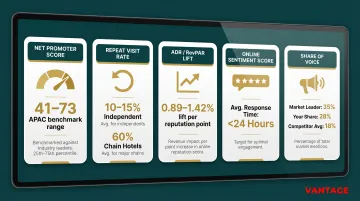
Strong hospitality brands monitor a core set of metrics that connect guest perception to business outcomes:
Net Promoter Score (NPS): Measures guest advocacy and likelihood to recommend. Across APAC, luxury hotels average 73, boutique properties 63, and upper midscale 41 (source: industry benchmarking data — verify and link source before publication).
Repeat Visit Rate: Tracks loyalty. Major chains achieve nearly 60% repeat guests compared to 10–15% for weaker independent brands — a direct revenue indicator.
Average Daily Rate (ADR) / Average Transaction Value: Signals brand premium. A 1% improvement in online reputation score correlates with a 0.89% rise in ADR and a 1.42% rise in RevPAR (source: verify and link before publication).
Online Sentiment and Review Scores: Reflects perceived experience quality. Global average hotel review response times dropped from 10 days in 2021 to 3.2 days in 2025 (source: verify and link before publication), setting a rising baseline for responsiveness.
Share of Voice: Measures brand visibility relative to competitors through mentions, search volume, and social media presence.
When to Review and Refresh
Hospitality businesses should review brand performance annually, drawing on guest feedback, competitive shifts, and business results. The critical question in every review: is the brand promise being delivered consistently? That gap — between what guests expect and what they actually experience — is where most hospitality brands lose ground.
Major brand refreshes typically occur every 5–7 years, or sooner when:
- Guest expectations have shifted
- Competitive positioning has changed
- The business model has evolved (new services, markets, or segments)
- Visual identity feels dated relative to current market standards
Frequently Asked Questions
What are the 5 C's of hospitality?
The 5 C's—Culture, Consistency, Competence, Communication, and Customer-centricity—are foundational principles that guide service delivery and brand experience. Together, they ensure internal operations and external perceptions align to create consistent, recognisable guest experiences that set a property apart.
What are the 4 types of branding strategies?
The four types are product/service branding (individual property focus), corporate/umbrella branding (parent company identity), endorsement branding (parent endorses individual properties), and experience-led branding (lifestyle or experience-focused identity). A single boutique property typically suits product branding; a hotel group operating across markets benefits more from umbrella or endorsement models.
What are the 4 P's of the hospitality industry?
The marketing mix—Product, Price, Place, and Promotion—applies specifically in hospitality where "product" is the service experience itself and "place" includes both digital environments (website, OTA listings) and physical locations where service is delivered.
How is hospitality branding different from regular branding?
Hospitality branding is uniquely experience-driven: the brand is not just communicated through marketing but lived by staff and felt by guests in real time. Consistency across human touchpoints is especially critical because service quality varies with each interaction.
How do you build guest loyalty through branding?
Loyalty follows consistent delivery on your brand's core promise — reliable service, personal follow-up, and engagement between visits. Guests who feel that promise kept return more often and refer others without prompting.
How often should a hospitality brand be refreshed?
Plan annual brand performance reviews, with major identity refreshes typically every 5–7 years. Refresh sooner if guest expectations, competitive positioning, or your business model has shifted, or if your visual identity no longer reflects how guests perceive the market.