This isn't a product problem. It's a brand strategy problem.
Most businesses treat brand strategy as something to figure out after launch, once "real" work is done. But the companies that succeed—especially in competitive markets like Singapore and across Asia—understand that brand strategy is the strategic foundation that determines whether a launch lands or disappears. This article explains the tangible business advantages of having brand strategy in place before launch day: pricing confidence, marketing efficiency, and customer loyalty that compounds over time.
TL;DR
- Brand strategy defines who you are, who you're for, and why you matter. That clarity has to exist before you enter the market.
- Without it, launches rely on guesswork in pricing, messaging, and targeting—burning budget before you find traction
- Pre-launch brand strategy creates a warm audience, consistent messaging, and a defensible market position
- Skipping strategy often triggers expensive rework—redesigned packaging, repriced products, or full rebrands within 12 months
- Brands built on strategy before launch attract the right customers faster, at lower acquisition cost, and retain them longer
What Is Brand Strategy? (And Why It's Not Just a Logo)
Brand strategy is the documented understanding of who your brand is, what it promises, who it serves, and how it should be experienced. Not a logo, not a colour palette — and certainly not a website.
According to the American Marketing Association (AMA), branding is "the process of creating a unique identity for your business that resonates with your target audience," explicitly stating it is "more than just your logo or catchy tagline; it's how people perceive and feel about your business as a whole, including your values, your personality, and how you communicate with your customers."
Where Brand Strategy Lives in Your Business
Brand strategy isn't just a marketing asset. It's a cross-functional tool that informs decisions across every customer-facing function:
- Shapes which product features matter most and how quality expectations influence decisions
- Establishes your market position and whether your pricing can command a premium
- Guides marketing voice, messaging hierarchy, and channel selection
- Gives sales teams a clear value proposition and differentiation story
- Defines how the brand should be experienced at every customer touchpoint
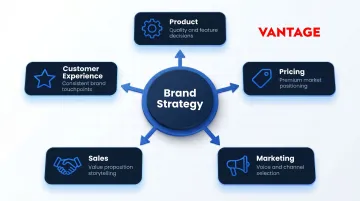
This cross-functional reach is well documented. McKinsey notes that building a brand requires "a concerted, creative effort throughout the organisation" — not solely within marketing — and that a brand's intangible, emotional benefits "frequently serve as the basis for long-term competitive differentiation and sustained loyalty."
Brand strategy is a means to a commercial outcome. Its value lies in the clarity and consistency it creates across every customer-facing decision, before and after launch.
Why Brand Strategy Must Come Before Your Product Launch
The advantages below aren't theoretical. They directly affect cost efficiency, launch speed, pricing power, marketing ROI, and customer acquisition. Each is tied to decisions that, if made without brand strategy, must be revisited at significant cost later.
Advantage 1: Pricing Confidence and Product Design Alignment
Brand strategy forces early clarity on your target audience, their expectations, and their willingness to pay. This directly shapes product design criteria—materials, features, manufacturing cost—before a single dollar is spent on tooling or production.
How this works in practice:
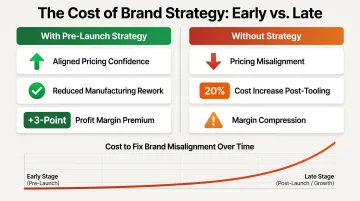
When a brand knows it is positioned as premium, every design and sourcing decision is made with that price point in mind from the start. When brand strategy is absent, products are often built on manufacturing cost assumptions, then forced into a market where the price point doesn't fit—requiring costly redesigns or margin compression.
Bain & Company's 2025 research found that companies confident in their pricing strategy achieve a 3-point profit margin premium over peers, with the gap ranging from 5 to 11 percentage points depending on industry. Separately, 52% of companies planning to raise prices are investing in frontline training to articulate unique value propositions that justify premium pricing.
Edelman Trust Institute data shows 59% of consumers are willing to pay more for brands that "do good in the world"—but only if that purpose is clear and credible from the start.
The cost of getting it wrong:
CMM Quarterly documents that design changes after tooling can increase costs by 20%, with the cost curve following an exponential trend. Digital-phase changes occur at negligible cost; post-tooling changes multiply by orders of magnitude.
KPIs impacted:
- Gross margin
- Manufacturing cost per unit
- Price-to-value perception
- Time to first profitable sale
Most relevant for: Physical product launches, new market entries, or any business where production costs are fixed early in development.
Advantage 2: Marketing Efficiency and Pre-Launch Audience Building
A defined brand strategy gives marketing teams a precise audience profile and a consistent message. Pre-launch content, advertising, and community building become targeted rather than broad, reducing wasted spend.
How this plays out:
Brands with strategy in place before launch can begin building audience awareness and emotional connection weeks or months in advance—teasing values, story, and promise, not just the product. Launch day arrives with a warm, ready-to-buy audience rather than a cold start.
The scale of marketing waste without strategy:
McKinsey's State of Marketing Europe 2026 report found that only 3% of CMOs can demonstrate marketing ROI of more than 50% of their spend, despite 72% planning to increase budgets. The vast majority of marketing investment, in other words, cannot be verified as effective.
Next&Co's Digital Media Wastage Report found that 42% of digital ad spend was wasted in Q1 2024, amounting to $97.1 million across audited companies. For 2023, a record $6.149 billion was wasted Australia-wide.
Why strategy changes the equation:
Clear brand positioning reduces the trial-and-error phase of finding the right audience and message—the phase where most launch budgets quietly disappear.
KPIs impacted:
- Cost per lead
- Ad conversion rate
- Pre-launch sign-up or waitlist volume
- Email open rates
- Time to audience threshold
Most relevant for: Startups with limited budgets, direct-to-consumer launches, and markets with high competitive noise where generic messaging fails to cut through.
Advantage 3: Trust, Differentiation, and Day-One Customer Loyalty
In saturated markets, customers don't just buy products—they buy into brands. A clear brand identity (values, voice, positioning) creates recognition and emotional resonance before the product is even available.
Trust as a purchase driver:
The 2025 Edelman Trust Barometer Special Report surveyed 15,000 respondents across 15 countries and found:
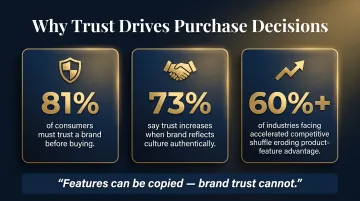
- 81% of consumers need to trust a brand before buying from it
- Trust now ranks alongside price and quality as a primary purchase consideration
- 73% say their trust in a brand would increase if it "authentically reflected today's culture"
- Only 27% say trust would increase if a brand "ignores culture and focuses solely on products"
This pattern is especially pronounced in Singapore and across Asia, where trust and relationships shape buying decisions as much as product specs. NIQ's APAC Consumer Outlook confirms that APAC consumers "think carefully before buying," "look for clear and trustworthy product information," and "use technology to compare and validate."
Why product features alone won't hold your position:
Features can be copied within months—but a brand's story, values, and relationship with its audience take years to build and cannot be reverse-engineered. McKinsey's analysis shows that competitive advantage "shuffle rate" has accelerated for more than 60% of industries in the past decade, with disruptive trends and new entrants eroding product-feature-based differentiation.
KPIs impacted:
- Customer retention rate
- Net Promoter Score (NPS)
- Referral rate
- Customer lifetime value
- Brand recall in target segment
Most relevant for: Industries with long buyer decision cycles (healthcare, B2B, professional services), premium-positioned products, and any brand competing against established incumbents.
What Happens When You Skip Brand Strategy Before Launch
Launching without brand strategy creates real operational pain, not just abstract risk. The consequences fall into four predictable patterns.
Messaging falls apart across teams. Without a shared brand framework, sales describes the offering one way, marketing another, and product a third. Potential customers encounter mixed signals and disengage before ever reaching a purchase decision.
Pricing becomes impossible to defend. The brand either undersells itself or can't justify its price point because no brand equity was built to support it. The Lucidpress/Marq Brand Consistency Report found that 68% of businesses say brand consistency contributed to revenue growth of 10% or more, with consistent brand presentation increasing revenue by up to 23%.
Acquisition costs spike. Without knowing who the brand is for, teams default to broad-reach campaigns trying to find their customer after launch. CB Insights' analysis of 431 VC-backed startup failures found 43% cited poor product-market fit as a primary cause — a direct result of launching without a defined market position.
Rebranding becomes unavoidable within 12–18 months when initial brand perception misses the mark. The cost is higher than most teams anticipate:
- Agency fees for strategy, identity, and design rework
- Lost brand equity built with early customers
- Customer confusion during the transition period
- Internal resources diverted from growth to correction
How to Build Your Brand Strategy Before Launch
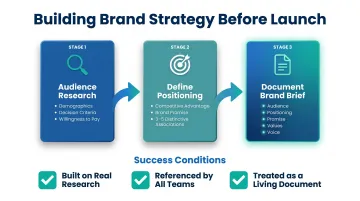
Brand strategy before launch doesn't require a year-long process, but it does require working through a defined sequence:
1. Understand the target audience deeply Go beyond demographics. Identify their expectations, decision criteria, emotional drivers, and willingness to pay through customer research, not internal assumptions.
2. Clarify the brand's unique positioning in the market Define your competitive advantage, brand promise, and the 3-5 distinctive associations that are credible, valuable, and defensible.
3. Document the core brand elements Produce a practical brand brief covering:
- Target audience definition
- Brand positioning and differentiation
- Brand promise
- Core values
- Brand voice and tone
These elements inform visual identity and messaging, not the other way around.
The process only delivers value when three conditions are met:
- Built on real customer research — interviews, competitor audits, not internal assumptions
- Referenced by all teams: marketing, sales, product, and customer service
- Treated as a living document, reviewed and refined against market feedback
For businesses launching into Singapore, across Asia, or into multiple markets at once, the stakes are higher. Regional differences in trust signals, cultural expectations, and competitive dynamics can make or break an early-stage brand. Vantage Branding works with companies at this stage — conducting the market research, developing positioning, and building brand foundations that hold up across markets — so post-launch corrections don't become the plan.
Conclusion
Brand strategy before a product launch isn't a creative luxury. It's the operational foundation that determines pricing logic, marketing efficiency, and customer trust from day one.
A brand built with clarity before launch attracts the right customers faster, spends less to acquire them, and gives them a reason to stay. The Lucidpress research shows that brand consistency alone can contribute to 10-23% revenue growth — but only if that consistency is established before launch, not pieced together reactively afterward.
The mindset shift is straightforward: a product launch is the deadline for brand thinking, not the starting line. Brand strategy should be complete before the product is ready — so that when launch day arrives, everything communicates with one clear, consistent voice.
Frequently Asked Questions
What is a pre-launch marketing strategy?
A pre-launch marketing strategy is the set of activities—content, advertising, community-building, and brand positioning—executed before a product goes to market. Its purpose is to create awareness, build an audience, and generate demand so that launch day arrives with momentum rather than silence.
What is brand strategy?
Brand strategy is the documented framework covering who a brand is, who it serves, what it promises, and how it should be perceived. It is distinct from visual identity (logos, colours) and guides decisions across marketing, sales, product development, and customer experience.
Why is branding important before a product launch?
Branding before launch ensures every decision—from product design and pricing to marketing messages and channel selection—is made in alignment with a clear market position. This prevents costly rework and gives the launch a stronger, more targeted foundation from day one.
What should come first—brand strategy or product development?
Brand strategy should come first. It defines the target audience and their expectations, which shapes product design criteria, acceptable price points, and go-to-market approach. This avoids the common trap of building a product and then searching for a market to fit it.
How long does it take to develop a brand strategy before launch?
A focused brand strategy process ranges from a few weeks to a few months, depending on business complexity, market research requirements, and organisational readiness. Starting with even a concise strategy brief early in product development gives every subsequent decision a clearer direction.
What are the key elements of a brand strategy?
Core components include target audience definition, brand positioning and differentiation, brand promise, core values, and brand voice and tone. Together, these elements inform visual identity and messaging so every piece of communication reinforces the same brand perception.