Introduction
Every founder hits the same wall: branding quotes that swing from S$500 to S$200,000, with no clear explanation for what you're actually paying for. A freelancer delivers a logo in 48 hours. A boutique agency proposes a six-week strategy engagement. Both might be the right answer — or exactly wrong — depending on where your startup stands.
Research shows that 40% of SMEs who choose budget branding options require a full rebrand within 18 months, burning capital they didn't plan to spend. Meanwhile, founders who overinvest before product-market fit waste runway on assets that pivot away within quarters.
Both mistakes are avoidable. This guide breaks down what startup branding costs by tier and stage, explains what drives pricing, and helps you build a budget that fits where your business is now — not where you hope it'll be in three years.
TLDR
- Startup branding costs range from under S$1,000 (DIY tools) to S$200,000+ depending on scope, partner, and stage
- Core cost drivers: scope of work, who executes it, and your startup's growth stage
- Pre-seed startups need credible baselines, not full brand systems — save strategic depth for seed and Series A
- Hidden implementation costs typically add 2–3x on top of the core agency fee — budget for these before signing any contract
How Much Does Startup Branding Cost?
Startup branding has no fixed price. The same word "branding" describes a S$500 logo from Fiverr and a S$500,000 transformation by Pentagram. Confusing the two leads to chronic underinvestment or wasted capital.
What Goes Wrong When Cost Is Misunderstood
Three mistakes repeat across founders at every stage:
- Underbudgeting for a professional system — Founders pay S$800 for a logo, skip strategy and guidelines, then rebuild everything 18 months later because the mark doesn't scale and nobody knows how to apply it consistently.
- Overspending before product-market fit — Pre-revenue founders invest S$75,000 in a polished identity before validating the business model. When the product pivots, the brand becomes irrelevant before launch.
- Missing hidden implementation costs — Website development, collateral production, trademark filing, and internal training often equal or exceed the core agency fee. A S$50,000 agency engagement realistically requires S$100,000–S$150,000 total to activate across touchpoints.
Tier 1 — DIY and Budget Options (Under S$1,000)
What's Typically Included:
| Platform | Cost Range | Deliverables | |----------|-----------|--------------|\n| Canva Pro | S$144/year | 5 brand kits, premium templates, AI tools | | Looka | S$20–S$65 (logo) / S$96/year (brand kit) | AI-generated logo files, basic templates | | Fiverr | S$5–S$2,200+ | Logo design from beginner to Pro tiers | | 99designs | S$299–S$1,299 (contests) | Multiple concepts via crowd contest |
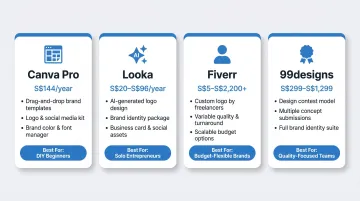
Best For: Idea-stage founders testing concepts who need something credible for initial conversations — not for pitching investors, closing enterprise deals, or entering competitive markets where perception drives trust.
Important Note: Crowdsourced contests have been criticized by design organizations like AIGA for devaluing professional work and creating intellectual property risks. These platforms deliver visual assets without strategic positioning.
Tier 2 — Freelancers and Boutique Agencies (S$5,000–S$30,000)
What's Typically Included:
| Budget Range | Provider Type | Typical Deliverables |
|---|---|---|
| S$5,000–S$10,000 | Senior freelancer or small studio | Logo system, color palette, typography, basic PDF guidelines, simple templates |
| S$15,000–S$30,000 | Boutique branding agency | Strategy workshops, competitor analysis, expanded visual system, messaging framework, comprehensive guidelines |
Scope varies across this range. At the lower end, expect execution-focused deliverables — a professional logo, color palette, and basic usage rules. At the upper end, agencies include positioning research, stakeholder interviews, and messaging frameworks that inform how the brand communicates.
Best For: Seed-stage and early-funded startups that have validated product-market fit and need a brand that looks established, attracts early hires, and holds up through investor conversations. This tier delivers professional credibility without the overhead of full-service agencies.
Tier 3 — Full-Service Branding Agencies (S$50,000–S$200,000+)
What's Typically Included: Top-tier firms like Pentagram, Landor, Wolff Olins, and Lippincott — as well as Singapore agencies like Vantage Branding — handle comprehensive brand transformations that go well beyond visual identity:
- Deep discovery: market research, audience segmentation, stakeholder workshops
- Full brand strategy: positioning, architecture, competitive differentiation
- Complete identity systems: visual and verbal identity, comprehensive guidelines
- Digital brand portals: governance frameworks replacing static PDFs
- Rollout support: internal training, vendor enablement, application templates
- Long-term asset durability: systems built to last 3-5 years across scaling
Best For: Series A and beyond companies scaling sales teams, entering new markets, preparing for acquisitions, or executing rebrands that need to last through multiple growth stages. At this stage, brand supports hiring, enterprise sales, and market expansion simultaneously.
At this investment level, the agency relationship extends beyond deliverables — strategy, identity, and implementation stay aligned under one team, which matters when consistency across vendors is difficult to enforce independently.
What Does Startup Branding Actually Include? A Component Cost Breakdown
Total branding investment is never one line item. It's a collection of components, each with its own cost range. Founders who only budget for the logo routinely underestimate total spend by 2-3x.
Brand Strategy and Positioning
One-Time Investment
Covers discovery workshops, stakeholder interviews, competitive analysis, and a positioning framework that defines what your brand stands for.
| Provider Type | Cost Range |
|---|---|
| Freelance / Boutique | S$2,000–S$15,000 |
| Mid-to-Large Agency | S$15,000–S$75,000+ |
Startups that skip brand strategy end up with visual consistency but no foundation to guide messaging, hiring, or positioning decisions. The result is a brand that looks cohesive but can't articulate why customers should choose it.
Visual Identity (Logo and Design System)
One-Time Investment
A logo is a single mark. A visual identity system includes typography, color palette, iconography, layout patterns, and usage guidelines that ensure consistency across every touchpoint.
| Provider Type | Cost Range |
|---|---|
| Freelance / Boutique | S$3,000–S$15,000 |
| Mid-to-Large Agency | S$15,000–S$100,000+ |
The investment gap reflects scope: logo-only engagements sit at the lower end, while full systems with comprehensive application rules sit at the upper end.
Verbal Identity and Messaging
One-Time Investment
Includes brand voice, tone of voice guidelines, tagline, key messaging pillars, and copy frameworks.
| Provider Type | Cost Range |
|---|---|
| Freelance / Boutique | S$2,000–S$15,000 |
| Mid-to-Large Agency | S$20,000–S$50,000+ |
Without verbal identity work, the same startup can sound like three different companies across pitch decks, the website, and social content — each channel telling a different story.
Brand Guidelines
One-Time Investment
The playbook that ensures everyone — internal teams, freelancers, vendors — applies the brand correctly.
Format choice depends on where the company is headed:
- Basic PDF guidelines: S$2,000–S$5,000 (suitable for teams under 10)
- Digital brand portals (Frontify, Brandfolder, Bynder): Custom pricing based on users and storage, typically starting at S$10,000+ annually
Static PDFs work for small teams. Digital portals enable scaling organizations to manage assets, enforce usage rules, and onboard vendors efficiently.
Website Design and Collateral
One-Time or Recurring (refresh)
The highest-variability cost component. Website design and website development are often billed separately, and collateral (pitch decks, social templates, one-pagers) is frequently excluded from core agency proposals.
| Component | Cost Range |
|---|---|
| Website Design (design only) | S$5,000–S$60,000+ |
| Website Development | S$10,000–S$120,000+ |
| Pitch Deck Design | S$500–S$25,000+ |
Budget accordingly: a S$50,000 brand identity engagement rarely includes website development, which can double total investment.
Key Factors That Affect the Cost of Startup Branding
Two startups can receive wildly different quotes for what appears to be the same scope. These factors explain why.
Scope of Work
The single largest cost driver. Each scope expansion compounds investment:
- Logo only: S$500–S$3,000
- Logo + identity system: S$5,000–S$15,000
- Strategy + identity system: S$15,000–S$50,000
- Full brand platform (strategy, identity, messaging, guidelines, rollout): S$50,000–S$200,000+
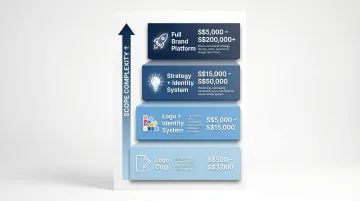
A logo-only engagement costs a fraction of a full brand system because the underlying work — research, workshops, application design, governance frameworks — grows exponentially with each scope addition.
Who Does the Work
Four main partner models deliver different outputs beyond the visual mark:
- DIY/AI tools: Fast and cheap, but no strategic input. You get logo files and templates — nothing more.
- Freelancers: Professional execution with limited strategic depth. Works well for tactical design when positioning is already defined.
- Boutique agencies: Strategy and execution under one roof, with closer collaboration and smaller teams. The sweet spot for seed-stage startups balancing cost and quality.
- Large agencies: Multi-disciplinary teams with enterprise-grade strategy and global rollout capability. Built for scaling complexity, not early-stage agility.
The cheapest option is not always the most cost-effective over time. A S$500 logo requiring replacement in 18 months costs more than a S$5,000 identity built to last.
Startup Stage and Complexity
Later-stage companies have more stakeholders, more existing brand equity to navigate, more touchpoints to design, and higher quality expectations — all of which increase project cost.
Seed-stage engagement: Fewer decisions, narrower scope, smaller internal teams, limited touchpoints. Branding focuses on establishing credibility with investors and early customers.
Series A rebrand: Scope expands considerably at this stage:
- More stakeholders requiring alignment across departments
- Existing brand equity to audit before any redesign
- Broader touchpoint ecosystem: sales collateral, product UI, investor decks, hiring materials
- Higher expectations for strategic depth and implementation support
Timeline and Geography
Rush timelines: Expedited projects typically command a 25-50% premium (sometimes up to 100%) due to parallel workstreams, prioritization over other clients, and compressed feedback cycles.
Geographic pricing differences: Median freelance and agency rates in South/Southeast Asia average S$20-S$50/hour, while North American and Western European rates average S$85-S$150+/hour. Location still influences cost, though remote work has narrowed gaps. Singapore-based agencies price within the boutique tier range and offer local market knowledge and regional audience understanding that Western agencies may lack.
Matching Your Branding Budget to Your Startup Stage
The right branding investment matches scope and ambition to where the business actually is. Overspending too early burns runway; underspending too late creates friction with investors and customers.
Pre-Seed and Bootstrapped (S$3,000–S$15,000)
At this stage, the brand's job is to look credible, not comprehensive.
Prioritize:
- Clean visual identity (logo, colors, typography)
- Basic web presence (single-page site or landing page)
- Simple pitch deck template
Defer:
- Deep strategic research
- Comprehensive messaging frameworks
- Elaborate brand guidelines
- Multi-channel collateral systems
A realistic S$10,000–S$15,000 pre-seed package typically includes a professional logo system, basic brand guidelines (5–10 pages), and a templated website. This is enough to look credible without over-engineering assets that will likely change as the business pivots.
Seed Stage (S$15,000–S$50,000)
With runway secured, founders can invest in a positioning foundation paired with a professional identity system. Ideally, this brand should be built to survive through Series A without full replacement.
Typical allocation:
- Brand strategy and positioning: S$5,000–S$15,000
- Visual identity system: S$8,000–S$20,000
- Basic applications (website design, pitch deck, templates): S$7,000–S$15,000
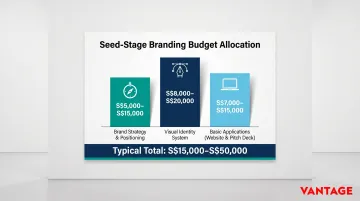
At this stage, invest in strategic clarity — positioning that differentiates you in the market, messaging that resonates with early customers, and an identity system that scales across hiring, fundraising, and product launches. Once that foundation is in place, the jump to Series A becomes a matter of expanding — not rebuilding.
Series A and Beyond (S$75,000–S$200,000+)
Brand now supports sales, hiring, and market expansion simultaneously. At this stage, fragmented execution becomes expensive. Working with a full-service agency like Vantage Branding — one that integrates strategy, identity, and guidelines end-to-end — reduces costly inconsistency and rework.
What a well-structured Series A brand investment covers:
- Deep strategic research and competitive positioning (S$20,000–S$50,000)
- Complete visual and verbal identity systems (S$30,000–S$80,000)
- Comprehensive brand guidelines and digital brand portal (S$10,000–S$30,000)
- Website design and development (S$20,000–S$60,000)
- Rollout training and vendor enablement (S$5,000–S$20,000)
This investment delivers assets built to last 3–5 years, supporting enterprise sales, global expansion, and multiple product launches without requiring strategic re-explanation or visual overhauls.
What Most Founders Get Wrong About Startup Branding Costs
Treating Branding as a Logo Purchase
Most founders think of branding as a visual output, not a strategic system. This framing causes them to underprice the work and underbuild the foundation.
A logo is a graphic symbol. A brand is the full strategic framework that defines how your company shows up across every touchpoint:
- Positioning — how you're differentiated in the market
- Messaging — what you say and how you say it
- Visual identity — logo, color, typography, imagery
- Tone of voice — your personality in written and spoken form
- Governance — rules for consistent application
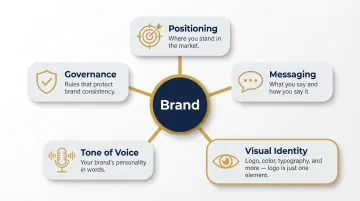
Buying a logo without strategy is like putting up a storefront sign without a business plan.
Investing Before Product-Market Fit
A polished brand on an unvalidated product is expensive waste. Validate first, then invest in brand depth as the business scales.
Pre-revenue founders should prioritize speed and flexibility over polish. DIY tools or budget freelancers deliver credible baselines without burning capital on assets that pivot away. Once product-market fit is proven and customer acquisition scales, that's the right moment to invest in brand systems built for growth.
Ignoring the 2-3x Hidden Cost Rule
The agency fee is rarely the total cost. Implementation — website development, collateral production, UI updates, legal trademark filing, photography, internal training — often doubles or triples total spend.
A S$50,000 agency identity project, for example, typically requires an additional S$100,000–S$150,000 for full activation. Budget for implementation from day one — stalled rollouts waste the upfront investment.
In Singapore, trademark registration adds:
Choosing the Cheapest Option Without Evaluating Strategic Depth
A S$500 logo that needs replacing in 18 months costs more than a S$5,000 identity built to last.
Evaluate quotes by asking:
- What strategic research informs the design?
- What usage guidelines ensure consistency?
- What file formats and ownership rights are included?
- What happens when you need to apply the brand to new touchpoints?
Low quotes often reflect appropriate scope (logo-only), not value. If you need a full identity system, paying for execution without strategy guarantees expensive rework later.
Conclusion
Startup branding costs vary significantly based on scope, partner, and stage. The right investment is the one that matches where the business is now and what the brand needs to do next.
Pre-seed founders need credible baselines, not comprehensive systems. Seed-stage startups benefit from positioning foundations paired with professional identity systems that scale through early growth. Series A and beyond companies require durable brand architectures built to support enterprise sales, hiring, and global expansion over 3-5 years.
Branding is not a one-time design expense — it compounds over time. Budget for hidden implementation costs upfront, and choose partners on the strength of their thinking, not just their portfolio pricing.
If you're ready to explore what a brand built for your stage and market could look like, connect with Vantage Branding at +65 6698 9257 or hello@vantagebranding.com.sg. We build insight-led brands designed to grow with your business.
Frequently Asked Questions
Is S$500 too much for a logo design?
S$500 can buy a passable logo from freelance platforms like Fiverr, but it rarely includes strategy, scalable file formats, or usage guidelines. It works for idea-stage testing but creates problems once you need to apply the mark across digital, print, and product touchpoints.
What are the 5 C's of branding?
The 5 C's are Clarity (clear brand positioning), Consistency (uniform application across touchpoints), Content (relevant messaging), Connection (emotional resonance with audiences), and Community (loyal customer base). For startups, clarity and consistency matter most early — without them, content and connection efforts fail.
What is the 3-7-27 rule of branding?
The 3-7-27 rule describes the exposures needed for recognition (3), familiarity (7), and trust (27). Every inconsistent brand application resets the counter — which is why visual and verbal consistency across touchpoints directly affects how quickly customers and investors trust you.
How much does branding cost for a startup in Singapore?
Singapore-based branding agencies typically price within the boutique tier range of S$10,000–S$30,000 for full identity systems, with strategy-led agencies charging S$35,000–S$100,000+ for comprehensive engagements. Singapore SMEs may also qualify for the Enterprise Development Grant (EDG), which subsidizes up to 50% of eligible branding costs.
What is the difference between a logo and a brand identity?
A logo is a single graphic mark. A brand identity is the complete visual system — colors, typography, iconography, patterns, and guidelines — that ensures consistency across every touchpoint and makes the mark work at scale.
Should a pre-seed startup invest in professional branding?
Pre-seed founders need credibility, not comprehensiveness. A professional but minimal identity (clean logo, basic guidelines, simple web presence) is worthwhile for investor conversations and early customer acquisition. Full brand strategy engagements are better timed after initial traction and product-market fit validation.