Introduction
Nearly 70% of failed brand identity projects trace back to a single point: the proposal stage. Agencies submit decks promising strategic transformation, yet many deliver surface-level design work with no clear link to business goals. Not every proposal communicates strategy, process, and value clearly — and a weak one leads to misaligned projects, scope creep, or wasted budget.
This guide covers what a brand identity proposal should include, how to break down a template section by section, real-world examples of what good looks like, and how to evaluate what you receive.
Whether you're a startup launching a new brand, an established company considering a rebrand, or an enterprise managing sub-brands, knowing what to look for protects your investment and sets the foundation for strategic brand development.
TLDR:
- Strong proposals include brand audit, strategic direction, specific deliverables, guidelines, transparent pricing, and clear timelines
- Look for strategy-first approaches that demonstrate research and market understanding before visual concepts
- Red flags include vague deliverables, missing brand guidelines, undefined revision rounds, and proposals that skip strategic phases
- Industry-standard projects run 8-16 weeks with milestone-based payments
- Evaluate proposals on strategic depth, not price alone—brand identity is a long-term business asset
What Is a Brand Identity Proposal?
A brand identity proposal is a formal document from a branding agency or designer that outlines their understanding of a client's brand needs, proposes a strategic and creative approach, specifies deliverables, and sets out timelines and costs. Unlike a general "branding proposal" that might cover marketing campaigns or advertising strategy, a brand identity proposal focuses specifically on the visual and strategic identity system: logo, colour palette, typography, brand voice, and usage guidelines.
The proposal serves a dual purpose. For the agency, it's a pitch document demonstrating strategic thinking and creative capability. For the client, it's a contract of expectations — a blueprint defining what will be delivered, when, and at what cost.
A strong proposal goes beyond a menu of services. It should articulate how the proposed identity will differentiate the brand in its market and support broader business objectives.
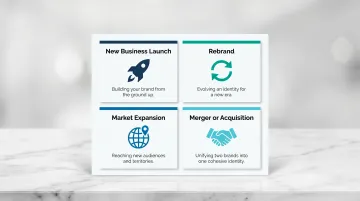
Businesses typically need a brand identity proposal in four situations:
- New business launch — establishing a visual and verbal identity from scratch
- Rebrand — when the current identity no longer reflects company positioning or market evolution
- Market expansion — especially relevant for Singapore and Asia-based companies entering regional or international markets
- Merger or acquisition — when brand architecture needs restructuring to reflect a new entity
What Should a Brand Identity Proposal Include?
While formats vary, every credible brand identity proposal should contain five core components. Any proposal missing key elements signals the agency may be offering surface-level work.
Situation Analysis / Brand Audit Summary
This section demonstrates the agency has done its homework. It should cover:
- Current brand perception among customers and stakeholders
- Competitive landscape analysis showing market positioning
- Target audience insights based on research, not assumptions
- Existing brand assets being retained, evolved, or retired
Proposals skipping this section often result in visual work disconnected from business reality. Design decisions made without this grounding tend to look polished but miss the mark strategically.
Strategic Brand Direction
This section should contain the strategic foundation that precedes design work:
- Brand positioning statement – How the brand will occupy a distinct space in the market
- Brand personality and values – The human characteristics and principles guiding brand behaviour
- Tone of voice direction – How the brand speaks across touchpoints
- Differentiation strategy – How the proposed identity will distinguish the brand from competitors
Strong agencies earn their fees here. McKinsey found that companies with top-quartile design scores achieve 32 percentage points higher revenue growth and 56 percentage points higher total returns to shareholders. That performance comes from strategic rigour — not aesthetics alone. Strategy must precede design.
Visual Identity Deliverables
Specific deliverables should be explicitly named, not hidden behind vague descriptions. A complete visual identity includes:
- Primary logo and logo variations (horizontal, vertical, icon)
- Colour system with primary, secondary, and accent palettes
- Typography system specifying headline, body, and supporting fonts
- Iconography or illustration style guidelines
- Photography and imagery direction
- Brand patterns or textures if applicable
Vague deliverable descriptions like "branding assets" without specification are a red flag. You should know what files, formats, and variations you'll receive before signing anything.
Brand Guidelines / Usage Documentation
A complete proposal should include brand guidelines as a deliverable — a document governing how all identity elements are used across touchpoints: digital, print, signage, and social media. Consistent branding can increase revenue by 10 to 20 percent, but consistency requires documentation.
Proposals lacking brand guidelines often leave clients without the tools to apply the brand consistently after the project ends. Guidelines should specify logo integrity (spacing, placement, prohibited modifications), colour precision (exact HEX, RGB, and CMYK codes), and typography rules.
Pricing, Timeline, and Process Overview
The pricing section should clarify:
- Total investment broken down by deliverable or phase
- Payment milestones tied to project phases
- What's included versus explicitly excluded
- Revision rounds (typically 2–3 per design phase)
- Additional costs such as font licensing or stock photography
- Deposit structure — a 50% upfront deposit is standard practice for most branding projects
The timeline section should show project phases with approximate durations. Full brand identity projects typically take 8 to 16 weeks, though enterprise-level rebrands can stretch to seven months or more depending on scope and stakeholder complexity.
Brand Identity Proposal Template: Section-by-Section Breakdown
A good template provides a repeatable structure ensuring no critical section is missed. Clients can use this breakdown to assess whether a proposal they've received covers all the bases.
Cover Page and Executive Summary
The cover page should be visually compelling and immediately communicate the agency's own brand standards—consider it proof of what they can do before a single brief is signed. The executive summary (one page maximum) should restate the client's core challenge and summarise the proposed approach.
If the executive summary reads like a generic brochure, the proposal likely isn't tailored to the client's specific situation. Strong executive summaries reference specific client pain points, market conditions, or competitive challenges uncovered during discovery.
About the Agency / Credentials Section
This section should briefly introduce the agency, relevant industry experience, notable clients, and past brand identity work examples. The focus should remain on relevance to the client's context—not a lengthy portfolio dump.
Agencies with cross-industry experience can bring unexpected strategic insight. For example, an agency that's worked in both healthcare and technology sectors might bring fresh positioning approaches to a healthcare client by applying frameworks developed in more competitive B2B tech markets.
Proposed Scope and Deliverables
The scope section should clearly delineate what work is included, what is explicitly out of scope, and what dependencies exist on the client side (such as copywriting or photography).
Tiered options are a sign of a flexible, experienced agency:
| Package | What's Included |
|---|---|
| Core Identity | Logo system, colour palette, typography |
| Full Identity | Core identity plus brand guidelines and collateral templates |
| Identity + Rollout | Full identity plus implementation workshops, internal training, and phase-one rollout support |
Clear scope documentation protects both parties from the most common source of project friction: undefined deliverables and unlimited revision rounds.
Investment and Payment Schedule
Pricing should be presented as clear line items, not a single lump sum. Milestone-based payment schedules protect both parties:
- Deposit on signing (typically 30–50%)
- Payment at concept presentation (25–30%)
- Final payment on delivery (20–30%)
This structure ensures agencies aren't financing client projects while clients aren't paying in full before seeing any work.
Project Timeline / Phase Diagram
With payment terms agreed, the next thing clients want to see is when things happen. The timeline section should map out major phases with estimated durations:
| Phase | Duration | Key Activities |
|---|---|---|
| Discovery & Research | 1–2 weeks | Brand audit, stakeholder interviews, competitor review, market research |
| Brand Strategy | 2–3 weeks | Positioning, values, brand promise, tone of voice, customer personas |
| Creative Concept Development | 3–4 weeks | Logo development, typography, colour systems, photography direction |
| Refinement & Revisions | 2–3 weeks | Client feedback integration, design refinement |
| Brand Guidelines Delivery | 1–2 weeks | Style guide, templates, social assets, specifications |
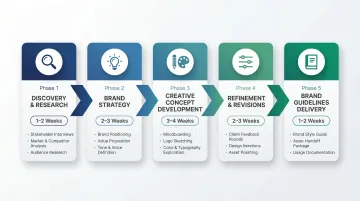
A visual Gantt-style diagram or phase table makes this easier to review. In a typical 12-week project, discovery and strategy run through weeks 1–5. Creative development follows in weeks 5–10, with guidelines and rollout completing the final stretch.
Brand Identity Proposal Examples: What Good Looks Like
Strong brand identity proposals share common qualities regardless of style: they are tailored, strategic, and built around context. The three examples below show how the same proposal framework plays out differently depending on the client's situation.
Example 1: Startup Brand Identity Proposal
A strong proposal for a startup launching from scratch should emphasise a blank-slate brand strategy section. Since there's no existing identity to audit, the situation analysis focuses on competitive positioning relative to other market entrants and the target audience's current brand preferences.
The strategic direction section carries extra weight, establishing positioning that will guide all future brand decisions. For a startup, the proposal should also address brand scalability—how the identity will hold up as the company grows from five employees to fifty, from one market to multiple regions.
Typical deliverables include:
- Complete logo suite (primary, secondary, icon, variations)
- Comprehensive colour system (not just primary colours)
- Typography system with clear hierarchy
- Photography and imagery direction
- Foundational brand guidelines document
- Core collateral templates (letterhead, presentation deck, email signature)
The pricing structure should acknowledge that startups often have limited budgets but need comprehensive systems. Tiered options allow startups to secure core identity immediately while planning for guidelines and rollout support in a second phase.
Example 2: Rebrand Proposal for an Established Company
A rebrand proposal differs fundamentally from startup proposals. It must include a brand audit section that honestly assesses what is working and what is outdated in the existing identity. 74% of S&P 100 companies rebrand within their first seven years post-acquisition, making this a common scenario for growing enterprises.
The agency should articulate a clear rationale for proposed changes, referencing:
- Competitive positioning shifts in the market
- Audience evolution (demographic or psychographic changes)
- Business model expansion requiring new positioning
- Outdated visual elements that no longer reflect company capabilities
For organisations with multiple stakeholders—enterprise clients, government-linked companies, or regional operations—the proposal should address change management and internal rollout support. Vantage Branding's work across healthcare, government, and B2B sectors in Singapore and Southeast Asia reflects how complex these alignment processes can be, with approvals spanning departments, ministries, and regional offices.
Additional rebrand proposal elements:
- Brand audit findings with specific recommendations
- Transition plan showing how existing materials will be phased out
- Internal communications strategy for rollout
- Staff training or brand ambassador programmes
- Asset migration timeline (updating websites, signage, collateral)
Example 3: Sub-brand or Brand Extension Proposal
Brand extension proposals have unique requirements. They must reference the parent brand architecture and explain how the new identity will relate to (or deliberately deviate from) existing brand elements.
The proposal should include a brand architecture section addressing:
- Relationship to parent brand (endorsed, sub-brand, distinct brand)
- Visual consistency rules (what elements must remain consistent)
- Deliberate differentiation points (where the sub-brand diverges)
- Governance structure (who approves sub-brand applications)
Take a healthcare holding company launching a new specialty clinic: the sub-brand proposal needs to show how the clinic's identity connects visually to the parent brand while speaking to a distinct patient segment. Done well, this protects the parent brand's equity while giving the clinic room to build its own recognition.
How to Evaluate a Brand Identity Proposal You Receive
Once you've received proposals from multiple agencies, how do you objectively compare them? Use this evaluation framework.
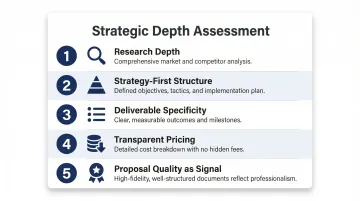
Strategic Depth Assessment:
Research depth — Does the proposal reference your competitive landscape, customer insights, or industry trends? Generic proposals with no specific context are a warning sign.
Strategy-first structure — Brand strategy should occupy at least 30-40% of the proposal's content. If visual concepts appear before any strategic rationale, the agency is skipping the most important step.
Deliverable specificity — "Brand identity package" means nothing. "Primary logo (AI, EPS, PNG, SVG), three logo variations, five-colour palette with HEX/RGB/CMYK values, three-typeface system" is specific. Vague deliverables lead to scope disputes.
Transparent pricing — Milestone-based pricing lets you evaluate value at each phase. A single lump sum with no breakdown makes it impossible to assess what you're actually paying for.
Proposal quality as a signal — The proposal is a live sample of the agency's work. Poor design, inconsistent formatting, or typos in their own document tell you what to expect in your deliverables.
Client-Side Red Flags:
Beyond the strategic checklist, watch for these patterns — each signals a poor fit or an agency that will cost you more time and money down the line:
- Skips the strategy phase and jumps straight to logo concepts
- Cannot articulate brand positioning beyond generic statements
- Pricing is a single lump sum with no breakdown
- Brand guidelines are absent from the deliverables list
- Revision rounds are unspecified, opening the door to endless feedback loops
- Generic case studies with no relevance to your industry
Ask agencies to walk through their proposal in a live presentation rather than letting you read it cold. This reveals their strategic thinking and collaborative approach — often more telling than the document itself. Watch whether they ask questions about your business, challenge your assumptions, or simply present their standard process unchanged.
Common Mistakes to Avoid in Brand Identity Proposals
Both agencies and clients make predictable mistakes that derail brand identity projects. Here are the most critical to avoid.
Mistake 1 (Agency Side): Presenting Visual Concepts Before Aligning on Brand Strategy
Starting with aesthetics without a strategic foundation leads to subjective feedback loops, unlimited revisions, and dissatisfied clients. When agencies present logo options before establishing positioning, brand personality, and differentiation strategy, clients evaluate designs based on personal taste rather than strategic fit.
The proposal should establish strategic agreement first. Only after positioning, values, and tone of voice are approved should visual concepts be developed.
Mistake 2 (Client Side): Evaluating Proposals Primarily on Price
Brand identity is a long-term business asset. Design-led companies outperformed the S&P 500 by 211% over a 10-year period. Choosing the lowest-cost proposal without evaluating strategic depth typically means redoing the work within 2-3 years — well short of the 7-to-10-year rebrand cycle most businesses expect.
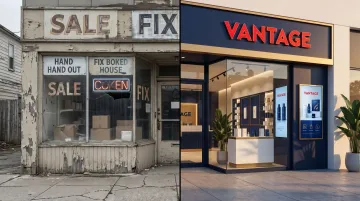
The real test is total cost of ownership: a SGD $15,000 strategic identity that lasts eight years costs less than a SGD $5,000 surface-level identity that needs replacing in three.
Mistake 3 (Both Sides): Vague or Undefined Scope Leading to Scope Creep
Undefined deliverables and unlimited revision rounds in a proposal are common sources of project friction. When a proposal states "logo design" without specifying how many concepts, variations, or revision rounds, both parties have different expectations.
Explicit scope documentation protects both parties. AIGA recommends using formal "change order" documents to acknowledge client requests that fall outside the original scope of work, describing additional time and money required before out-of-scope work proceeds.
Frequently Asked Questions
What should a branding proposal include?
A comprehensive branding proposal should include situation analysis, strategic brand direction (positioning, personality, tone of voice), visual identity deliverables (logo, colour, typography, guidelines), brand guidelines documentation, transparent pricing with payment milestones, and a project timeline. The most important element is that strategy precedes design—proposals jumping straight to visual concepts without strategic foundation typically underdeliver.
What are the 5 C's of branding?
The 5 C's framework refers to Clarity (clear brand message), Consistency (cohesive brand application across touchpoints), Content (valuable brand communications), Connection (emotional audience engagement), and Credibility (trust-building through authentic brand behavior). A well-structured brand identity proposal should show how the proposed work addresses each of these principles directly.
What is the 3-7-27 rule of branding?
The 3-7-27 rule suggests it takes approximately 3 seconds to form a first impression, 7 interactions to remember a brand, and 27 touchpoints to build trust. This principle connects directly to why a brand identity proposal should outline how the visual identity will be applied consistently across multiple touchpoints—inconsistent application breaks the trust-building sequence and requires customers to start the recognition process over with each encounter.
How long should a brand identity proposal be?
Most brand identity proposals are between 10-20 pages. The priority is clarity and specificity over length—a shorter, well-structured proposal is preferable to a bloated one. The proposal should include enough detail to evaluate strategic approach, scope, and pricing, but not so much that key information gets buried in unnecessary content.
How is a brand identity proposal different from a brand guidelines document?
A brand identity proposal is a pre-project document outlining the scope, strategy, timeline, and pricing for developing a brand identity. Brand guidelines are a post-project deliverable showing how to use the completed identity system across touchpoints.
What questions should I ask a branding agency before approving their proposal?
Four questions worth asking before you sign off:
- How do you approach brand strategy before design—what research and discovery do you conduct?
- Can you share examples of similar projects in our industry or with comparable complexity?
- What does your revision process look like, and how many rounds are included?
- What happens after delivery—do you offer implementation support or ongoing consultation as the brand rolls out?